Kirsten Hodgins is one of the coaches that we found this month and we did a little interview with her. She impressed us with her psychic abilities to see the dynamics operating behind each person. Especially the Ego. She is a master at revealing all the ways we slave under our Egos, Fears and negative beliefs. She helps people get free from these inner forces and helps her clients create a plan for reaching their goals. Here is what she said.
Meet Life Coach Kirsten Hodgins:
Name: Kirsten Hodgins Pillar: The Spirit Who is this coach for: Anyone who wants to free themselves from fear based beliefs, ego, and reach their goals in life. How they can help: Through Soul Alignment Tools and Life Mastery Skills, as well as using her mastery to unveil the function of the ego in another person.
First of all, how are you and your family doing in these Pandemic times?
Well, thank you.
How does the coronavirus pandemic affect your clients? Did it affect you at all?
Yes.
What are the biggest lessons that you learned in this pandemic?
Community extends beyond my physical neighborhood. I’ve learned how to create an online community.
Also, I’ve always been very comfortable with time to myself and love alone time, but I’ve realized how valuable it is to personally connect with other in person.
I have learned to not take things for granted.. to appreciate the efforts people make to take time out of their busy lives to connect in live workshops. I miss them and can’t wait to return to them soon.
The Origin:
Tell us about you, your career, how you started with your coaching career?
The joy of supporting others on their spiritual awakening journey was directly related to my own healing and shedding of an old self identity.
What was your biggest obstacle that you had to overcome in your life that made you who you are today?
Not feeling lovable, or worthy to be loved, feared rejection, not begin accepted fully by others. Sense of inadequacy and lacked skills to self regulate my thoughts and emotions.
The Coaching Style:
How do you innovate with coaching your clients?
I teach intuitive discernment and decision making skills. Also, psychic mediumship techniques.
What’s unique about your coaching approach?
I’m a psychic medium and I am a master at unveiling the function of the ego in another.
What benefits do your clients get after working with you?
Liberation of restricting fear based beliefs and a strategy plan to set them up for success!
Do you use any specific tools to be efficient with your clients?
Yes. Soul Alignment Tools and Life Mastery Skills.
The Impact:
If you had a super megaphone that, when you speak into, the whole world will hear your message, what would you say?
Give yourself permission to love yourself.
Avoid tolerating unwanted experiences and making them your “normal” in your life. Know that what soars in your heart is actually meant to lead you like a signpost to get uncomfortable and cut things out that are not serving you so that you can learn new skills, grow and evolve into a bigger and better version of yourself.
What is the greatest lesson you have learned in your life?
I’ve become a leader in my own life. To validate and honor myself and know that I am enough. I know that I am whole and don’t need fixing and I’m not damaged goods. I am worthy of love and all that soar in my heart.
I’ve learned to reclaim my life’s agenda and take the initiative to go for what soars in my heart without seeking permission or validation from others.
Your final thoughts?
Nothing to add.
Where Can You Find Kirsten Hodgins?
If you liked this interview and you would love to free yourself from the grips of your Ego, Fears, negative beliefs, then go to www.kirstenhodgins.com where you can find all the ways Kirsten can help you.
Make sure to contact her if you have any question. You can connect with here via LinkedIn. It was an honor having this interview with her.
Mariya Molduvanova is one of the coaches that we found this month and we did a little interview with her. She impressed us with her unique and intuitive approach to coaching. She is giving her clients unconditional support and understanding to discover, recognize, accept their feelings and realign with who they really are. This room of acceptance allows her clients, with a little guidance, to dig up the one thing that truly sets their hearts on fire, their true calling in life. Here is what she said.
Meet Life Coach Mariya Molduvanova:
Name: Mariya Molduvanova Pillar: The Spirit Who is this coach for: Anyone who wants to find the spark that gives meaning to their life. How they can help: Through unconditional support, discussion and judgment free environment, as well as using tools like the “Wheel of Life”, just one of many in her box.
First of all, how are you and your family doing in these Pandemic times?
Thank you for asking! We are blessed… It was tough, but we supported each other through it. And fortunately we are all safe and still here.
How does the coronavirus pandemic affect your clients? Did it affect you at all?
I don’t think there is anyone today not affected to some emotional degree by the pandemic. If they tell you they were not, they are probably just not being honest with themselves.
As of me, as someone with a rare autoimmune disease, who was considered a very high risk, but couldn’t receive a vaccine due to it, I had to live with the fear of getting sick for two long years.
And I won’t lie it was really scary and traumatic for the first few weeks of the lockdowns, as there was so much uncertainty around it all.
But I had no choice, but to be a rock for my son at this moment, and decided that, if it was in God’s plan for me to go, I didn’t want his last memories of me to be of us hiding.
So I decided then and there, that I won’t allow myself to live in the fear. Yes I will be cautious in a reasonable degree, but I would continue to live my life, and take calculated risks being around people.
And at the end, I happened to contract the virus back in Nov, but to everyone surprise I barely had any symptoms, and recovered in no time, without any complications. For which I am grateful, humbled, and so relieved now.
I feel like I finally got my freedom back.
What are the biggest lessons that you learned in this pandemic?
I guess I’ve already touched base on that. But if I need to add anything, it was a reminder that tomorrow is never promised. That we all have an expiration date, like it or not.
So we need to enjoy life, and to appreciate the people around us, and to live in our purpose, because at the end, at least for me, what matters is, how many lives you’ve positively touched.
The Origin:
Tell us about you, your career, how you started with your coaching career?
I used to be an Event Designer and Photographer… But with the pandemic those industries stopped… Which gave me a chance to look deeper into my authentic self, and my purpose, and the ways I can be of service to others.
I’ve stumbled across Jay Shetty Coaching Certification program, and that just felt like it was the right path to follow. Best decision ever.
The rest is history.
What was your biggest obstacle that you had to overcome in your life that made you who you are today?
I would say me being blessed with Anti-Musk Myasthenia Gravis 7 years ago. My world changed overnight. I turned from this powerful, confident woman, into this shell of a human.
It took 10 different specialist and 3 years to actually figure out what was happening with me.
I had all those inexplicable symptoms out of the blue. Couldn’t support my head up, double vision, complete loss of my voice, I would chock on just trying to sip water. It was very testing time. For me for my marriage, which ultimately ended few years later.
Luckily after having a final diagnosis, I was able to start regular blood treatments, and with this, all the symptoms are now kept at bay. Aside from my weak voice… I lost my beautiful singing voice, but it could’ve been worse.
All this gave me a different perspective, and appreciation of the little things in life.
The phrase “good to see you” has deeper meaning, tasting food, drinking water, dancing bring so much more joy now.
I would say this experience taught me to appreciate life more, and enjoy it to the fullest, here and now.
The Coaching Style:
How do you innovate with coaching your clients?
I would say as a creative soul and an artist, I always think outside the box. As Pablo Picasso said “Lean the rules as a Pro, and break them as an Artist”.
Jay Shetty Certification School gave me the solid foundation of the framework, and tools and strategies to become a professional coach, but now that I am stepping more into my authentic self, and my power as a Coach, I am using more creative ways to help my clients, incorporating insights from my other fields of knowledge and adapting the process to the different needs of my clients.
Just yesterday I used a concept from Dance Consent Workshop, to relay a boundaries setting to a client for example.
What’s unique about your coaching approach?
What’s unique is ME. My unique combination of strengths. And my approach to each client.
For me coaching is a journey, side by side with my clients, engaged in a thought provoking and creative conversation, serving as a guide through their reflections, as a sounding board for their thoughts, and as a mirror holder, so they can see their authentic self, behind all the dust.
My guiding principle in meeting people, in general, has always been “the first thing you (I) should know about me (them), is that I (they) am (are) not you (me)”.
A lot more makes sense after, and we can develop more authentic relationships, seeing the person for who they are, and not who I think they are.
I see my clients as whole, capable individuals, who are the best expert in their own life journey.
I approach each encounter from a place of true curiosity, holding space with empathy, and no judgement.
I am not there to give them advice or answers, because I truly believe that each and everyone of us have the best answers within, and my job is only to help them look within and to empower them to trust their own gut voice.
So I would describe myself as an Intuitive, Holistic Mindset, Communication and Emotional Intelligence Coach.
What benefits do your clients get after working with you?
What sums up all the amazing clients that I’ve attracted so far is I am helping Humans find what sets their Soul on Fire. Reignite that spark, that define them, and gives meaning to their journey.
Being highly Empathetic allows me to hold space without judgment for virtually anyone.
Being an intuitive coach, helps me to see the patterns, and the underlying root causes and adjust to the needs of each client, guiding them through powerful breakthroughs.
And being highly Emotionally Intelligent, allows me to help my clients discover, recognize and accept their own feelings.
Which allows them to build better relationships and view all the different perspectives and outcomes in any life situation.
Do you use any specific tools to be efficient with your clients?
As every coach I have a whole bag with magic tools, depending on the needs of the clients, but probably the “Wheel of Life” is the go to for everyone in the beginning stage of my client to coach relationship.
The Impact:
If you had a super megaphone that, when you speak into, the whole world will hear your message, what would you say?
I think I am here to teach Humans one thing, “Appreciate the little things in life, and make this journey counts”.
What is the greatest lesson you have learned in your life?
I’ve learned many lessons, and I am continuing to learn every day, but aside from everything already mentioned, maybe to love myself the way I am… perfectly imperfect. To hold space for myself the same way I am holding it for others, and to be more self compassionate.
It’s easy to give others compliments, but when was the last time you talked the same way to yourself?
Your final thoughts?
Thank you so much for this opportunity, it was a real pleasure chatting with you and I look forward for more opportunities to collaborate in the future.
Where Can You Find Mariya Molduvanova?
If you liked this interview and you would love to find what sets your heart on fire, make sure to reach out to Mariya by scheduling a free discovery call here.
You can connect with her personally also via LinkedIn. She is active on social media so, if you want to get a glimpse of her coaching, follow her on Facebook and Instagram.
There are always moments in our life when no matter what we do, we can’t fully relax. You might have had a super stressful day at work, only to come home to another set of problems.
When your body is put under so much pressure, it’s hard for it to let go of tension which makes it impossible for you to relax.
Some people have been turning to alternative remedies, and one of the most popular is CBD. If you were to buy CBD online, you’ll notice the many different options available on the market.
There are oils, gummies, teas, and even cookies to choose from, so you’ll be able to find something suitable to incorporate into your daily life.
CBD works by entering your body’s endocannabinoid system and potentially decreasing the number of endocannabinoids being broken down.
This allows them to have a better effect on your body, and they can help to regulate sleep and your mood, among many other things.
So, if you’re interested in how CBD could benefit you, keep reading and discover 5 ways it can help you relax.
5 Ways CBD Helps You Relax:
1. Better Sleep.
Not getting enough sleep has a detrimental effect on your health, which can make stress and worry hit your brain and body harder than they normally would. A lot of people who suffer from anxiety find that lack of sleep is one of the main symptoms that they have to deal with.
The less sleep you get, the worse you then feel, and then the harder it is to get to sleep. You end up caught in a vicious no sleep cycle that doesn’t allow you any respite. However, CBD is now being used to help break the cycle so you can finally get some sleep.
People are taking a form of CBD before hitting the hay as it could help to quieten your mind, relax your body, and help you to stay calm.
Studies have shown that CBD might have an actual calming effect on your central nervous system, so not only will you fall asleep easier, but you’ll stay asleep during the night.
You could use a few drops of CBD oil under your tongue before heading to bed, or you could use CBD bath salts and infused body lotions to bring a sense of peace to your body.
2. Reduce Anxiety.
Anxiety can make relaxing almost impossible as it causes panic attacks and general unrest within the body and mind.
Symptoms of anxiety can be difficult to manage, so more people are trying out CBD products for their claimed benefits.
For example, some people take CBD when they feel a panic attack coming on and they find that it can stop it from occurring.
Other people may take CBD throughout their day to maintain a consistent dosage in their bodies, and this could help improve their overall wellbeing.
By trying to eliminate the associated symptoms of anxiety, some people have found that it can greatly enhance their ability to relax. CBD has been shown to help reduce the symptoms of anxiety, but it can’t cure it, so if you’re really struggling with anxiety, it’s best to speak to your doctor.
3. Help With Pain.
Pain can be terrible to deal with and make it even harder for you to relax after a hard day.
Studies suggest that CBD has anti inflammatory properties so it could provide some pain relief. You can take it as an oil, by when trying to alleviate pain, some people prefer to use topical CBD creams.
The CBD is said to penetrate the skin and reach down into your muscles, which could possibly help ease the pain.
This means if you can’t fully unwind because of the ache in your lower back, applying a CBD cream could be a potential solution.
4. Reduce Stress.
Stress can affect us all and it can suddenly impact your life out of nowhere. Although stress isn’t a physical ailment, it can present itself outside of your body too.
These can then increase your stress as you try to alleviate them, so you’re stuck in a never ending loop of worry.
It’s been suggested that taking CBD could help reduce stress and its side effects. For example, you may apply a CBD cream to your shoulders to try and help ease the stress related tension, or you might take a drink of CBD infused tea before bed, to help calm your busy mind.
Studies have also shown that regular users of CBD are able to deal with stress when it presents itself again.
Prevention is always best, so taking CBD before you encounter stress could actually be a huge benefit as it might enable you to deal with it better.
5. Improve Your General Wellbeing.
You don’t have to be suffering from anxiety, chronic pain, or stress to incorporate CBD into your life.
If you just want a slight helping hand to unwind in the evening, having a few drops of CBD could be effective.
CBD has been shown to possibly help improve your mood day to day when taken regularly, so if you just want to bring a little more relaxation to your day, this could be the way to go.
CBD is still a new product and there are still ongoing studies to see the effects that it has on the body, so if you’re considering taking it, be sure to speak to your doctor first.
There are many potential benefits of taking CBD but allowing you to relax really is one of the best.
Helping to reduce pain and enhancing your sleep quality are just some of the claimed results, so why not add a little CBD into your life and see the difference it could make.
While many people in the world are religious, they don’t all take the steps to further their religious education.
This is completely fine, some people may be happy to simply learn about their religion on their own, especially because people often see it as a deeply private and intimate experience.
Other people, however, may feel the need to dive deeper into their religion and pursue a proper religious education.
This can be helpful for many reasons.
If you are considering furthering your religious education, keep reading to learn about a few ways that doing so can help you.
4 Ways How Furthering Your Religious Education Helps:
1. It can help you in your career.
People who feel strongly about their religion may often want to pursue a career path that helps them to teach others about this religion.
They don’t do this for the money, but rather because it is their passion. Some may even feel that it is their calling to help others discover religion.
While there are ways of doing this without furthering your religious education, you will be more likely to get a job in your religious field if you do study it a bit more in depth.
This way, you will be able to dedicate most of your time towards spreading your religion and educating others.
Of course, the main reason why people decide to further their religious education is that they want to learn more about their religion and connect to it on a deeper level.
The problem that many people face is that they do not make time for their religion.
Studying your religion will therefore allow you the time needed to analyze it and truly experience all it has to offer.
Hopefully, this will motivate you to schedule your time so that you make time for your religion and other important aspects of your life.
3. It can help you in your relationships.
Relationships are complicated, and they require a lot of skills that many religions preach.
Things like love, patience, forgiveness, and understanding are but a few of the virtues that most religions focus on.
By furthering your religious education, you will learn more about how to implement these qualities in your life, and you will thus be improving your relationships.
As mentioned, religion is often a deeply personal thing. Because of this, it often requires a lot of introspection.
This means that you will be getting to know yourself better at the same time you are getting to know your religion better.
As you can imagine, there are other ways to get to know yourself. That being said, if your religion forms a big part of who you are, it makes sense that you will be undergoing personal development while expanding your religious knowledge.
Lenny Terra is one of the coaches that we found this month and we did a little interview with him. He impressed us with his vast 10 years of experience with coaching. He is an ontological coach, meaning, he focuses on changing the way people are BEing in the world. He worked with countless clients and understood that each person is different, each person needs a different approach. That’s why he practices holistic coaching, using what each client needs the most to create a lasting positive change in their lives. Here is what he said.
Meet Life Coach Lenny Terra:
Name: Lenny Terra Pillar: The Spirit, The Mind Who is this coach for: Anyone who wants to understand themselves and what they want in life better, get more confident, motivated, empowered, and change the way they are BEing in the world. How they can help: Through variety of tools like personality assessments, SMART goal setting, change management, as well as questioning and reframing, just to name a few.
First of all, how are you and your family doing in these Pandemic times?
My family is doing well, thanks for asking. We took the necessary precautions to stay safe and healthy. Now that the virus is spreading more slowly, we’re starting to get back to our normal routines.
How does the coronavirus pandemic affect your clients? Did it affect you at all?
The pandemic has had a big impact on my clients. Many of them have been affected by the virus either directly or indirectly. Some of them have had to deal with job loss, illness, and other challenges.
The pandemic has been a challenging time for everyone, but it has also been a time of growth and change. In my case, with less travel and more time at home, I started writing more.
I also started a blog called “10 Best For Men,” where I share tips and advice for men on health, relationships, and personal growth. I’ve been surprised by how many people have been reading it and finding it helpful.
This was a shift for me, as I usually work with individuals, but now I am more and more focused on writing. I believe that we can all learn from each other, and I want to share the knowledge I’ve gained as a coach with as many people as possible, and I think writing is a great way to do that.
What are the biggest lessons that you learned in this pandemic?
The biggest lessons I learned in this pandemic are that we need to be flexible and accept change.
I’ve had to change the way I work, the way I live, and even the way I think. I’ve had to let go of some of my old beliefs and assumptions and open myself up to new possibilities.
I’ve also learned the importance of self care. In times of stress, it’s more important than ever to make time for yourself and do things that help you relax and recharge.
The Origin:
Tell us about you, your career, how you started with your coaching career?
I’ve been a life coach for about 10 years.
I got interested in coaching after working with a coach myself. I found that it was really helpful to have someone to talk to about my goals and help me stay accountable. He showed me that anyone could benefit from coaching, and I decided to become a coach myself.
I studied ontological coaching in the same program that my coach did. This type of coaching focuses on helping people change their way of being in the world. I’ve found it to be very powerful in helping people make lasting changes in their lives.
I started my coaching career soon after I finished my training, and I’ve been working with clients ever since.
I keep learning and evolving as a coach, taking new courses and learning new techniques. My aim is to help my clients live their best lives, reach their potential, and create the life they want.
What was your biggest obstacle that you had to overcome in your life that made you who you are today?
One of the biggest obstacles I had to overcome was self doubt.
I used to doubt my abilities and wonder if I was good enough to be a coach.
I had to do a lot of personal growth work to overcome this.
I also had to learn how to set boundaries and say no.
I used to be a people pleaser, and I would take on too much. I’ve learned that it’s okay to put my own needs first and say no to things that don’t serve me.
The Coaching Style:
How do you innovate with coaching your clients?
I don’t believe there’s a “one size fits all” approach to coaching. Every client is unique, and I work with them to find the best method for their individual needs.
Depending on what they need, I might use different techniques with different clients.
For example, some clients might benefit from visualization exercises to help them see their goals. Other clients might prefer to use journaling or meditative practices to help them focus on their goals.
I also use a lot of questioning and listening to help clients find their own answers.
What’s unique about your coaching approach?
I try to use a holistic approach with my clients.
This means that I consider all aspects of their lives when working with them.
I believe that the mind, body, and spirit are all interconnected and that it’s important to work on all of them when making changes.
What benefits do your clients get after working with you?
After working with me, my clients have reported feeling more motivated, confident, and empowered.
They’ve also said that they better understand themselves and what they want in life.
They’ve been able to create goals that are meaningful to them and find ways to achieve them.
Do you use any specific tools to be efficient with your clients?
I use various tools, including personality assessments, SMART goal setting tools, and change management tools.
I also use many coaching techniques, such as questioning and reframing, to help my clients make changes and reach their goals.
The Impact:
If you had a super megaphone that, when you speak into, the whole world will hear your message, what would you say?
My message to the world would be that we are all connected and that we can create a better world by working together.
We need to focus on our similarities, not our differences, and remember that we are all human beings with similar needs and wants.
We can make a difference in the world by being kind to others, standing up for what we believe in, and working towards a brighter future.
What is the greatest lesson you have learned in your life?
The greatest lesson I have learned is that we are all capable of growth.
We can always learn new things and evolve into our best selves. There is no limit to what we can achieve if we set our minds to it.
Neuroscience has shown that we can change our brains, which gives us the power to create the life we want.
Your final thoughts?
I believe that everyone has the potential to live a happy and fulfilling life.
We just need to learn how to tap into our own greatness. I think that coaching can help people do this.
It’s an amazing process that can help people make positive changes in their lives.
Where Can You Find Lenny Terra?
If you liked this interview and you would like to change the way you are BEing in this world, make sure to connect with Lenny and see how he can assist you.
He is a man of many talents, writing is one of them. If you are a man yourself, you can check out his blog or even get his book if what he says resonates with you. It was an honor having this interview with him.
The Healthcare industry is among the most important welfare industries working for living beings.
Doctors have always been idealized for their tireless services, but the nurses’ assistance is unavoidable.
Nurses play a pivotal role in protecting the moral fabric of the healthcare industry.
The nursing profession is now progressing by leaps and bounds each day. The nursing industry has widened its boundaries massively.
New trends have now been set that support the evolution of nurses. Here is a brief account of what wonders the future holds for the nursing career.
7 Things the Future Holds for Nurses:
1. Better Nursing Education.
Education is the fundament to enter into a domain and get established there. It provides you with broader views along with skills in a particular subject.
Nursing has been among the disciplines that are studied as professional courses. Nursing education is in demand like any other degree. People are now aware of its critical position in the healthcare industry and therefore want to indulge in it.
Different universities offer both on campus and online degree programs in nursing. These programs have helped national and international students to approach nursing courses easily.
One of such programs is RN-BSN online degree program offered by many educational institutes. It gives a deep insight into clinical reasoning and leadership skills that help a nurse deliver flawless patient care.
These facts prove that nursing has become one of the most wanted leading specializations.
2. Demographic Shift.
It has long been believed that the nursing profession is limited only to females. Even today, men refrain from opting for this profession.
However, as the awareness among people has risen, this taboo has also vanished. The male nurse population is increasing day by day in nearly every hospital.
Due to this, the amalgamized services of both genders give the best possible outcomes that favor the patients and healthcare institutes.
It has made the status of nurses stronger than before. It has consequently added to the enlightened future of a nursing career.
3. Leadership Opportunity.
Nursing professionals are offered bountiful leadership opportunities nowadays. Since nurses are well aware of the patient’s attitude and behavior, many new domains have emerged.
The posts include clinical nurse leader, nurse manager, nurse executive, nurse administrator, nurse anesthetists, nurse midwives, and nurse practitioners.
Several multidisciplinary courses are available at the bachelor’s and master’s levels for those interested. Pursuing one can help you avail yourself of the opportunity like many others.
4. Growing Patient Number.
Over time, ill dietary habits and health practices have rendered diseases very high. The patients include people from infancy till the old aged citizens.
With changing age, the attitude of the patient also changes. The nurses are trained to deal with the type of patients accordingly. It is one of the additional points that speak of the diverse future of nurses.
Also, the coronavirus pandemic has highlighted the importance of nurses in healthcare centers. In such situations, well educated, experienced, and skilled individuals are called to give their magnificent good turns. It has further added to the doors promising stability for nurses in the future.
5. In home Nurses.
The facility of in home nurses provides benefits, especially to the aged population. An old aged person usually does not feel comfortable in the hospital environment.
The caretakers from the family may not be as experts as professional healthcare practitioners.
Therefore, the emergence of in home nurses has helped such families greatly. They are specialized in layout functional mobility, personal hygiene, toilet hygiene, and feeding practices.
This role of nurses has revolutionized the healthcare business for the past few years.
6. Veterinary Nursing.
It might not be very well known, but veterinary nurses are also making their mark in healthcare.
Since the type of animals and their breeds are quite different, the specifications are also extensive.
They act as saviors for the pet keepers and animal lovers.
Not only this, but they perform a prime role in maintaining businesses running animal farms.
They have also given immense services to ensure animal health and care in different countries’ poultry and meat industries.
7. Role of Informatics.
Healthcare technology has advanced with advancements in information technology. Everything has become digitized, which calls for expert informaticians.
The handling of data and records demands proficiency too. Fortunately, nursing presents jobs to professionals as Clinical informatics specialist, Nursing informatics specialist, Clinical analyst, Clinical informatics manage, Clinical informatics coordinator, and Nursing informatics analyst. These areas have made the entry of non medical graduates into the medical field easier.
What you should remember?
Like any other healthcare practitioner, nurses have been given tremendous services. Unfortunately, the nursing profession has never been prioritized the way it should have been.
Many people looking for steady work have had their views cleared by growing awareness of the need for competent healthcare providers.
The best part is equal representation for both males and females.
A huge influx of educated individuals has entered into the nursing domain. It has made healthcare institutes more balanced than ever before.
The need only is to believe in the good of any line of work, and the brighter sides will shine the brightest for loyal ones.
As you know, here at Life Coach Code we are dedicated in helping you unleash the true potential of your Spirit, Mind, Body, Heart, all the 4 fundamental pillars.
Each of these 4 fundamental pillars has its own superpower that comes available to you once you start working on it. However, training your mind is something else. You start feeling like a super human.
Once you unleash even a tiny glimpse of your mind’s true potential, you will feel limitless. That’s why we decided to tell you 3 secrets on how to do that.
You see, The Mind is like a supercomputer. But most people don’t really know how to use it, they haven’t read the manual. So instead, they are being used by the random processes of their mind.
If you want to feel like a transcended human being and start using the full potential of your mind, here are the 3 secrets of how to boost its performance and focus.
3 Secrets How to Unleash Your Mind’s Full Potential:
1. Listen to The Experts.
There are many experts who mastered their mind. With the power of the internet and their influence they are able to share their step by step guides on how to reach peak mental performance to people all over the world.
There are countless books you can read like “Atomic Habits” and “Focus” that will show you a peek inside the mechanics of our mind.
If you are not the type of person who wants to spend days reading, you can find online workshops, events, and videos for free.
You are reading this at the right time because we actually have something spectacular for you!
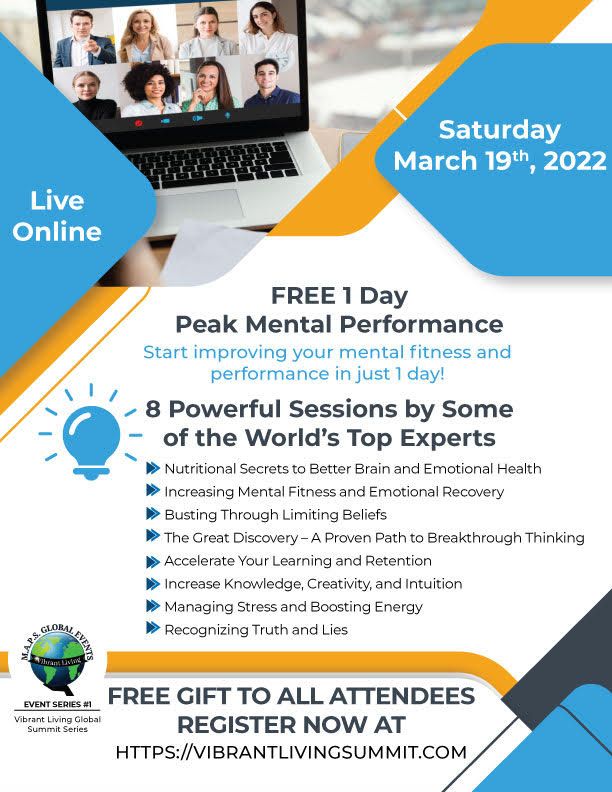
If you want to fast track to peak mental performance and ultra sharp focus, go to https://vibrantlivingsummit.com/ and join the online summit happening on 19th of March!
Sign up right now for the most anticipated event of Spring 2022.
*** SIGN UP EVEN IF YOU CAN’T ATTEND LIVE… replay available *** – the replay of the events will be available for 3 days.
What you’ll get inside?
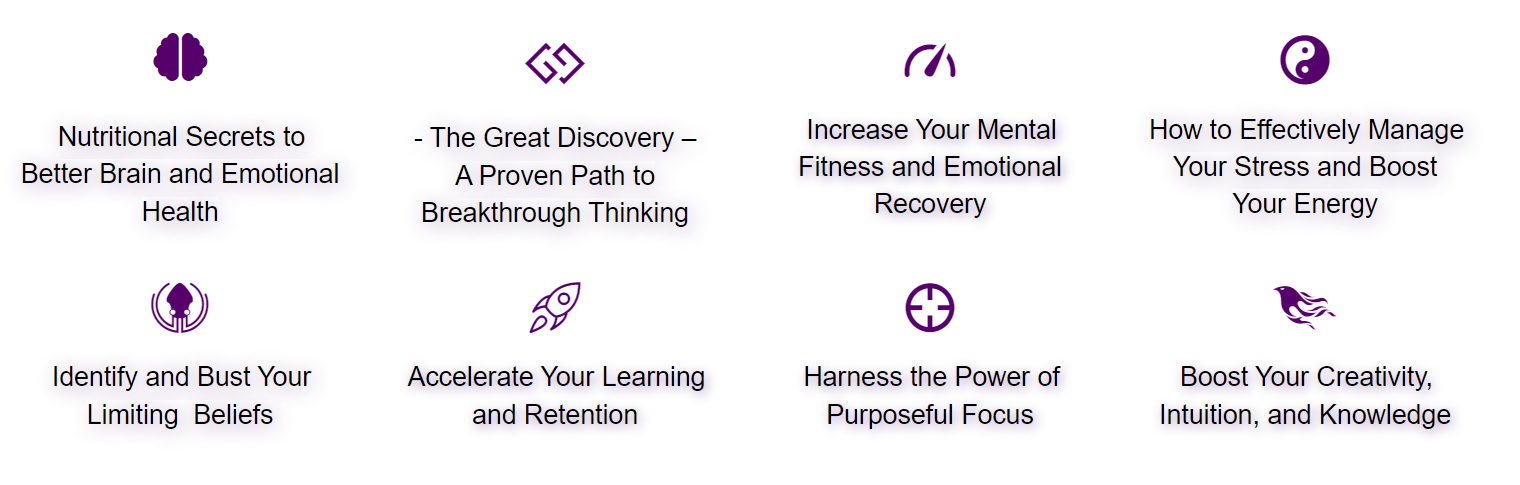
8 POWERFUL sessions by some of the world’s TOP experts covering the most In-Demand topics to help you boost your mind’s performance and focus.
See you inside.
2. The Hidden Benefit of Health.
Your Health affects every aspect of your life. Even business!
It’s logical to say that your health directly affects the performance of your mind.
It can diminish its ability or enhance its performance depending on your choices. Each choice, every small and every big thing regarding your health, compounds the effect in either direction.
Here, I will mention few crucial decisions that you should make, important lifestyle changes that will have the largest impact on your mind’s performance.
The more of these suggestions you practice, the more their effect compounds.
Quality sleep.
When we talk about quality sleep we don’t mean just 8 hours, we mean 8 QUALITY hours. This means, sleep in a dark, silent, and slightly colder room, without electronics around, and no screen exposure at least 1 hour before you go to bed.
Nutrition.
If you want to learn all about the best foods that boost your mind’s potential sign up to Vibrant Living Summit. They will share their secrets about this topic on the first day, 19th of March! So you better sign up fast if you don’t want to miss.
Avoiding toxins.
There are certain things, as we said, that diminish your mind’s potential. These toxins, as we like to call them, are negative news, consumption of alcohol, drugs, fast and sugary food that makes you tired afterwards. Avoid those.
Dopamine detox.
If you want to go to another level with your mind’s performance, then try dopamine detox for 30 days. I explain all the benefits of a dopamine detox here.
Being active.
Move your body, pump your blood flow, exercise, go for a walk, try yoga. Your body is meant to be moving, not sedentary. And when your body is moving your mind is working.
Stress management.
In the modern world stress is a natural part of every day life. That’s why we don’t say avoid stress, but learn to manage it. Stress can sometimes stimulate your mind to work faster, but prolonged stress can lead to burnout and can seriously impact your mind’s potential. Do breathing techniques, exercise, meditate to release stress at the end of the day.
3. Active Training.
Have you heard of Flow?
This is the state you enter when the little voice in your head that continuously judges you goes away, and you are fully embodying the present moment with the activity that you are doing.
That’s one way to train peak performance of your mind.
Find what puts you into that flow state and practice that. Train for few days per week, literally, like going to the gym.
You can also train your memory and your capacity to carry information in your conscious RAM. You can play games that stimulate your mind. There are countless ways to train your mind.
But just like any muscle, if you train it and you are consistent, it will get stronger.
What you should remember?
Your mind is a supercomputer. Learning how to use it can make you feel like a superhuman.
In order to do that, you can train it, make sure you follow the path of health, and listen to what the experts have to say.
One way to do that is to grab the opportunity to listen to the world’s TOP experts on how to increase your mind’s peak performance and unleash its hidden potential by attending the https://vibrantlivingsummit.com/ on March 19th, at 12:00 – 5:00 PM EST.
Get your spot today. *** SIGN UP EVEN IF YOU CAN’T ATTEND LIVE… replay available *** – the replay of the events will be available for 3 days.
By Dr. Dolores Fazzino, DNP, Nurse Practitioner, Medical Intuitive, Energy Whisperer.
Last year, I adopted a 2 year old grey tabby from a feral cat rescue nearby. Gracie is all of 8 pounds, pint sized, and a cat of “very few meows”.
I can tell that she is grounded in who she is and presents herself as a Queen, not a diva or a princess. Gracie has a strong sense of who she is and what she likes and doesn’t like, I know she is a cat!
The other day, I wanted to take her to the vet for an exam due to some skin issues she was having. My initial attempt was unfruitful.
Having to cancel and reschedule our vet visit for the next day, I thought I was being clever, when I brought out her carrier that night, added some cat nip and treats to it.
The next morning, I scooped up Gracie, and attempted to place her in her carrier. She fought me, scratched me up pretty badly, and took cover in the family room.
I was surprised by her response, never having issues like this with my other feline friends. I decided that I was going to get her and put her in the carrier. Gracie, the cat of few meows, was now growling and hissing, you know that warning meow they usually give prior to attacking their enemy.
She was not at all happy.
Me, being persistent, continued to chase her around the room. She finally landed in a chair. I thought now, I got you. I proceeded to pick her up and she peed in the chair and all over me. The poor baby was terrorized.
I felt so bad. Gracie definitely was setting a boundary, and I choose not to honor that, and she escalated her boundary, I still did not listen, and finally, I got the message.
How many times are we confronted with other people’s boundaries and do not listen, honor, or respect them?
The 3 Things that I Learned Were:
1. Listen and observe.
People set boundaries, sometimes they are subtle and sometimes not so much.
2. Learn to accept other people’s (or animals) yes or no at face value.
How often do we have our own agenda and timeline for situations and not consider the other parties involved? Our actions my appear to be bullying behavior, even though are intentions were not so.
3. Look for other solutions.
There are always other possibilities. Become a possibilitarian, looking at a situation and seeing more solutions and options.
Needless to say, I now have an appointment with a mobile veterinarian to see Gracie, probably the best solution for all parties involved.
Interestingly, later that day, I was giving a talk at luncheon networking event, on the topic of “Boundaries”. You just can’t make this stuff up! LOL!
I want to thank Gracie for being a loving example of boundary setting and what others may experience when we draw the proverbial line in the sand.