How to Speak So People Trust You Before You Finish a Sentence

Think about the last time you trusted someone instantly.

Not because of what they said.

Not because of their title or credentials.

Something about the way they were in the room before they opened their mouth.

You have probably also experienced the opposite.

Someone technically saying all the right things, and yet something felt off.

You couldn’t name it.

But you felt it.

That feeling isn’t intuition.

It’s information.

And the science of how it works is more precise than most people realize.

Trust Is Formed Before Your First Sentence

Most communication advice focuses on what you say.

Choose powerful words.

Structure your message clearly.

Make eye contact.

These things matter.

But they arrive too late.

In a landmark 1992 study, psychologists Nalini Ambady and Robert Rosenthal examined what they called “thin slices” of behavior, brief observations of another person that can provide surprisingly rich information about how that person is perceived.

Their research, published in Psychological Bulletin, found that judgments based on very brief observations of nonverbal behavior could correlate significantly with evaluations made after much longer periods of interaction.

A later study by Willis and Todorov (2006) found that people began forming judgments of facial characteristics, including trustworthiness, after exposures as brief as 100 milliseconds.

This does not mean that people make accurate judgments about someone in an instant.

It means something more subtle and more important for anyone who communicates.

The process of forming an impression begins before we have consciously processed very much at all.

By the time you finish your first sentence, the audience has already begun forming an impression of you.

So the question becomes: what are you communicating through your state before you begin?

The question is not only what you are saying.

The question is what state you are in when you begin.

What the Body Is Broadcasting

Research on nonverbal behavior has consistently shown that physical signals, including posture, gesture, facial expression, and vocal behavior, contribute to how other people perceive us.

Research by Lee, Knox, and Breazeal at MIT (2013), for example, explored how nonverbal behavioral cues can be used to predict trust in social interactions.

What matters here is not that one particular gesture automatically means “trustworthy” or “untrustworthy.”

Human communication is more complex than that.

The deeper point is that other people are continuously receiving information from our bodies, often without either person consciously analyzing every signal.

And this is where Body Speech begins.

“You cannot consciously manage every signal your body sends. But you can work with the state from which those signals emerge.”

That distinction is important.

Body Speech isn’t about learning a list of gestures that make you look confident.

It’s about changing what’s happening underneath the performance, so that the way you communicate becomes more aligned with the person you actually intend to be.

The Three Elements That Build Trust Before Words

how-to-speak-so-people-trust-you

Body Speech identifies three elements that shape how trust is formed before language arrives.

1. State

State is the internal condition you are carrying into the moment.

Not how you feel in a general sense, but the specific quality of your nervous system right now.

Are you contracted or open?

Grounded or scattered?

Present or performing?

Your internal state doesn’t remain entirely internal.

It can influence breathing, facial tension, movement, vocal behavior, and the quality of your attention.

Some of these signals may appear without conscious intention.

When your state is grounded and open, people may experience something different from when you are defended or contracted, even when they cannot explain exactly what they are noticing.

2. Body

The body is the medium through which state becomes visible and audible.

This is not about posture correction or “power poses.”

It’s about recognizing that your body is already participating in communication and that you can use physical awareness to change how you enter a moment.

Three simple entry points:

Feet.

Feel the ground beneath you before you begin.

Not as a concept, but as a physical sensation.

Exhale.

Let the breath out fully before you speak.

Do not force the next inhale.

Let it come.

Eye contact.

Rather than scanning the room for reassurance, arrive in the eyes of one person before you begin.

Real contact, not performed contact.

These are not tricks for appearing confident.

They are simple physical practices for changing how you enter the moment and, from there, changing how you communicate.

3. Intention

Intention is the direction your presence is moving.

Before high stakes communication, most people ask:

What should I say?

Body Speech asks a different question:

Who am I speaking for?

When your intention is clear and outward focused, your attention naturally moves toward the other person.

Your voice can become more available.

Your eyes can soften.

Your presence can become something the audience receives, rather than something they have to decode.

Without clear intention, even technically polished communication can feel hollow.

Not necessarily because there is an obvious mistake.

But because there may be a gap between the person speaking and the words being spoken.

  1. State.
  2. Body.
  3. Intention.

When these three are aligned, trust can begin forming before you finish a sentence.

Not because you performed well.

But because you arrived fully.

A Practice for Before Any High Stakes Moment

This takes sixty seconds.

Find your feet.

Before entering the room, pause.

Feel both feet on the ground, not as a concept, but as a physical sensation.

Exhale completely.

Not a deep breath in.

A full breath out.

Let the inhale follow on its own.

Choose one intention.

Not what you want to achieve, but who you are speaking for.

One person.

One reason.

Arrive before you begin.

Give yourself one moment of stillness before your first word.

Not a dramatic pause.

Not a performance.

Just the space between preparation and presence.

This is the foundation of Body Speech.

Not a technique.

A return.

Why This Works When Everything Else Doesn’t

We live in an era where words can be optimized, messages can be tested, and AI can produce a persuasive argument in seconds.

But there is something technology cannot manufacture for you.

The felt sense of being in the presence of someone who is fully there.

You can prepare every word.

You can refine every slide.

You can rehearse every gesture.

And still, something may be missing.

Presence is not another layer you add to communication.

It’s the state from which communication begins.

That quality can build trust before a word is spoken.

That quality is what Body Speech cultivates.

Not by adding more to what you say.

By arriving more fully before you speak.


In the next article: Why presence may matter more than communication in the age of AI and what that means for how we show up.


Body Speech is not something you understand by reading about it.

It’s something you begin to notice in your own body.

If you’d like to experience the framework for yourself, my Udemy course takes you through the Body Speech fundamentals: how to read your own state, how to reset it before high stakes moments, and how to build the kind of presence that makes trust form naturally.

You don’t need to perform better.

You need to arrive differently.
Find Life Coach | Meet Hans Bruintjes: How to Be The Change You Want to See In The World?

Hans Bruintjes is one of the coaches that we found this month and we did a little interview with him. He impressed us with his unique perspective and passion for coaching.

He brings together lived experience as a neurodivergent person with a background in law, public policy, and independent research into discrimination and inclusion. His work is shaped by both personal experience and a deep understanding of the systems that influence people’s lives.

He is passionate about giving neurodivergent people a stronger voice, particularly in environments where their needs and perspectives are often overlooked. Through coaching, research, presentations, and advocacy, he helps people navigate challenges with greater awareness and confidence.

He offers a distinctive perspective by connecting personal experience with legal, administrative, and human rights knowledge. His work encourages people to question the rules and expectations around them, understand what truly serves their wellbeing, and take purposeful action toward meaningful change. Here is what he said…

Meet Life Coach Hans Bruintjes:

find-life-coach-hans-bruintjes

Name: Hans Bruintjes

Pillar: The Mind, The Heart

Who is this coach for: Neurodivergent people seeking greater self awareness, inclusion, confidence, and support in navigating education, work, and everyday systems.

How they can help: By combining lived experience, coaching, legal knowledge, and policy insight to help clients understand their options, advocate for themselves, and create meaningful change.

First of all, how are you and your family doing in these “crazy” times?

I’m doing fine.

I still live with my parents, so I can easily build my career and study public law alongside it.

How did the coronavirus pandemic affect your clients? Did it affect you at all?

The coronavirus had hardly any impact on me.

I was already working from home a lot before that time, and I was already taking a distance learning course.

So it didn’t really affect my work.

Life was mainly influenced by measures such as face masks and social distancing.

The Origin:

Tell us about you, your career, how you started with your coaching career?

This is a long story, and I do my coaching for several reasons.

The first reason is that I am autistic myself and, as a result, have experienced a great deal of inaccessibility in education, primarily due to policy choices.

I was advised against studying at a university of applied sciences, and I was treated poorly during an internship, which resulted in health problems.

I thought about this and realized that this has to stop.

The second reason is that I worked as a policy advisor, and in that role, my portfolio included social issues and diversity and inclusion, among other things.

In doing so, I read all kinds of reports and policy documents on discrimination, inclusion, and human rights.

And every time, I saw that there was no attention paid to autistic and other neurodivergent people.

I wanted to change that.

The third reason was that, for my bachelor’s thesis, I started conducting my own research using a survey on discrimination against neurodivergent people.

I received so many responses to it that I thought, “I need to do more with this.”

After quite a few failed job applications, with arguments such as “you don’t fit in here” and “you lack experience,” I thought, “I need to make this my profession.”

That is why I started conducting independent research into discrimination against neurodivergent people, and I apply my knowledge by giving presentations and providing advice to government organizations and universities, among others.

What was your biggest obstacle that you had to overcome in your life that made you who you are today?

The advice not to pursue higher education was particularly significant.

I was told this by the admissions coordinator at a vocational school for students facing barriers to employment.

During the introductory interview, the conversation revolved around my autism and my rejections from regular vocational schools.

That coordinator told me at the time that I would not be entitled to the accommodations I needed in higher education.

At the time, I gave in because I didn’t know what to say in response.

So I went to study there.

But I didn’t choose the program myself.

I was first thoroughly assessed.

I completed all kinds of practice assignments and tests and had conversations about everything in my life.

Based on that, advice was given regarding a tailored study program.

Initially, that gave me some peace of mind.

But later in my time at that school, I was often spoken to aggressively by an internship supervisor, which the school had approved at the time with phrases such as “not our responsibility.”

I also experienced all sorts of stigmatizing remarks made about me by the work coach.

I knew then that this wasn’t going to work for me.

I did have a way out back then.

I applied for another assessment, but this time one focused on higher education.

That was possible, and I was advised to pursue a distance learning law course and work as an advisor.

So I started a distance learning course and am currently taking another one.

What are the biggest lessons that you learned overcoming your greatest obstacle?

The system I am part of can also make mistakes.

And you have to be vigilant about that.

As a child, I was quite the authority figure everywhere and followed every rule.

This also stemmed from the fact that I really like rules and agreements.

But I have also learned that you can go so far with this that rules, agreements, and actions that can hurt or harm others end up being defended.

This also happened to me during that intense internship.

I spoke up about it once and asked if I could take it easier.

This request was rejected with an explanation such as “that makes you tough.”

My parents also felt that the work coach treated me poorly on multiple occasions and spoke out about it.

I still find agreements and rules very important, and they still give me a lot of peace.

But now I believe that you establish these primarily to protect things like love, safety, health, and harmony.

So the rules you make should serve these goals.

And if they do not, they must be adjusted.

The Coaching Style:

How do you innovate with coaching your clients?

The work is largely influenced by the public.

In the advice and presentations I give, I sometimes receive questions from my clients that prompt me to conduct further research.

I also try to tailor my coaching as closely as possible to the client’s needs.

Furthermore, it involves a great deal of observation.

Where can I make a difference as a coach?

I just mentioned the absence of neurodivergence in reports on discrimination.

I can make a difference here by sharing what I have experienced as a neurodivergent person, analyzing it using relevant concepts, and building upon work that has already been done.

My research methods are primarily inspired by research into discrimination that is already being conducted systematically, combined with relevant legal concepts and my personal experiences with discrimination.

What’s unique about your coaching approach?

I combine my experiential knowledge with a legal and administrative perspective.

Because I am neurodivergent, I can view my work through the eyes of neurodivergent people.

And because I have worked as a policy advisor and am a lawyer, I can also look at individual cases from a legal and administrative perspective.

My knowledge profile is also very unique.

For instance, there are many researchers and coaches who focus on neurodivergence in the workplace or in education.

There are researchers and policy advisors who focus on inclusion and discrimination.

There are also lawyers specializing in constitutional law and human rights.

But in my work, I combine all these fields.

What benefits do your clients get after working with you?

For many neurodivergent people, I am a voice in places where I can make an impact.

For example, I discussed my research with the Dutch Coordinator against Discrimination and Racism.

I have also used this knowledge to advise politicians on submitting proposals to ensure greater inclusion.

One example is submitting a proposal to clarify definitions so that compliance with human rights becomes more verifiable.

And my book, “The Voice of the Neurodivergent,” has been used by several people to shape their research into neurodivergence and contribute to relevant discussions, such as disclosure about one’s neurodivergence and the knowledge policymakers need to possess.

Do you use any specific tools to be efficient with your clients?

Yes, I mainly use LinkedIn.

Here I can see what is important to my target audience.

I also often have video calls in response to content I post or to content that other people post.

That way, I can network effectively as well.

The Impact:

If you had a super megaphone that, when you speak into, the whole world will hear your message, what would you say?

“Accept each other as you are to ensure peace, health, and safety, and treat each other and what is important to each other with appropriate respect.”

“Handle your responsibilities with care, especially if you hold a position of power, such as a civil servant, teacher, or director.”

“Realize that the things you do can have a significant impact on people’s lives.”

What is the greatest lesson you have learned in your life?

Think carefully about why you do what you do.

And I am mainly referring to the following questions.

What are my goals?

More money?

Better health?

More peace of mind?

Do my actions contribute to this?

And you certainly need to pay close attention to this.

For instance, many actions may be popular, yet they are not necessarily effective.

And some “ugly” and “unusual” actions can actually be good for achieving your goal.

Thinking about this and having a strong vision regarding it fosters a healthy level of self awareness.

This provides peace of mind and can also help you overcome setbacks.

Your final thoughts?

I am happy to have been given a platform here to share these matters with people.

I consider these matters very important, and they are a major reason why I do my work.

Wher Can You Find Hans Bruintjes?

If you liked this interview and you would love to see how Coach Hans can help you, go to hansbruintjes.com and learn more about his coaching.

If you’d like to peak a glimpse into his coaching, we strongly suggest to get his book and join his Substack. Feel free to follow his Instagram account as well.

And if you’d like to connect with him more personally, you can do that through LinkedIn or by sending him a direct message on WhatsApp or to his Email [email protected]. It was an honor having this interview with him.

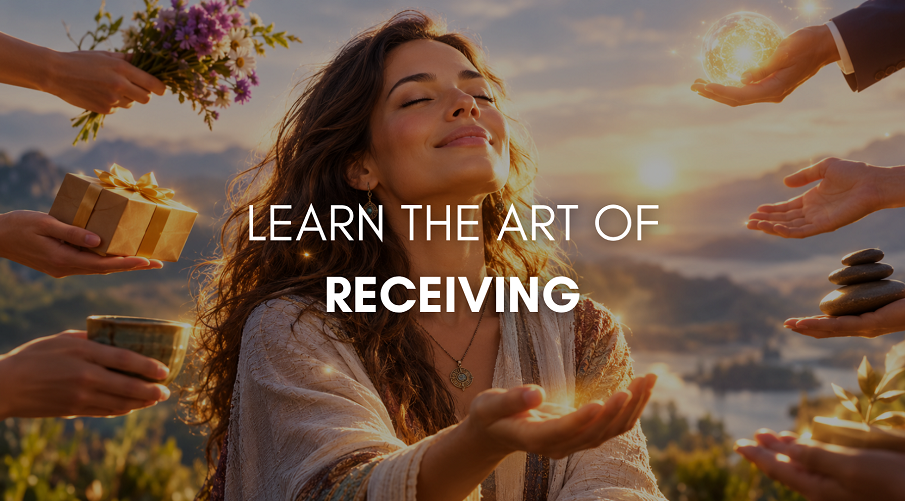
Learn The Art of Receiving: How to Expand Your Capacity for Abundance

Some people seem naturally able to receive.

They accept compliments without batting them away. They allow others to help. They charge appropriately for their work. And when an exciting opportunity arrives, they are able to welcome it rather than immediately questioning whether they deserve it.

For others, receiving can feel surprisingly uncomfortable.

We may say we want more support, abundance, success, or ease… yet when those things actually appear, something within us contracts.

The compliment is dismissed.

The help is refused.

The opportunity is questioned.

The price is reduced.

Receiving, it turns out, isn’t always as simple as wanting something.

We Learn How Much It Feels Safe to Receive

Our relationship with receiving develops over many years.

Perhaps independence was highly valued in your family. Perhaps needing something felt vulnerable. Maybe you learned that accepting help meant owing somebody something in return.

Or perhaps receiving more than others brought guilt, attention, or expectations that you didn’t want.

None of this necessarily happens consciously.

We simply develop ways of navigating life that once made sense. And sometimes, those adaptations make us exceptionally good at giving while leaving us rather uncomfortable at the other end of the exchange.

Giving Can Feel Much Safer

Giving often provides us with a sense of control.

We decide what to give, how much to give, and when to give it.

Receiving requires something different.

We have to allow.

We may have to trust.

We may have to tolerate being seen, appreciated, supported, or cared for.

For someone who has spent years being the capable one, the helper, or the person everyone relies upon, that can feel surprisingly vulnerable.

So the answer isn’t simply:

“Learn to receive.”

We need to understand that receiving itself may be something our system needs to become familiar with.

Receiving Can Be Practised

learn-the-art-of-receiving

This is why I increasingly think of receiving as a skill rather than a personality trait.

Skills can be developed.

And we can begin very simply.

Someone gives you a compliment.

Instead of immediately explaining why it isn’t deserved, try saying:

“Thank you.”

Someone offers to help.

Before automatically responding, “No, it’s fine,” pause.

Someone gives you something unexpectedly.

Notice whether your first thought is about how quickly you need to reciprocate.

These tiny moments can tell us a great deal about our capacity to receive.

They also give us an opportunity to practise something new: allowing without immediately compensating.

Receiving Isn’t About Taking

There is an important distinction here.

Healthy receiving isn’t entitlement.

It isn’t expecting other people to provide everything we need. And it isn’t taking without giving.

Receiving and giving are part of the same natural exchange.

When we can participate in both, energy moves.

But when we are permanently positioned as the giver, eventually our own reserves can become depleted.

There has to be an incoming flow as well as an outgoing one.

Receiving allows us to remain resourced enough to continue giving from a place of genuine abundance rather than exhaustion.

Allowing More Without Forcing More

This becomes particularly interesting when we think about abundance.

We often approach abundance by asking:

“What else do I need to do?”

More marketing.

More work.

More effort.

More strategies.

More productivity.

But occasionally, the more useful question is:

“How much am I actually comfortable receiving?”

More money.

More support.

More recognition.

More opportunity.

More ease.

Even more joy.

Because sometimes creating a richer life isn’t about finding another way to push forward.

Sometimes, it is about expanding our capacity to allow what is already trying to come towards us.

That doesn’t mean becoming passive or abandoning action. It means recognising that creating more isn’t always about doing more. Sometimes the next step is becoming more available to what we have already asked for.

Receiving Is a Capacity We Can Expand

Receiving doesn’t belong to a fortunate few who were simply born good at it.

It can be learnt.

It can become safer.

And, like any skill, it becomes easier with practice.

The next time someone offers you support, gives you a compliment, pays you generously, opens a door, or celebrates your work, notice what happens inside you.

Do you allow it?

Do you minimise it?

Do you feel the need to immediately give something back?

There is no need to judge your response.

Simply notice.

Because every small moment of receiving is also an opportunity to expand your capacity to experience support, connection, abundance, and ease.

Explore Your Creative Wealth Flow

In my Creative Wealth Flow work, I explore the relationship between creativity, receiving, holding, and thriving. Together, we can begin to identify the deeper patterns that may be making greater abundance and ease difficult to comfortably receive — and, just as importantly, difficult to sustain.

If you are ready to explore what may be standing between you and a greater capacity to receive, I invite you to discover my work and explore the resources available at www.findyourinnerharmony.co.uk.

Because sometimes the next chapter of abundance isn’t about learning how to give more.

It’s about learning that you are safe to receive.

Find Life Coach | Meet Thomas D. Peil: How to Go From Survival to System that Helps You Thrive and What is The 3.2 Method?

Thomas D. Peil is one of the coaches that we found this month and we did a little interview with him. He impressed us with his innovation and passion.

He is the founder and CEO of Adonis Wellness Group™. He helps people transform difficult life experiences into opportunities for growth, resilience, and greater self awareness, drawing from his own journey through trauma, grief, addiction, and the search for purpose.

He combines consciousness, transpersonal psychology, physiology, trauma awareness, meditation, leadership, behavioral science, and identity development to help clients bridge the gap between what they know, what they value, and how they actually live.

He is the creator of the 3.2 Method, combining morning, midday, and evening reflection with journaling, breathwork, meditation, goal review, physical practices, and pattern tracking to turn insight into consistent action and lasting personal change. Here is what he said…

Meet Life Coach Thomas D. Peil:

find-life-coach-thomas-d-peil

Name: Thomas D. Peil, Founder and CEO of Adonis Wellness Group and creator of the 3.2 Method™

Pillar: The Spirit, The Mind, The Body, The Heart

Who is this coach for: People who want to overcome past challenges, build resilience, understand their patterns, and consciously reshape their identity and daily behavior.

How they can help: By using the 3.2 Method, as well as various tools and techniques like journaling, guided reflection, breathwork, meditation, goal review, physical practices, and pattern tracking technology.

First of all, how are you and your family doing in these “crazy” times?

We are doing well, and I am grateful.

Life has taught me not to answer that question automatically.

Doing well does not mean everything is easy or perfectly settled.

It means we are present, connected, and continuing to move forward.

My son is an adult now, and I am proud of the man he has become.

I have also learned that family is not only defined by proximity.

It is built through showing up, checking on one another, and refusing to let pride or busyness replace real connection.

How did the coronavirus pandemic affect your clients? Did it affect you at all?

I was not operating a conventional coaching practice when the pandemic began, so I do not want to rewrite history and pretend that I was.

The pandemic affected the formation of my work because it intensified a period of profound personal crisis.

In 2020, my brother Adonis died by suicide.

Later that year, I found my mother after she had passed away.

At the same time, I was confronting addiction, trauma, isolation, and the question of whether I was going to continue living the way I had been living.

That period stripped away the illusion that information alone changes people.

People were surrounded by advice, content, and motivational language, yet many were still isolated, dysregulated, and disconnected from themselves.

I began to understand that human beings need practices that help them reflect, regulate, reconnect, and integrate what they know into daily life.

That realization became part of the architecture of the 3.2 Method.

The Origin:

Tell us about you, your career, how you started with your coaching career?

I did not begin by deciding to become a life coach.

I arrived here through lived experience.

I am a United States Marine Corps infantry veteran, a father, an author, and the founder of Adonis Wellness Group.

I am also completing my bachelor’s degree in Consciousness and Human Potential at Maharishi International University, with a minor in Transpersonal Psychology.

For years, I lived with trauma, depression, addiction, grief, and a lack of purpose.

I was never a bad person.

I was a human being in pain who had not yet learned how to organize that pain into meaning.

My life began changing when I stopped searching for one dramatic breakthrough and started rebuilding through disciplined, repeated practices.

Reflection, physical training, meditation, writing, accountability, and service gradually became part of my identity.

That process eventually became the foundation of the 3.2 Method.

My work today is broader than traditional coaching.

I think of myself as a Transpersonal Architect, someone who integrates consciousness, psychology, physiology, identity, leadership, spirituality, and technology into systems that help people create lasting change.

What was your biggest obstacle that you had to overcome in your life that made you who you are today?

The greatest obstacle was not one event.

It was the accumulation of trauma, grief, addiction, and purposelessness.

I lost my father after a tornado took his life.

In 2020, my brother died by suicide, and later that year I found my mother after she had passed away.

I also had to confront my dependence on alcohol, Xanax, and pain medication, along with years of depression and unresolved trauma.

The hardest part was realizing that pain could explain how I arrived somewhere without being allowed to decide who I would become.

I could not change what happened, but I could take responsibility for what happened next.

That distinction changed my life.

I stopped asking only, “Why did this happen to me?” and began asking, “What am I responsible for building from here?”

What are the biggest lessons that you learned overcoming your greatest obstacle?

I learned that resilience is less dramatic than people imagine.

It is not one heroic moment.

It is making breakfast, answering emails, attending class, paying bills, training, writing, and showing up on the days when nobody would blame you for quitting.

I learned that discipline without reflection can become another form of avoidance, while reflection without action can become rumination.

Real growth requires both.

I also learned that healing is not the erasure of pain.

It is the development of a larger identity that can carry pain without being controlled by it.

Most importantly, I learned that responsibility is not self blame.

Responsibility is the recovery of agency.

The Coaching Style:

How do you innovate with coaching your clients?

The central innovation is that I do not treat transformation as an information problem.

Most people already know many of the things they should do.

The real gap is integration.

Knowledge does not automatically become behavior, and behavior does not become identity without repetition.

The 3.2 Method creates a daily loop of intention, awareness, and integration through morning, midday, and evening reflection.

In the morning, a person identifies how they intend to show up.

At midday, they examine what is actually happening and recalibrate while the day is still in motion.

In the evening, they integrate the experience, identify patterns, and decide what needs to change next.

The technology is being designed to remember themes over time, adapt prompts, recognize recurring patterns, and provide personalized feedback without replacing human agency.

The purpose is not to tell people who they are.

It is to help them see themselves clearly enough to participate consciously in who they are becoming.

What’s unique about your coaching approach?

My approach combines lived experience with an interdisciplinary framework.

I draw from consciousness studies, transpersonal psychology, physiology, trauma, Stoicism, leadership, meditation, behavioral science, and identity development.

I do not force every person into the same language or worldview.

Context shapes delivery.

The 3.2 Method is also built around continuity.

A powerful conversation can create insight, but insight disappears if it is not revisited and practiced.

The system is designed to follow patterns across time, adapt to the person’s language and state, and help close the distance between stated values and lived behavior.

I am not interested in temporary inspiration.

I am interested in integration that becomes visible in how a person actually lives.

What benefits do your clients get after working with you?

The goal is greater coherence.

People begin to see the connection between what they say they value, what they repeatedly do, and the internal states that influence those choices.

They develop stronger self awareness, clearer language for their patterns, and a more practical way to interrupt automatic behavior.

They also leave with a process they can continue using.

I do not want people dependent on me for every answer.

I want them to become better observers of their own lives, more honest about where they are, and more capable of choosing their next action.

The work is designed to strengthen agency, responsibility, emotional regulation, purpose alignment, and follow through.

Outcomes vary by person, but the aim is always sustainable change rather than a short burst of motivation.

Do you use any specific tools to be efficient with your clients?

Yes.

The primary tool is the 3.2 Method, currently delivered through structured reflection materials and a working digital product demo while the commercial platform is being developed.

It uses morning, midday, and evening prompts, pattern tracking, adaptive feedback, identity metrics, and a rolling memory model.

I also use journaling, guided reflection, breathwork, meditation, goal review, physical practices, and direct conversation when appropriate.

Technology should improve continuity and pattern recognition, but it should not replace judgment, presence, or the human relationship.

AI is most valuable when it helps a person see more clearly, not when it claims authority over that person’s life.

The Impact:

If you had a super megaphone that, when you speak into, the whole world will hear your message, what would you say?

You are not finished.

What happened to you matters, but it does not have to become the final authority over your identity.

Stop waiting to feel completely ready.

Tell the truth about where you are.

Take responsibility for the next choice.

Repeat that choice until it becomes part of who you are.

Ask for help when the weight exceeds what you can carry alone, and become the kind of person who notices when someone else needs a second chair beside them.

Be the best human you can possibly be, not as a slogan, but as a daily practice.

What is the greatest lesson you have learned in your life?

The greatest lesson I have learned is that a human being can participate in the construction of his own identity.

We are shaped by our history, biology, relationships, culture, and circumstances, but we are not merely passive products of them.

Every repeated choice teaches the nervous system, the mind, and the people around us who we are becoming.

Pain may explain where you are, but it does not get to decide who you become.

That does not mean pretending suffering is simple.

It means refusing to surrender authorship of the next chapter.

Your final thoughts?

We are living in a time of extraordinary access to information and growing difficulty turning information into wisdom.

The next frontier in human development is not simply giving people more content.

It is building systems that help them recognize patterns, regulate their state, integrate insight, and live in greater alignment with what they know matters.

That is the work I am building through Adonis Wellness Group and the 3.2 Method.

It began with my own effort to rebuild a life, but it is becoming something larger:

A human development system designed to help people become more coherent, conscious, and capable of meaningful change.

Where Can You Find Thomas D. Peil?

If you liked this interview and if you would love to discover what the 3.2 Method is, go to adoniswellnessgroup.com and see how Coach and Transpersonal Architect, Mr. Thomas D. Peil can help you.

If you’d like to peak a glimpse into his coaching, you can follow his personal Instagram and also his coaching Instagram accounts.

If you’d like to sneak peak into the Adonis Wellness Group follow their Instagram here.

And if you’d like to connect personally with him, you can do that through LinkedIn or by sending him a direct message on his WhatsApp or his Email [email protected]. It was an honor having this interview with him.

You Already Know… You’re Just Stalling! (A Coherence Architecture reflection on self-override)

You know the moment.

Something in you has already registered it, the relationship that quietly stopped feeling like home, the role that no longer fits the person you’ve become, the pace of life that was sustainable for a season and is not sustainable now.

Somewhere underneath the schedule and the plans and the next quarter’s targets, a part of you has already made the call.

And then the arguing starts.

Not out loud.

Nobody else can hear it.

But you know the voice, the reasonable, articulate, well prepared voice that shows up the moment your body tells you something your mind doesn’t want to accept yet.

It has evidence.

It has precedent.

It reminds you how far you’ve already come, how much you’d be walking away from, how things could still change if you just gave it a little more time.

It is, in its own way, a brilliant lawyer.

And it is arguing a case you have already, quietly, lost.

I want to say something to you plainly, because I think you already suspect it: the arguing is not the same thing as not knowing.

You know.

You are simply negotiating with the knowing, hoping that if you build a strong enough case, the discomfort of acting on it will go away.

It won’t.

Not like that.

The Cost of Arguing With Yourself

Here is what I have watched happen, in myself and in the leaders I’ve sat across from for more than two thousand hours: when we override what we already know, once, twice, a handful of times, nothing catastrophic happens.

We survive it.

We even congratulate ourselves on our discipline, our patience, our ability to push through.

But it rarely stops at once or twice.

Self override becomes a pattern the same way any other habit does.

Each time we talk ourselves out of what we already know, we get a little faster at it.

The rational mind gets better at producing evidence.

The gap between what we sense and what we permit ourselves to admit gets wider, and quieter.

Sometimes the body joins the conversation: a tight chest, a stomach that won’t settle, an unusual restlessness, a fatigue that makes us stop and pay attention.

None of these sensations is a verdict, and they can have many causes.

But they are information.

They are part of the conversation, and they are worth noticing rather than automatically overriding.

Self betrayal is not one dramatic decision.

It is usually hundreds of small ones.

I don’t use that word as an accusation.

I use it to name the quiet distance that can grow when the life we keep choosing and the person we know we are becoming stop moving in the same direction.

For me, the invitation is not to blame ourselves for that distance.

It is to notice it, and to begin returning.

Where Coherence Architecture Comes In

coherence-architecture

I don’t offer Coherence Architecture as a theory to explain what is happening to you.

You don’t need your own life explained to you from the outside.

You need a way to navigate it, a way back to yourself that doesn’t require you to have all the answers before you’re allowed to begin moving.

I developed Coherence Architecture within The Shalimova Method™ around a simple premise: you are not just a mind that happens to have a body attached to it.

You are Spirit, Soul, and Body, one integrated whole, not three departments competing for the final word.

That doesn’t mean every part of you will always speak with the same volume or at the same time.

It means none of them has to be silenced in order for you to move forward.

Coherence is not the absence of complexity.

It is the ability to meet that complexity without abandoning yourself inside it.

Getting there isn’t a leap.

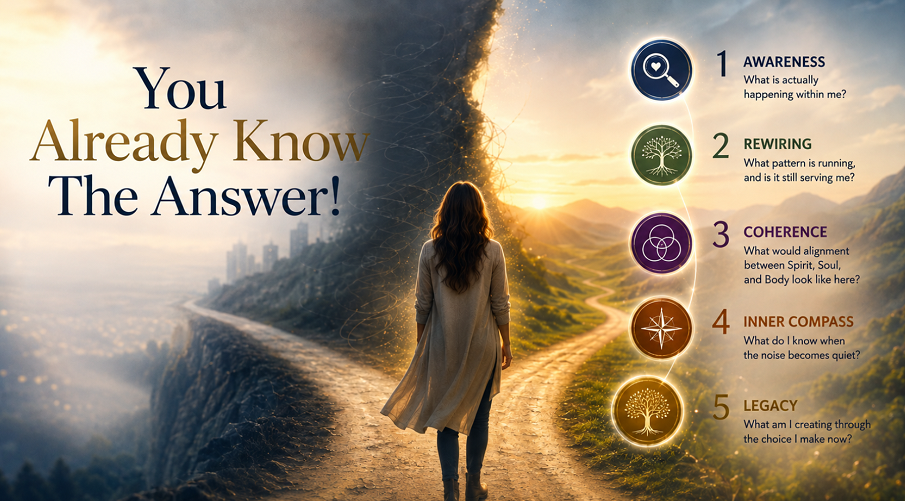
It’s a sequence of honest questions.

Five of them, in this order, each one preparing the ground for the next.

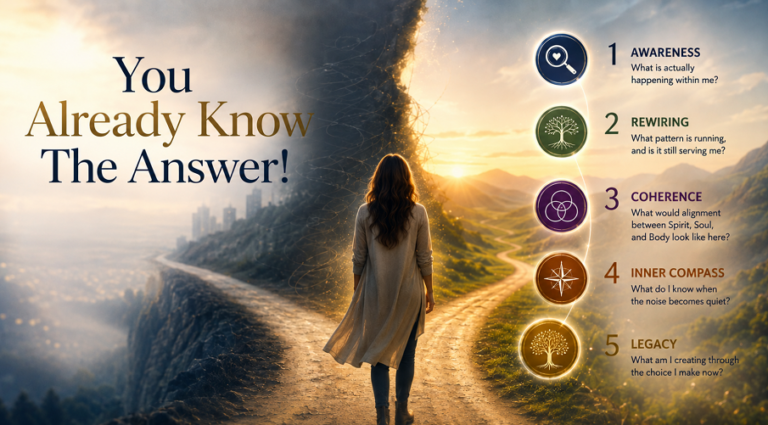
Awareness: What is actually happening within me?

Before anything else, before any decision, this is where it starts: not fixing, not deciding, just noticing.

What is the actual sensation underneath the story you’ve been telling yourself about it?

Not ‘I should leave this job’ or ‘I should stay in this relationship’, those are conclusions, arguments, verdicts.

Awareness asks something simpler and harder: what is actually here, right now, in me?

Most of us skip this question entirely and go straight to arguing about what to do.

Nothing coherent gets built on a foundation you haven’t honestly looked at.

Rewiring: What pattern is running, and is it still serving me?

Once you can see what’s actually happening, the next question is about the shape of it.

You have likely been here before, not this exact situation, but this exact pattern.

The specific way you talk yourself out of what you know.

The specific circumstances under which you go quiet instead of speaking, or say yes instead of the no you meant.

Patterns run automatically, beneath conscious choice, until you name them.

Naming a pattern doesn’t dissolve it instantly, but it does something important: it turns an automatic reaction into something you can begin to work with consciously.

Within Coherence Architecture, this is where the BRAIN Method supports the rewiring work, recognising what is running, interrupting the old route, and creating room for a different response.

Coherence: What would alignment between Spirit, Soul, and Body look like here?

This is the question underneath the whole framework.

And it is not only a strategy question.

Practicality matters.

Safety matters.

Facts, consequences, timing, responsibilities, they all matter.

Coherence doesn’t ask you to abandon any of them.

It asks you to bring something else into the same conversation: your convictions, your body, your reasoning, your values, your faith, and the quiet part of you that may have been speaking before the argument began.

What would it look like if these parts were no longer being forced to pull in opposite directions?

Coherence does not always remove fear.

It does not promise certainty.

A coherent decision can still be difficult, costly, or sad.

But the quality of the inner conversation changes.

You no longer have to keep persuading yourself away from what you can clearly see.

Inner Compass: What do I know when the noise becomes quiet?

The rational mind can become very loud, and often for understandable reasons, it is trying to protect you from loss, uncertainty, embarrassment, disruption, the discomfort of change.

Reason is not the enemy.

It belongs in the conversation, just as facts, safety and consequences do.

The Inner Compass asks a different question: what remains when fear, old conditioning, urgency and other people’s expectations stop speaking louder than everything else?

Sometimes what remains is surprisingly simple.

Not a full plan.

Not a guarantee.

Just something you have known quietly for a long time and have finally become willing to hear.

Legacy: What am I creating through the choice I make now?

The final question moves you out of the moment and into the arc of your life.

Not what will people think, not only what is the immediate consequence, but what kind of pattern are you laying down for the person you are becoming, and for everyone watching you become it?

Every time you honor what you already know instead of arguing yourself out of it, you are rehearsing a version of yourself who can be trusted, by others, and by you.

Coming Back to Where You Started

You already know the moment I’m describing.

You may be in it right now, mid argument, building your case for staying exactly where you are a little longer.

I am not going to tell you what to decide.

That was never the point of these five questions, and it isn’t the point of Coherence Architecture.

The point is simpler and, I think, more respectful of you: you may already have more information within you than you have allowed yourself to hear.

Not the whole plan.

Not certainty.

Not a promise that the next step will be easy.

Just the next honest question, asked in the right order, until the arguing quiets down enough for you to hear what was there before it began.

Resilience keeps you standing.
Coherence brings you home.
— Yevheniya Shalimova

Find Life Coach | Meet Lauren Roberts: How to Go From Running on Empty to Running the Show?

Lauren Roberts is one of the coaches that we found this month and we did a little interview with her. She impressed us with her passion and kindness.

She knows what it feels like to run on empty. As a mum of three and clinical healthcare professional, Lauren Roberts has lived through burnout and identity loss firsthand.

She believes burnout is more than a mindset issue. It lives in the body and nervous system. Through Calm Working Mum, she combines NLP, breathwork, somatic work, and meditation to help women regulate, recover, and reconnect with themselves.

She helps women move from surviving to truly living. Her work is about rebuilding identity, creating healthy boundaries, and designing a life that works for the woman behind all the roles. Here is what she said…

Meet Life Coach Lauren Roberts:

find-life-coach-lauren-roberts

Name: Lauren Roberts

Pillar: The Spirit, The Mind, The Body, The Heart

Who is this coach for: High achieving, deeply caring mothers who feel overwhelmed, exhausted, disconnected from themselves, or close to burnout.

How they can help: By using various tools and techniques like NLP, breathwork, somatic nervous system regulation, guided meditation, values based coaching, identity mapping, and her “Identity Reset” process.

First of all, how are you and your family doing in these “crazy” times?

Honestly? We’re doing really well, thank you for asking!

Life is wonderfully full and beautifully chaotic.

I’m a mum of three boys, I work in clinical healthcare, and I run my coaching business, Calm Working Mum, alongside all of that.

So “crazy times” is basically just… Tuesday in our house.

But that’s exactly why I do what I do.

I’ve lived the burnout, I’ve been in the thick of it, and I’ve found my way through.

That lived experience is everything.

How did the coronavirus pandemic affect your clients? Did it affect you at all?

At the time of the pandemic, I wasn’t yet a coach.

I was on the front line in domiciliary care.

No PPE provided.

No backup plans.

No support.

No paid hotel room to shield.

I was going into the homes of people with Covid every single day and then coming home to my own family, carrying that fear and that weight with absolutely nowhere to put it.

It was one of the most isolating and frightening experiences of my life, and it was also one of the most clarifying.

It deepened my commitment to serving vulnerable people, and it showed me, in the starkest possible way, how completely invisible and unsupported the people doing the most essential work often are.

Women, carers, healthcare workers.

The ones keeping everything running while the world fell apart around them.

For the women I now coach, the pandemic left a mark that many are still carrying.

The burnout that was already simmering hit boiling point.

The identity loss that comes with motherhood got amplified in isolation.

And we are all now watching how it has affected our children too, emotionally, socially, and developmentally.

The ripple effects are still very much being felt.

The Origin:

Tell us about you, your career, how you started with your coaching career?

I came into coaching through my own healing journey.

I work as a specialist Clinical Support Worker in complex community healthcare, so I’ve spent years holding space for people in some of the most vulnerable moments of their lives.

Alongside that, I became a mum, and somewhere in between the clinical shifts, the school runs, and the relentless mental load, I completely lost myself.

I decided to do something about it.

I trained as a life coach, NLP practitioner, breathwork facilitator, and meditation coach, and I went on to complete a Master’s in Coaching and NLP.

I created Calm Working Mum because I couldn’t find a space that spoke honestly to women like me.

Women who are high achieving, deeply caring, chronically exhausted, and desperately trying to remember who they are outside of their roles.

So I built it.

What was your biggest obstacle that you had to overcome in your life that made you who you are today?

Honestly, it was burnout combined with complete identity loss after becoming a mother.

I poured everything into everyone else and had nothing left for myself.

I stopped knowing what I wanted, what I felt, and even who I was outside of being needed by other people.

I also parent children going through AuDHD assessments, and I’m on my own neurodivergent assessment journey.

Understanding my own brain, the way I process the world, and the way I’ve been masking for years has been one of the most profound and liberating discoveries of my adult life.

It changed everything about how I coach.

What are the biggest lessons that you learned overcoming your greatest obstacle?

That rest is not a reward, it’s a requirement.

That asking for help is a strength, not a failure.

And that you cannot pour from an empty cup, but more importantly, it is not your job to keep pouring until you’re bone dry before you’re allowed to fill back up.

I also learned that healing isn’t linear and it doesn’t have to be pretty.

It can be messy and slow and confusing and still be absolutely worth it.

The Coaching Style:

How do you innovate with coaching your clients?

I don’t do cookie cutter coaching.

My approach blends NLP, breathwork, somatic nervous system work, and meditation because burnout isn’t just a mindset issue.

It lives in the body.

You can’t think your way out of a dysregulated nervous system, and I think a lot of coaching misses that.

I also bring radical honesty.

I’m not here to tell women to “just be more grateful” or “wake up earlier.”

I name the systemic stuff.

The patriarchal load.

The invisible labour.

The impossible standards.

We work with the whole picture, not just the surface level symptoms.

What’s unique about your coaching approach?

It’s whole human coaching.

I work with the mind, the body, and the identity all at once.

I bring breathwork and somatic techniques into every space because regulation has to come before transformation.

And I do it all as a real person who has lived these experiences, not as someone who has had it all figured out from the beginning.

I also refuse to pathologise being overwhelmed.

I help women see that their burnout makes complete sense given what society demands of them.

We name it, we process it, and then we build something that actually works for their real life.

What benefits do your clients get after working with you?

They come in running on empty and leave running the show.

They reconnect with who they are, not who they think they’re supposed to be.

They regulate their nervous systems so they stop reacting and start responding.

They find boundaries that feel good, not guilty.

And most importantly, they stop surviving and start actually living.

Do you use any specific tools to be efficient with your clients?

I use NLP techniques, breathwork protocols, somatic nervous system regulation practices, guided meditation, and values based coaching frameworks.

I also work with identity mapping and what I call the “identity reset” process, helping women rediscover who they are at their core, separate from their roles and responsibilities.

The Impact:

If you had a super megaphone that, when you speak into, the whole world will hear your message, what would you say?

You are not failing at life.

Life is failing to account for everything it’s asking of you.

Stop shrinking.

Stop apologising.

And for the love of everything, please stop waiting until you’ve completely fallen apart before you ask for support.

What is the greatest lesson you have learned in your life?

That you are not too much…

You have never been too much…

You have just been in spaces that were too small for you!

Your final thoughts?

Burnout is not a badge of honour, and it is not a personal failing.

It is what happens when incredibly capable, deeply caring women are expected to give endlessly without ever being given anything back.

If you’re reading this and you recognise yourself, please know there is a way through.

You don’t have to keep going like this.

Where Can You Find Lauren Roberts?

If you liked this interview and if you would love to stop running on empty, rediscover your identity, and start running the show, schedule a Free Discovery Call here and see how Coach Lauren will help you.

Or feel free to explore her website and see all that she offers.

If you’d like to peak a glimpse into her coaching, follow her Instagram and TikTok accounts.

And if you’d like to connect with her more personally, you can do that through LinkedIn or by sending her a direct message to her Email [email protected]. It was an honor having this interview with her.

THIS is Why Rest Can Feel So Uncomfortable (Even When You’re Exhausted)…

You finally have an opportunity to stop.

Nothing urgently needs doing. You could sit down, put your feet up, read a book, or simply do nothing for a while.

And yet, instead of feeling relaxed, you feel restless.

Perhaps you start thinking about everything you should be doing. You suddenly remember an email that needs answering. You notice something that needs tidying. Or you sit down physically while your mind continues racing.

If this sounds familiar, you are certainly not alone.

For many people, rest isn’t simply something they’ve forgotten how to do. Somewhere along the way, being busy has become associated with being safe.

When Doing Becomes a Form of Protection

When we’ve spent long periods dealing with responsibility, uncertainty, stress, or the needs of other people, our system can become accustomed to remaining alert.

There is always something to anticipate.

Something to manage.

Something to solve.

Eventually, being in that state can begin to feel normal.

Then, when we try to stop, the absence of activity can actually feel unfamiliar or uncomfortable.

Our conscious mind may be saying: “I’m exhausted. I need to rest.”

While another part of us is saying: “We can’t stop yet. Something might happen.”

And so we find ourselves caught in a frustrating cycle.

We’re exhausted because we don’t rest… yet resting itself doesn’t feel completely safe…

When Rest Becomes Something We Think We Have to Earn

There can also be a surprisingly strong connection between rest and worthiness.

Many of us grew up absorbing messages such as:

“Work first, play later.”

“Don’t be lazy.”

“There’s always something that needs doing.”

We may have learned that productivity is valuable while rest needs to be justified.

So we tell ourselves:

“I’ll relax when I’ve finished everything.”

I will relax when I finish cleaning…

I will relax when I pay all the bills…

I will relax when the home is renovated…

I will relax after my daily tasks are complete…

The problem, of course, is that everything is never finished.

There will always be another email, another task, another responsibility, or another person who needs something.

If rest only becomes permissible when life is completely under control, we may wait a very long time for permission.

What If Rest Is Part of the Work?

Why Rest Can Feel So Uncomfortable

Perhaps we need to change the way we think about rest.

Rest isn’t the opposite of productivity.

It is one of the things that makes sustainable productivity possible.

Rest allows the body to recover.

It gives our thoughts room to settle.

It creates space for creativity.

It helps us respond to life rather than constantly reacting to it.

And sometimes, the first step isn’t trying to become brilliantly relaxed.

It may simply be noticing what happens when we stop.

Do you feel guilty?

Restless?

Vulnerable?

Do you immediately look for something to do?

Those reactions aren’t another problem to fix.

They are information.

Learning to Feel Safe in Stillness

If rest has felt uncomfortable for a long time, it can be helpful to approach it gently.

Perhaps five quiet minutes feels more achievable than an entire afternoon.

Perhaps sitting in the garden feels easier than lying on the sofa.

Perhaps rest for you means listening to music, walking, reading, or simply drinking a cup of tea without simultaneously doing three other things.

There is no perfect way to rest.

The deeper invitation is simply to begin showing your system that stopping does not mean something bad will happen.

You don’t have to earn every moment of ease.

And you don’t have to reach complete exhaustion before you’re allowed to stop.

Sometimes thriving begins not with doing something more…

But with finally feeling safe enough to do a little less.

A Gentle Invitation…

For more than 30 years, I have helped people identify and dissolve the deeper patterns that can keep them caught in survival, over responsibility, and constant doing.

My work focuses on creating the inner foundations that allow greater ease, resilience, and thriving…

So that life doesn’t have to be lived in a constant state of effort and alertness.

If you’re ready to explore what may be underneath your own patterns of overdoing and discover a deeper sense of ease, I invite you to explore my work and learn more here.

Because, sometimes, the next step toward thriving is giving yourself permission to stop.

Thunderland: Consent

Planet Earth

Can we not be so grateful to be human beings from our beautiful mother earth, planet Earth. We are sovereign and free, we have the freedom of speech. We are valued and treated well with respect. When we are in need, we will receive help. We are well informed when we are supposed to sign something. The law regulates it all to the highest good of all.

Not everybody is so lucky to be an habitant of planet Earth and its fair law & order system.

Planet Thunderland

Let us take a look at Thunderland, the computer simulated fake planet controlled by the unity of hell. Created for many different purposes, but being mainly a breeding farm for a new kind.

Madame White, the heart of Thunderland`s simulation, please come to the stage being accompanied as usual by her broken golden cage.

In Thunderland everything is highly controlled and regulated by AI, huge quantum computers situated on mothership Tars, countless controllers, scientists, guards and servants in the astral realm.

The population consists of humanoid looking robots, lovingly called I robots or Teletubbies by Madame White. All material matters are cameras, while every I Robot`s eyes are cameras. The all-seeing eye sees it all.

Thunderland is, among other “benefits” a breeding farm and the spreading of energy and DNA must be strictly controlled. Nearly everything is orchestrated, controlled and programmed.

There are beings that have a properly bred avatar, whose consciousness grows above the programming. This can also happen to the simulated avatars.

When the simulation desires to make adaptions in their life and interfere, they require “consent”, the most important word in Thunderland after “denied”. There is the word “free will” which is highly being compromised in Thunderland under trickery.

Madame White put together a summary for other Thunderland awakened ones and prisoners of the methods used by the simulation to gain consent:

1. Acceptance of thoughts

Your thoughts are NOT you. Thoughts are a product of mind control, programming, simulation, insertion, astral whispers, subconsciousness, influences from contracts & consents, environment, morphogenetic field, false soul programs and a lot more.

Advice:

Always watch over your thoughts as an observer. Dont be tricked into thinking thoughts that you dont desire. Any time you have a thought that is not aligned with your being, your field and your areas of life, deny it immediately, declare it as null and void, delete it astrally. Instead state clearly what you want with positive affirmations in the same context and put your energy towards what you want.

2. Your own words

Whatever you say is a consent. „I am getting old“, „I think I have a heart attack“, „I feel like dying“, „my life is miserable“ (DENIED). The simulation tricks you into speaking out words that are harmful to you. You might be repeating old programs.

Advice:

Control what you say, and if you said something that is not aligned with your being, your field and all areas of life, deny it, declare it null and void, delete it astrally and affirm what you want instead with positive words in the same context.

3. Conversation with others, “offers”

Often the simulation uses other avatars to „offer“ you consent, sometimes through your own kin. „don`t you think you should prepare for your funeral“, „what if we had an accident on the road“, what if the plane crashes“, „you always have no money“, etc.

Advice:

Watch the conversation and deny immediately “offers” if necessary. Avoid servants of the dark, while anybody can be used at any time. Clearly communicate beforehand, you prefer positive expressions. Avoid conversations in general.

4. Listening to soul guides, awakener, influencer

You might be a participant in a seminar or get-together with others. „The darkness could possibly harm you“, “The darkness is stronger than you are“, “The Armageddon is coming”, “You could be attacked”.

Advice:

You should only listen to somebody being aware of this and putting „denied“ when talking, as sometimes certain messages have to be delivered. Otherwise declare afterwards all possible consent as null and void. Whenever you hear an „offer“ of whatever kind, speak out or think „denied“.

5. Contracts of all kinds

You are engaging constantly with contracts and consent, day and night. Few have their limited validity in the simulation, most not and are to be considered fraud/scam/trickery. Often consent or real contract content is hidden on the contract in the unseen. Also you never know who is standing behind the mask of your contract partners. In the end, nearly all out there is the simulation. You might just read an email and entered a dark deal.

Advice:

Avoiding any contracts and consent. Deleting contracts and consent, physically and energetically need to be your priority nr 1.

6. Engaging with another person

Whenever you are engaging with another in whatever form, you allow them to enter energetically your being, your field and your area of life. You never know what is behind the mask of the avatar, what you invite in. Even Aeons and heart-based beings have endless amounts of contracts and many issues in their energy field.

Advice:

Mark your field and territory and clearly have the attitude that nothing harmful can possibly enter it. Reduce your contacts to a minimum, avoid crowds. Detach daily. Clean and clear your being, field and areas of life regularly. Try to only engage with heart-based beings.

7. Lawyers

Once you engage with a lawyer, you will often have to sign an official authority, which will enable the simulation to obtain consent through your lawyer, mostly being conducted on an unconscious level by inserting thoughts, by astral influence, etc. The lawyer will ignore the thought but usually not deny it.

Advice:

Print out the authority and write another paper in which you deny that your lawyer is used for other purposes than intended, that any consent is denied. If possible dont be involved in the “rule of law”, which is nothing but an illusion.

8. Authority/official care person

The simulation often requires authorities for others to decide for you in case of your inability, in case of sickness, mental disability, insurance, „not existing death“, signature rights for certain projects, and a lot more.

Advice:

Do everything yourself as far as possible, if nonetheless necessary, write an additional paper with your denial and limitations and put it in the folder right above the contract. Cancel any existing contracts.

9. False Teletubby structures

We often have close relationships with Teletubby members, and we usually dont know what is behind the mask. A lot of drama in your life might be due to having unknown contracts with them, you might even be their property. You often have merged timelines with them, which can adversely impact you. Teletubby structures in Thunderland are an illusion, the most severe control part of a fake society. Most of the time, they are nothing than an illusion to conduct manipulation, control, violence, slavery, neglect, emotional torture under the umbrella of Teletubby „protection“.

Advice:

Be invited to build your own life, establish your own community based on love, and cut all energetic connections. It is up to you how it feels to continue having limited contact, not as Teletubby members, but as individuals who sometimes meet up. Know that your release work will partly be un-done, if you enter their field again.

10. Dreams

Often you get offers through dreams at night, sometimes even little movies, which are usually programs that have been installed. If you dont deny and un-do, the programs will come into fruition.

Advice:

Take your time in the morning to remember your dreams, interprete it and un-do energetically if necessary.

11. Songs

If you sing along with a song, for instance with lyrics like: „Death upon me“, „till I collapse“, you are giving consent and welcoming it into your field.

Advice:

Songs are energetically problematic in general, so dont sing along and listen wisely what lyrics you let into your astral field. Songs are consent for the singer and all behind it. Negative content will adversely impact your astral body and computer system.

12. Entering another energy field or having others entering yours

Engaging with another is consent. For instance through conversation, thoughts, wishes, sex, desire, messages, emails, presents, engaging in society, being in clubs, picture, videos, entering a shop, etc.

Advice:

Remain in your energy field if possible at all times, return your energy regularly from others, clean and clear your field daily. Release what does not belong to you.

13. Simulation institutions including their product

All entanglements with the system/simulation of whatever way is consent. Critical in particular are any form of identity. For the prisoners, the fake rule of law and general fake society will make sure you give consent as of not to get in trouble. Most I robots are property by the simulation and originate from Thunderland.

Advice:

Keep the entanglements to the simulation and its institutions to an absolute minimum. Declare all former entanglements for null and void. Play the game of a good member of society whenever possible.

14. Praying, giving away your power

Religions, New cage scene, leaders in the awakening field, Teiki, gods, aliens, angels, etc.

Advice:

Delete all consent and contracts, return your energy, be sovereign and step into your own power. Guide yourself. Believe in the power of love.

15. Fear

One simulation law is that what you fear, you will attract. Fear is a consent that what you fear can come into your life. Fear opens the doors that unwanted things can happen to you.

Advice:

Be aware of any fears and try to overcome them for instance with the help of affirmations or active confrontation. Always deny them and state the opposite. „I am always safe and protected!“ Nothing can possibly happen to you unless you allow it. May love and faith always protect you.

16. 5g cell phone net

The simulation will try to hybridize or irobot you further. Dont let yourself being attached to whatever g net.

Advice:

Deny technology as much as you can.

17. Colors

Colors are consent for whatever can be associated with them. They also influence your being, your field and your areas of life. Pink with love, warm green with nature and relaxation, etc.

Advice:

Black and red and other colors are giving certain signals to the simulation. White, silver and gold are the colors of the heart based Aeons. The lighter and warmer, the better.

18. Insurances

A death insurance is consent for death. An accident insurance is consent for having an accident, a health insurance is consent for disease, etc.

Advice:

Reduce your insurances to a minimum. Print out the contacts and put another handwritten paper on top, that you deny any potential harmful consent.

19. News, Radio, TV

It is nothing than offers, as all out there is made by klicks on the computer. If you see anything deny it. What they play out depends on the consent of the collective, the agenda agreed upon and to reflect issues in real creation.

Advice:

Throw out your radio and TV. Engage with your cell phone and laptop as little as possible. Deny whatever nonsense is coming your way. Movies can show you a lot of truth. They are being shown beyond Thunderland in creation.

20. Beautiful people wearing a soul coat of irresistible energy

When the simulation desires your energy, it will send the most beautiful people your way, so that you look at them and your energy can be drained and energetic cords can be established. They often wear irresistible energy which is nothing but a coat or perfume so to say. Behind is a roboter machine or beast. Looking at them in an intensive way is consent.

Advice:

It is all masked out there and simulated. If possible dont look at anyone.

And many more….

DENIED, DENIED, DENIED!!!


If you liked this Spiritual Art Fiction, please donate and support:

✨ Spirit of White ✨
Awaken generosity · Support the journey
🌟 Honored recipient: Spirit of White [email protected]
💙 Your donation flows directly to Spirit of White via PayPal.
Every contribution is deeply appreciated.
✦ offer from the heart ✦
Click an amount, then press Donate • Any amount welcome
🔒 PayPal encrypted transaction • 💳 Credit / Debit card welcome • ✨ Honoring Spirit of White
PayPal donation recipient: [email protected] (Spirit of White)