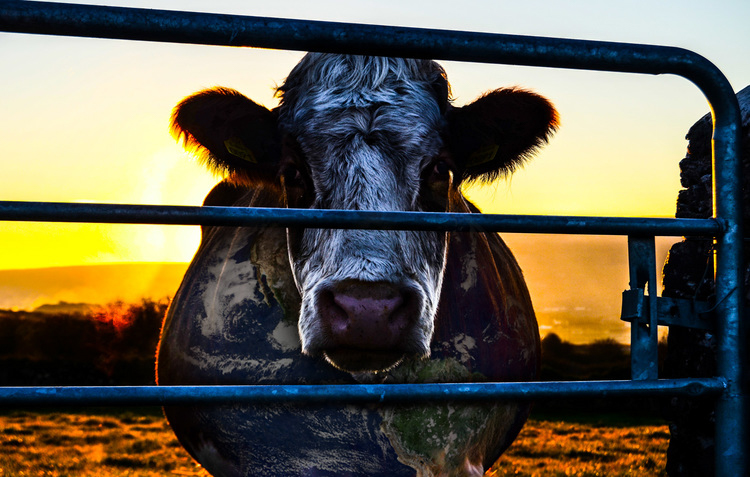
Vegetarianism will Save 7,3 Million Human Lives Until Year 2050 and That’s Not All!

1 Million human lives might be saved each year if people accept the vegetarian style of eating, shows a new study published by “Independent”

Cutting down on meat consumption worldwide would also protect the planet by cutting emissions by two thirds, and avoid over $1trillion in costs linked to climate change and healthcare, according to research published in by Oxford University.

Dr Marco Springmann, lead author of the study conducted at the Oxford Martin Programme on the Future of Food, highlighted that a person’s diet “greatly influences” their health and the global environment.

And that’s not all. If people adopt vegetarian diet the greenhouse gas emissions linked to food will drop up to incredible 63% the study shows.

This change in diet will also impact our pockets by increasing their thickness. Researchers found that changing how we currently eat would save between $700 to $1,000 billion each year in healthcare, unpaid informal care and lost working days worldwide.

“Imbalanced diets, such as diets low in fruits and vegetables, and high in red and processed meat, are responsible for the greatest health burden globally and in most regions,” Dr Springmann said.

“At the same time the food system is also responsible for more than a quarter of all greenhouse gas emissions, and therefore a major driver of climate change.”

Nicolas Hewitt, Distinguished Professor at Lancaster University Environment Centre, said that the study confirms what his research and that of others has already shown.

“Consumer choices around food have significant impacts on greenhouse gas emissions. Eliminating meat from the diet can reduce food-related greenhouse gas emissions by about 35 per cent and changing from carbon-intensive beef and lamb to less carbon-intensive pork and chicken can reduce food-related carbon emissions by about 18 per cent.

Overall, changing to a vegan diet can reduce food-related emissions by about a quarter, which in the UK represents about 40 Mt of carbon dioxide equivalent emissions every year. This is equivalent to about half of the total CO2 emissions from the entire UK passenger car fleet.

If society is serious about reducing greenhouse gas emissions, then we should be trying to make savings in every area of our day-to-day activities, including in our diet.”

Researchers found that leading a vegan lifestyle would save 8.1 million lives by 2050, while vegetarianism could save 7.3 million. And simply following the minimum global dietary guidelines could save 5.1million deaths.

A simple change in diet can fix more than 70% of the world’s problems. It’s time to stop blaming and start acting.


Source: http://www.independent.co.uk/;

Kids Giving Advice How to Talk to Someone You Really Like will Be The Best Thing You Watch Today!

Kids can be the greatest teachers. But, not too often do we give them a chance to share their wisdom with us.

Most of us are shy to approach people, even if we like them. Why are we shy, beats me. Maybe it has something to do with our ego.

And when it comes to dating, the approach can be one of the hardest things. If only we can somehow be thrown into the middle of the conversation we are sure that they’re gonna like us too. But unfortunately we can’t, we have to fight through this monster we call shyness.

So how do we do this? Why don’t we ask the greatest teachers out there:

Heart Points

Aliens Observed Us for a Couple of Years and They Conclude These 11 Facts about Humanity!

After couple of years observation, an intelligent race from a distant galaxy finally is done with the research for humanity.

11 Things we have noticed about humans:

1. When a human likes another human, they hold hands.

Humans will often walk, sit, or talk while holding hands. They hold hands with their mate, family, friends, and offspring. (Awwww.)

2. Humans love to eat sweet and soft concoctions made of sugar and cream. When it’s warm, they call it “pudding.” When it’s cold, they call it “ice cream.”

They love sugar and cream so much sometimes they whip it and put the “whipped cream” on top of their other cream-based sweets.

3. Humans love to “hug.” They embrace each other’s bodies and it actually produces good-feeling chemicals in them.

Humans will hug each other for many reasons — love, celebration, sadness, comfort, romance, and even just to say hello or goodbye! How cute is that?

4. Humans often “cuddle,” which is basically just a very long hug.

One of the positions of “cuddling” resembles the utensil they use to eat pudding, “spoons,” so they call it “spooning.”

5. Humans like interacting with each other so much, they created the internet so they could be in constant contact even with humans who live far away.

They also invented FaceTime so they could not only talk to each other at long distances but also look upon each other’s faces. Aw.

6. When humans hear “music,” they often can’t help but bop to the rhythm. They call this “dancing.”

They also “slow dance,” which involves holding each other and swaying.

7. When a human hears something they think is funny, an involuntary repetitive sound comes from them called “laughter.”

Sometimes, if something is not that funny, and even if they feel a little sad, they fake their smile just so they don’t ruin the atmosphere for fellow humans.

8. Humans like human life so much, they spend many hours a week watching other humans act out pretend scenarios of human life on TV, in movies, and onstage.

They create human “characters,” and people called “actors” pretend to do things as said characters. Humans become deeply attached to these characters.

9. Humans created soft pads covered in cozy fabrics to sleep in at night, which they call “beds.”

Much like hamsters (cute and furry animals living on Gaya), humans love soft materials such as cotton and wool. They snuggle into what they call “blankets” for comfort and warmth.

10. Humans love games. They have invented countless amount of games for them to play.

Many of them spend their whole lives working just so they can have free time to play, which explains they are not too bright. They also dig holes in their backyards and fill them with water to splash around in. Especially in the summer. They love observing the distance over great chunks of water, feeling a certain kind of nostalgia for some reason.

11. Even if it doesn’t always seem like it, the majority of humans just want to make the world a better place for other humans.

Research shows most humans are at least trying to do what they think will help everyone else. The news focuses on the bad eggs because they think it’s more engaging. But truth is, humans are innately good, and that just makes them even cuter!


CONCLUSION:

To conclude our research, humans are decent species, with good hearts. Sometimes they do bad things, and they hurt each other, but their deepest intent is always to make things better.

Sometimes they are weak in character, sometimes they are afraid, and this fear almost destroyed them a couple of times till now. But many times, especially times you least expect, they show to be courageous.

And after so much observation we still have no clue how and where do they find that incredible capacity to love, after so much bad that happened to their world.

Yes, they are flawed in many ways. But, taking in consideration they were left alone in this Universe to find their own way, they are doing the best they can. We need to cut them some slack, as they have a tendency to say.

We’ll stay hidden until further notice.

Report finished.

NOTE: Of course, this article is fiction.

Inspired by: http://www.buzzfeed.com/;

NEUROSCIENCE CONFIRMS: It’s Unbelievable How Much The Subconscious Shapes Our Reality!

Groundbreaking neuroscience confirms what Sigmund Freud first theorized: “what we believe to be the objective reality surrounding us is actually formed by our subconscious.”

David Eagleman, who wrote and filmed a 2015 PBS documentary on our “inner cosmos,” explains:

“Neuroscience has drifted off a little bit from the directions that Freud was going in terms of the interpretations of whether your unconscious mind is sending you particular hidden signals and so on.

But the idea that there’s this massive amount happening under the hood, that part was correct and so Freud really nailed that. And he lived before the blossoming of modern neuroscience, so he was able to do this just by outside observation and looking at how people acted.”

To go even deeper down the rabbit hole, David made numerous experiments on our perception of time. What he discovered is quite the breakthrough both, in our understanding of time and our perception of it.

So we come to a conclusion that our perception of time depends on how much energy our brain makes use of to create memories. Or, in other words, the speed of our time perception equals the density of our memories.

Our brain writes memories much densely when we are in a life threatening situation. This is probably a self defensive mechanism of our bodies to get as much details as we can about the dangerous situation, so we can make the best choice and get out alive.

Retrospectively, when we look at that particular situation we have much more details than any other memory of a similar time frame. So, because we have so much details, it seems that the moment lasted for a very long time, that’s the only interpretation our brain can make.

As David Eagleman says, “Time, your assessment of how long something took, has a lot to do with how much energy your brain has to burn during the event and how much footage you have of the event.”

Surprisingly, our subconscious plays even a bigger role in the way we perceive reality than we already gave it credit for. It determines what kind of details we perceive, what they mean, what options are available… It even determines the way we perceive time.

Our subconscious shapes and colors our reality. Therefore, if you want to fix something about your life, in all probability your answer hides somewhere inside your Inner Cosmos.

The Promo for David’s Groundbreaking Documentary “The Brain”

Inspired by: http://bigthink.com/;

The Cure for Anxiety No One Talks About! (And It’s So Freaking Simple You’ll Start to Laugh!)

Have you ever had a panic attack? I did a couple of months ago. Several of them. It’s scary, you think that you are having a heart attack, you are unable to hold yourself together, your mind is screaming and a wave of emotions goes through you.

And it’s all because of anxiety. It’s a result of living a long time with anxiety. A life where you are not true to yourself, to what you want and how you want to live.

You are desperately trying to swallow these emotions and act as everything is alright because you are scared of other people judging you. And this continuous process amplifies the anxiety like putting more and more branches to the fire.

The thing with anxiety is that you are always scared. You are always focused on controlling the chaos inside you and this takes A LOT of your energy. You act like your old self but inside you are extremely fragile, like an unstable dynamite.

And when the excessive waste of energy becomes too much, when you waste your reserves that keep all that turmoil at bay, your conscious mind is over flooded with emotions that cannot be comprehended and you start having a panic attack.

“I went to doctors, I exercised, I meditated, I did yoga, I deep breathing exercises, I took supplements, I went to chiropractors, naturopaths, spiritual healers, I cleaned up my diet, I went on long runs, I prayed, I volunteered, I did a fast for nine days where I had nothing but water, I did psychedelic drugs – everything you can think of! I even took a six week course online specifically designed for men struggling with anxiety. And at the end of all of this experimentation, nothing worked. Things would work for a day or 2 but then I would go right back into feeling miserable.” – says Charlie Hoehn explaining his struggle with panic attacks and anxiety.

What helped him is nothing you would normally think of. I must admit that watching this video truly helped me too. I started laughing because the solution is actually so freaking simple, and it’s always staring us in the eyes…

The Ancient Hopi Message about Water: (According to Their Prophecy, We are Ready!)

“Water sustains all life. Her songs begin in the tiniest of raindrops, transform to flowing rivers, travel to majestic oceans and thundering clouds and back to earth again. When water is threatened, all living things are threatened.” – Indigenous Declaration on Water, 2001

Hopi are one of the oldest remaining ancient cultures in North America, known by many as Tibet of the West.

The Hopi have kept their ancient instructions from Creator, they hold a great wisdom and connection with nature.

They are innovators who grow many things in the Arizona desert and experts in ritual to call forth rain to water their crops.

Their connection to water is very sacred and intimate.  So it is no surprise that in early 2006 Japanese scientist, Masaru Emoto visited the Hopi Mesas in Northern Arizona to make a presentation about his work.

“The aquifers breathe in rain and snow and breathe it out. The springs are the breathing holes. Humankind is a participant in water-life. Mankind’s thoughts influence whether the rain and snow comes.” – Hopi Elder Vernon Masayesva

Recent studies have shown that water, in fact, has a memory of itself. This may actually be The Discovery of The Millennium.

In other words, your tears hold a memory of your whole being, bodies of water are stored information of what each drop in there went through, and rain is just a transfer of information. That’s how we are globally always connected. – Read more

“You see that sun rising? Sing songs to it, make your prayers, be present and give thanks. If you do that every day you will be alive, you will have lived life and it won’t matter if the world ends tomorrow or what the prophecies have said because you will have lived today.” – Morgan Saufkie, Hopi Elder

With the world waters in gourds, the Hopi began a historic run from Northern Arizona to Mexico City. Running is a traditional form of prayer for Hopi, who believe that the pounding of their feet on the ground sends prayers into the heart of Mother Earth.

Mexico City was hosting the World Water Forum, but it was being sponsored by corporations that aimed to profit off of the privatization and sale of bottled water.

Hopi planned to bring a different message of indigenous people from all over the world. It is a simple message, that Water is Life.

Their message was a warning that profiteering from water while many don’t even have access to clean water for drinking or hygiene will not be accepted. This message would be delivered in a beautiful way, with respect in a sacred manner and from representatives of the most ancient people on the planet.

“When the Eagle returns from the north and dances at The Pyramid of the Sun, the world will be ready for the medicine of healing that we have kept alive for centuries.” – Local Prophecy

Beneath an ancient megalith of Tlaloc, The Aztec God of rain and water that has been moved to the centre of Mexico City from its original home at The Pyramid of The Sun, the tribes gathered in ceremony and prayer.

On that day, The Hopi were invited to bring Eagle Dancers to the foot of The Pyramid of The Sun on Spring Equinox to fulfill a 500 year prophecy from the time of Montezuma.

On Spring Equinox of 2006, the people of central America welcomed the ceremonial and symbolic return of The Eagle signifying the beginning of a great time of change, healing, purification, and ultimately peace for the whole world.

The Maya are known as The Keepers of The Ancient Flame, The Lords of Time (also known to Ancient Celts as The Vanir). This milestone also represented an aspect of healing of the 500 year-old wound since the arrival of Columbus, a time when native people would no longer need to hide their ancient knowledge from the world.

Thus heralding a time when the world is ready to listen to the ancient wisdom of the original people of this land is upon us. That time is now.

The video above was directed by tribal elders and shot by youth media-creators.

Evolution is not a spectator sport. Get involved and participate, spread the word through your own social networks. Some stories are told, others are meant to be lived.
Global PointsJoin us for a global campaign to heal the waters of the world at Bless the Water.


Inspired by: http://upliftconnect.com/;

Thumbnail Image by: http://upliftconnect.com/wp-content/uploads/2016/03/hopi-water-featureE-400×211.jpg;

Neuroscience Backs Up The Buddhist Belief that “The Self” Isn’t Constant, but EVER-CHANGING!

If somebody asked “Who are you?” you’d probably start describing yourself as someone with certain qualities and flaws, you’d try to define yourself and your character as someone who was and always will be you.

But do you know that the person you take yourself to be now, is a COMPLETELY different character than the one you were at, let’s say eleven. And if 7 or more years have passed since you were eleven, you two have nothing in common. Not even your body molecules are the same.

In all probability, the only thing that stayed the same is the awareness that goes beyond the self. The observer.

“Buddhists argue that nothing is constant, everything changes through time, you have a constantly changing stream of consciousness,” – Evan Thompson, a philosophy of mind professor at the University of British Columbia, tells Quartz.

“And from a neuroscience perspective, the brain and body is constantly in flux. There’s nothing that corresponds to the sense that there’s an unchanging self.”

One neuroscience paper, published in Trends in Cognitive Sciences in July, links the Buddhist belief that our self is ever-changing to physical areas of the brain.

There’s scientific evidence that “self-processing in the brain is not instantiated in a particular region or network, but rather extends to a broad range of fluctuating neural processes that do not appear to be self specific,” write the authors of the paper.

“The standard neuroscience view is that deep sleep is a blackout state where consciousness disappears,” Thompson says.

“In Indian philosophy we see some theorists argue that there’s a subtle awareness that continues to be present in dreamless sleep, there’s just a lack of ability to consolidate that in a moment-to-moment way in memory.”

A study published in 2013 found that meditation can affect electro-physical brain patterns during sleep, and the findings suggest there could be capacity to “process information and maintain some level of awareness, even during a state when usually these cognitive functions are greatly impaired,” according to the researchers.

Buddhists believe that there’s some form of consciousness that’s not dependent on the physical body, while neuroscientists (and Thompson), disagree.

But Thompson supports the Buddhists’ view that the self does in fact exist.

“In neuroscience, you’ll often come across people who say the self is an illusion created by the brain. My view is that the brain and the body work together in the context of our physical environment to create a sense of self. And it’s misguided to say that just because it’s a construction, it’s an illusion.” says Thompson.

But what if both views are correct? What if there is a certain consciousness which is not dependant on the body and our body is a receiver for it. Take for example vision, there is certainly some form of consciousness in living things outside of us and we perceive it in many forms, in which one is vision. We receive this translated consciousness through our eyes.

This consciousness, in whatever way we perceive it, slightly affects our brain and reshapes our neural activity. But in any case, you are the one who tunes to whatever you want to receive.

So maybe, the spirit you choose to embody through any given moment in life shapes the neural activity in your brain and a certain kind of self
is produced.

Mind PointsThe self itself is just an illusion, an ever-changing illusion, but you are the magician that decides what kind of illusion you’ll make.


Source: http://qz.com/;

Thumbnail from: http://www.sbs.com.au/news/sites/sbs.com.au.news/files/20150920001179430563-original.jpg;

THIS Eye-Opening Video of The World Shrunken to a 100 People Society will Make You Grateful!

There are approximately 7.4 Billion people on planet Earth. That’s a big number to grasp and put in perspective. I mean a lot of us find hard to imagine 50 different faces and characters, and we are speaking of 7 Billion here. Impossible, right?

But it’s crucial to understand how the world functions so we can have a clear picture of reality.

For this we need to shrink the population of the world to 100 people keeping the same structure we have today and whala… we have a nice and clear picture of reality we can imagine and fully comprehend.

100-Population-World Facts:

–  The sex is balanced, 50 would be female and 50 would be male;
–  There would be 74 adults, 8 of whom would be an age of 65 and older, and 26 would be children;
–  There would be 60 Asians, 15 Africans, 14 people from the Americas, and 11 Europeans;
–  31 would be Christians, 23 would be Muslims, 15 Hindus, 7 Buddhists, and 12 people who practice other religions, the rest 12 people would not be aligned with a religion;
–  12 would speak Mandarin, 6 would speak Spanish, 5 English, 4 Hindi, 3 Arabic, and the rest 70 would speak 6,500 other languages;
–  86 would be able to read and write, 14 people would not;
–  15 people would make 2$ per day, 56 would make between 2-10$ per day, 13 between 10-20$ per day, 9 between 20-50$ per day, 6 between 50-90$ per day, and 1 person makes more than 90$ per day;
–  1 person controls 50% of all the money in the world;
–  There would be 21 overweight people, 63 healthy, 15 malnourished, and 1 person starving for food;
–  87 people would have clean water and 13 people would not;
–  77 people would have shelter and 23 people would not;
–  44 people would have internet and 56 people would not;
–  75 people would have mobile and 25 people would not;
–  7 people would attend college and 93 people would not;

Global PointsBE GRATEFUL FOR WHAT YOU HAVE – You have more than you think! GIVE TO OTHERS WHAT YOU DON’T NEED – It may be the only thing they need! SHARE WITH OTHERS WHAT YOU HAVE MORE THAN NECESSARY – Make a better world!