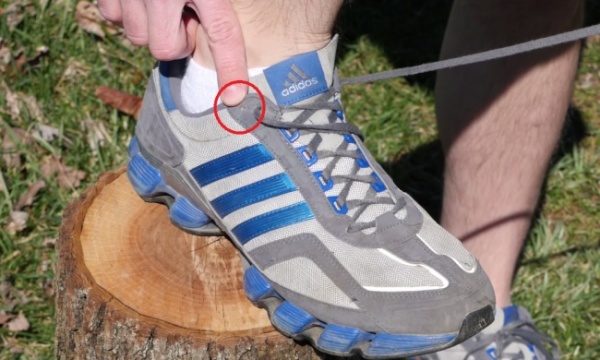
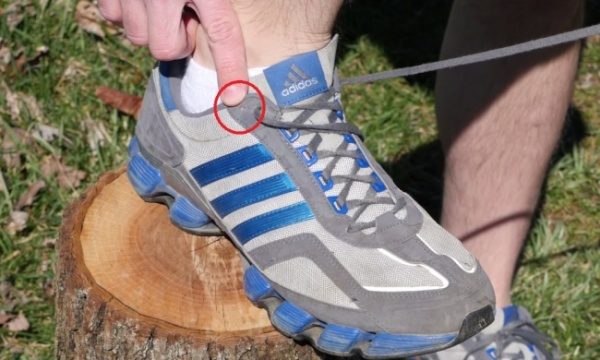
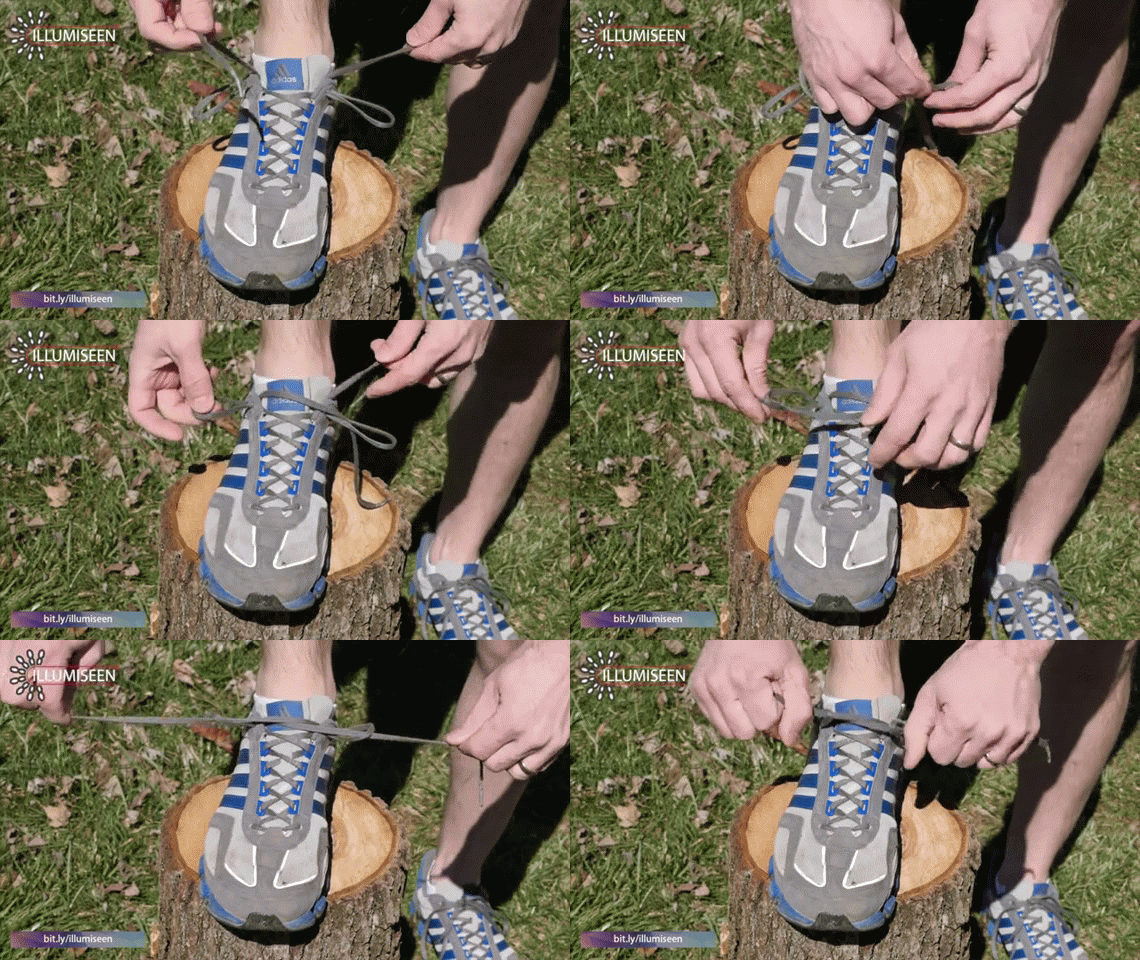
You’ve probably noticed that there are two small eyelets at the top of your running shoes.
Maybe you’ve wondered what purpose they’re meant to serve. Well, now we can tell you the answer — and it turns out they’re actually really useful!
These eyelets are a seriously clever invention…
…which will make doing sport a lot easier…
As an active runner this came as a bit of a shock. You do something for so long and you never realized that you can do it so much better.
And all because of this simple and easy trick.
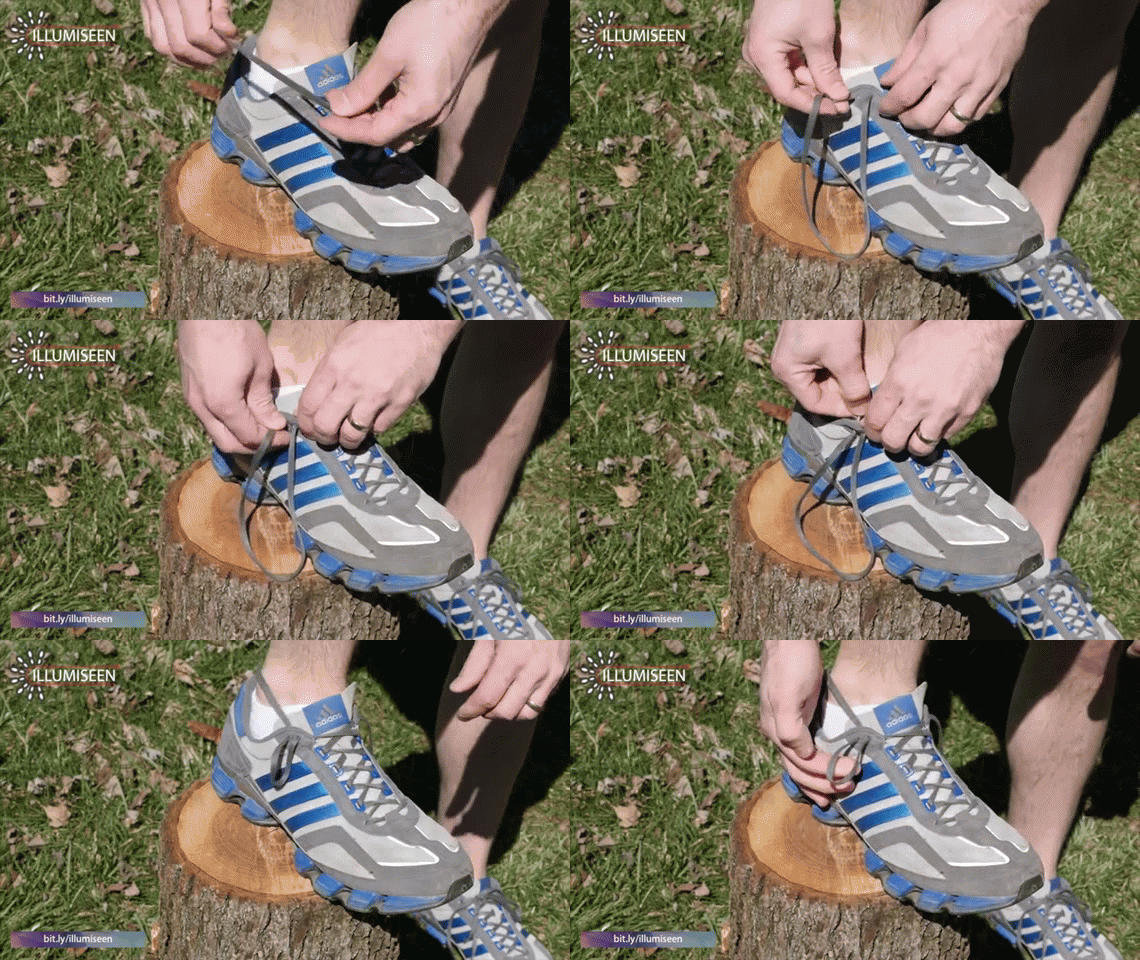
Basically, these holes are an additional way to ensure your shoelaces stay tied together.
If you use them correctly, your shoes will never slip off or rub your feet. Your performance will peak and exercising will become a much more comfortable experience:
Sometimes psychology is not that invisible structure behind your consciousness, sometimes how parts of your body are arranged and developed is a result of your inner forces that drive your character.
There are some theories claiming that your fingers can say a lot about your personality. In fact, some believe that your little finger can reveal a lot about your character and unique personality.
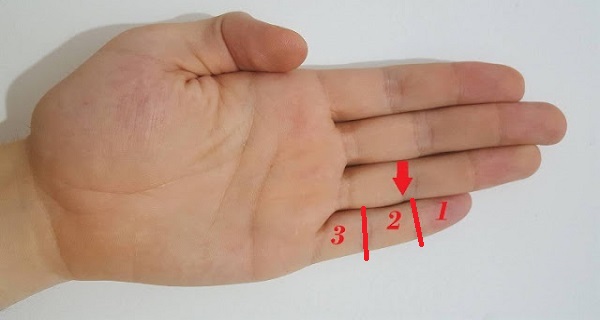
This is what the length of these sections reveal about you:
The Longest Section is Number 1
If this section of your little finger is longer, it means that you are attractive and have great language skills. Your observation skills are remarkable too.
The Longest Section is Number 2
People with the longest section II have an inherent need to help and care of others. They can also be quite determined too. Health professionals and doctors often belong to this group.
The Longest Section is Number 3
People with this type of small finger section are honest and always tell the truth. They have good verbal and social skills too.
The Shortest Section is Number 1
People belonging to this group are not very popular among people. They are often nervous and weak.
The Shortest Section is Number 2
If the central part of your little finger is shorter, it means that you’re stubborn and a bit lazy. You also don’t like changes.
The Shortest Section is Number 3
If the lower section of your little finger is shorter, you are innocent and trusting. Always have this in mind as people can easily manipulate you.
They say that the secret lies in the place you never think of looking for. They say that everything we always wanted hides behind our greatest fears, the treasures we seek are inside the cave we fear to enter. They say by becoming nothing you become everything.
They are pretty smart, don’t they… However, rare are the ones who truly understand what these pearls of wisdom really mean.
What are we most afraid of? Nothingness. But could it be, that in the midst of nothingness our greatest treasures can be found?
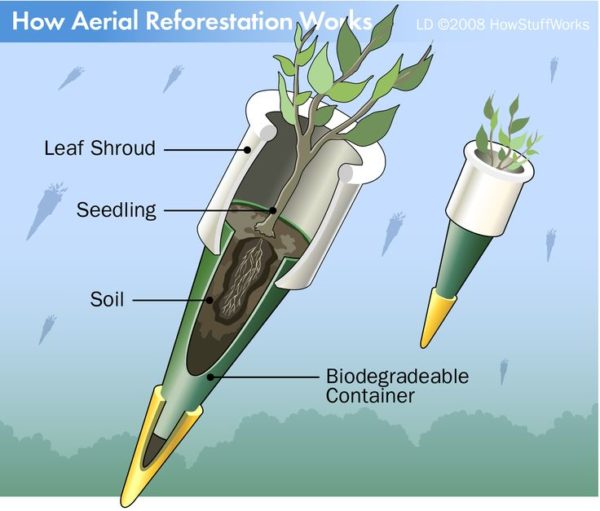
Can Nature win the war on climate change? Maybe with a little help from humanity. Old military planes are now being reconditioned and refitted with new mechanics. Using these planes, we can drop tree bombs instead of landmines.
The program uses some of that fastest growing trees in the world, which grow over 10 feet per year. These trees can fully counter the negative effects of de-forestation within a few years.
“The current proposal retrofits unused C-130 Hercules cargo planes to drop cones of seeds. The cones “bury themselves in the soil of a deforested area at the same distance that one would want them to be if planting the trees by hand. The tree bombs don’t explode on impact but rather their casing dissolves over time and they contain a measure of fertilizer and enough moisture to ensure that the tree takes root.”
Thailand already plans to use this program as one of the greatest “weapons” against deforestation:
Elizabeth Parris, the CEO of “Bioviva” USA Inc, has become the very first human being to successfully, from a biological standpoint, reverse the age of her white blood cells, thanks to her own company’s experimental therapies.
“Bioviva” utilizes intramural and extramural peer-reviewed research to create therapies for age-related diseases (Parkinson’s, Alzheimer’s, cancer, heart-disease), and now, they have reversed 20 years of ‘telomere shortening’ in a human for the first time.
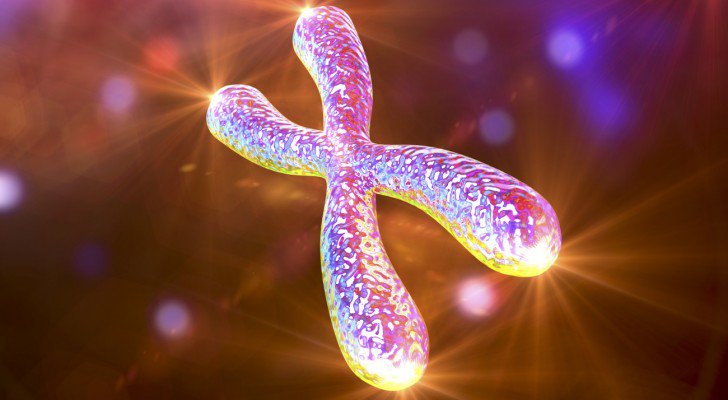
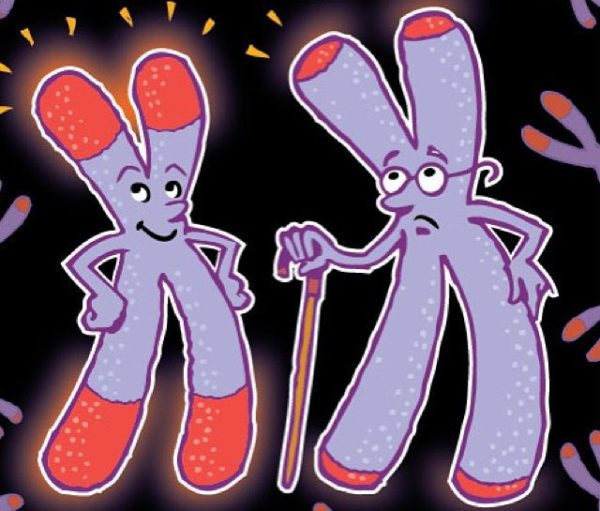
Telomeres are short segments of DNA that cap the ends of every chromosome and act as a protective feature against wear and tear, which occurs naturally as the human body ages. As we age, these telomeres become shorter and shorter as our cells continue to divide more and more. Eventually they become too short to protect the chromosome, which is what causes our cells to malfunction and age related diseases to start setting in. And that’s what we call aging.
In September of last year, the 44 year old volunteered to partake in two of her own company’s experimental gene therapies; one intended to battle stem cell depletion, which happens when we age and leads to various age related diseases, and the other intended to protect against loss of muscle mass with age.
After the gene therapy was completed on Parrish, the company’s website revealed the astonishing results of the experiment:
“In March 2016, the same tests were taken again by SpectraCell revealed that her telomeres had lengthened by approximately 20 years, from 6.71kb to 7.33kb. This implies that Parrish’s white blood cells (leukocytes) have become biologically younger. These findings were independently verified by the Brussels-based non-profit HEALES (HEalthy Life Extension Company), and the Biogerontology Research Foundation, a UK-based charity committed to combating age-related diseases.”
After learning of the experiment’s success, Parrish remarked that “if these results are anywhere near accurate, we’ve made history.”
The company will continue to monitor her blood in the months and years to come, and will be testing new gene therapies to restore age related damage.
Researchers still need to determine if the success seen in leukocytes can be extended to other organs and tissues, as well as repeated in other patients. For now, this is the first and only instance of such therapy being used (and successful) on a human, and was intended to prove the safety of this technique.
Long term scientific scrutiny is still necessary to say for certain whether this is a safe and viable procedure, but what’s happened so far is almost unbelievable.
It’s a very promising discovery, and one that has already attracted attention from various investment and scientific communities. One example is Deep Knowledge Life Sciences (DKLS), a UK investment fund company which has already made BioViva a portfolio company of theirs.
According to Parish, “the best-case scenario would be that we added 20 years of health onto the leukocytes, and the immune system might be more productive and catch more of the bad guys. But we have to wait and find out. The proof will be in the data,” she said.
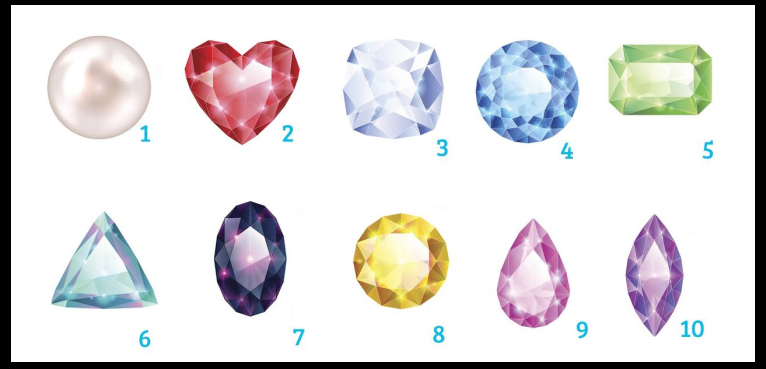
If you were drawn to the pearl, you’re dignified and prideful. You’re wise, charitable, and often pure. You’re calm, kind, and think before you speak. The pearl also indicates that you may be nearing a moment of transformation.
2. Ruby:
If you were drawn to the ruby, you’re often passionate, intense, and lively. You always make waves and know how to make someone’s blood boil. You’re full of energy and if you’re fighting against something, the other side will rue the day.
3. Diamond:
If you stopped at the diamond, you’re strong, determined and proud. You give strength to the people around you. Diamond itself means “unbreakable” and “untamed.” You are fearless and bold. New adventures may be headed your way.
4. Blue topaz:
People drawn to blue topaz are calm and collected, often reflective and enjoying in the quiet moments in life. You have strong, soothing energy and your communication skills are impeccable. Those skills will come in handy in your life.
5. Peridot:
If you chose the peridot, you’re curious by nature and tend to radiate joy. The peridot is somewhat mysterious and rare. They’re found buried underground or in meteorites whipping through space.
6. Aquamarine:
If you chose aquamarine, you’re likely drawn to the ocean and compassionate. Your debates are spirited and your adventures, well, extra adventurous. You may also be drawn to the moon. If you’ve been bored lately, you’re likely to attract something new and fun.
7. Tanzanite:
If you were attracted to tanzanite, you’re sensuous, sharp, and passionate. You have a strong aura that people love to be near. This stone is often used in psychic explorations and is strongly connected to the other side. If you were drawn to it, remember that you need to trust your instincts. They’re not often wrong.
8. Citrine:
If you were drawn to citrine, you’re bubbly, creative, and fairly zesty. You may also be warm and kind. Citrine represents zing and freshness. People drawn to this stone likely value teamwork. If you chose citrine, you’re the kind of person who shines through dark clouds.
9. Pink tourmaline:
People drawn to pink tourmaline are soft, sensitive, and compassionate. They tend to be sincere and are refreshing to be around. That’s not to suggest you’re a pushover, however. Scientists found that an electric charge was emitted from the stone when rubbed or heated. You can get pretty electric when heated or rubbed the wrong way yourself.
10. Amethyst:
You’re the vibrant, brainy one if you were drawn to amethyst. You exude strength and honor in everything in your life. Nothing stands in your way. You make an excellent parent figure, but don’t forget to have fun sometimes.
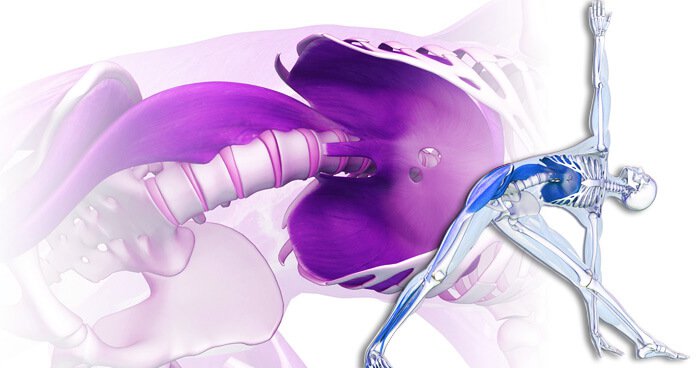
The psoas major muscle (pronounced “so-as”) is often referred to as the deepest core, or as yoga therapist and film-maker Danielle Olson states, the “muscle of the soul.” This core-stabilizing muscle located near the hip bone affects mobility, structural balance, joint function, flexibility, and much more. In addition to its function to help keep the body upright and moving, the psoas is believed to allow you to connect with the present moment especially when it is stretched out and tension is released from the body.
Research indicates that the psoas is vital to our psychological wellbeing, connecting fear and anxiety, in addition to structural health.
Liz Koch, author of The Psoas Book, states that our psoas “literally embodies our deepest urge for survival, and more profoundly, our elemental desire to flourish.” This means that there is a lot more to the psoas than one might initially think. It is entirely possible to harness healing pranic energy and improve mental health by keeping the psoas healthy.
WHERE IS THE PSOAS?
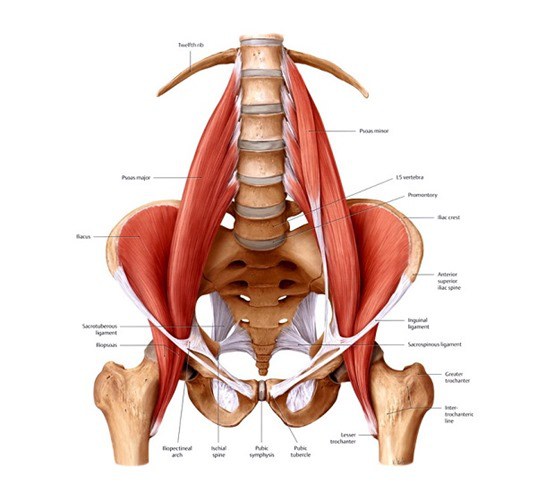
The psoas is the principal muscle associated with physical stability. It stretches from the legs to the spine and is the only muscle connecting the legs to the spinal column. The muscle flares out from the T12 vertebrae, follows down the five lumbar vertebrae, before attaching to the top of the thigh bone.
THE REPTILIAN CONNECTION
In addition to connecting the legs and spine, the psoas is connected to the diaphragm. Breathing is modulated at the diaphragm, and it is also the location where many physical symptoms associated with fear and anxiety manifest. Koch believes that this is due to the direct link between the psoas and the most ancient part of our brain stem and spinal cord, called the reptilian brain.
According to Koch, “Long before the spoken word or the organizing capacity of the cortex developed, the reptilian brain, known for its survival instincts, maintained our essential core functioning.” The way we live today, constantly rushing, competing and achieving, has the psoas in a constant “fight or flight” state.
ISSUES ASSOCIATED WITH CHRONIC PSOAS STRESS
Trapped in a constant “flight or fight” state, psoas muscles are stressed and constricted, almost from the time of birth. As Koch notes, “this situation is exacerbated by many things in our modern lifestyle, from car seats to constrictive clothing, from chairs to shoes that distort our posture, curtail our natural movements and further constrict our psoas.” This lifelong chronic stress put on the psoas can lead to many problems like back, hip, or knee pain, and even digestive issues and dysfunctional breathing. It could also be a major cause why people suffer from chronic physical pain.
The physical body is not the only part of you that suffers from a chronically-stressed psoas. The psoas is much more than a muscle used for structural stability. It influences every element of life, from how you feel, to how you look at the world, and even how you treat others. A variety of problems have been associated with a chronically-stressed psoas muscle: it can negatively affect your emotional state; it can impact your interpersonal relationships; and it can influence your general contentment with life. Awareness that a healthy psoas is important to emotional wellness, as well as physical health, is the first step towards ensuring that we give this muscle the attention it deserves.
Koch states, “Whether you suffer from sore back or anxiety, from knee strain or exhaustion, there’s a good chance that a constricted psoas might be contributing to your woes.”
FEAR AND THE PSOAS
Since the psoas is closely linked to our “fight or flight” mechanism, fear can be over-represented in those with a constricted psoas. It is an emotion that manifests itself in the most unusual ways and can “lock” itself into the body resulting in both physical and emotional tension. By restoring balance to your psoas muscles, you are likely to release this pent up tension, which can have a profound effect on releasing unfounded fearfulness about life, and thus improve both your physical and mental wellbeing. You will feel a greater sense of inner peace, along with fewer muscle aches and strains.
THE CONNECTION TO THE ENERGETIC BODY
Lengthening and releasing your psoas grounds you to the Earth, which is filled with healing and revitalizing energy, thus allowing you to balance your pranic energy and enabling you to feel more present in the moment. Proper structural stability attributed to a healthy psoas allows prana to flow, unimpeded, throughout the body, allowing for proper distribution of vital energy. In the physical sense, when the body can properly support itself, movement is less-restricted and requires less effort, thus leaving you more energetic.
ANCIENT WISDOM FOR MODERN TIMES
Our understanding of the psoas is by no means new knowledge. In fact, it is more akin to ancient wisdom that was either lost or discarded over time. Yoga shows us explicitly that ancient gurus understood the importance of releasing contracted psoas muscles. Ancient yoga asanas, or postures, that are now practiced all around the world, focus on lengthening and releasing psoas muscles and restoring comfort and balance to the entire body. With consistent practice, you can learn how to isolate this muscle, which can be immensely useful and healing in the long run.
Yoga is also a great way to measure the current health of the psoas. There are many postures, such as tree (Vrksasana), which cannot be properly achieved if the psoas is contracted. If you are practicing a sitting or standing yoga pose and feel strain in either your knees or lower back (or both), then there’s a good chance that your psoas is constricted and needs more of your attention.
The psoas is an important, yet often unknown, muscle that plays a vital role in physical health and mental well-being. The cumulative effect of neglecting this muscle is physical and mental stress and tension, which manifests itself in our society as anxiety, depression, chronic back pain, knee pain, digestive distress, respiratory problems, etc.