Find Life Coach | Meet David Jennison: How to Transform Your Life with Empathy and Innovation?

David Jennison is one of the coaches that we found this month and we did a little interview with him. He impressed us with his vast toolbox, expertise and innovativeness.

He is a psychotherapist and life coach whose journey into the world of coaching was fueled by an insatiable curiosity about the human mind and a deep seated desire to facilitate personal growth. He spent years honing a unique approach that blends cognitive, emotional, somatic, and visual imagery techniques, offering clients a holistic path to healing and self discovery.

He has navigated his own personal challenges, including the complexities of neurodivergence and the demands of raising a neurodivergent child. These challenges profoundly shaped his approach to therapy and coaching. These experiences, coupled with overcoming anxiety, depression, and PTSD, particularly from a harrowing experience as a pilot, have imbued him with a compassionate and empathetic perspective. This journey has enabled him to provide genuine support and effective strategies to manage fear based distortions and an overactive mind.

His coaching style is unique. Innovation is at the heart of it. By seamlessly integrating evidence based therapeutic techniques with experiential interventions, he offers a personalized and comprehensive approach to each client. Whether it’s through cognitive behavioral strategies, mindfulness practices, or somatic experiencing, he ensures that clients receive tailored support that addresses their unique needs. Here is what he said.

Meet Life Coach David Jennison:

find-life-coach-david-jennison

Name: David Jennison

Pillar: The Spirit, The Mind, The Body, The Heart

Who is this coach for: Anyone who wants to transform holistically, attain greater emotional and mental wellbeing, heal their body, improve their nutrition, reshape their belief system and become the best version of themselves.

How they can help: By using various tools and techniques like EFT, Internal Family Systems, exposure therapies, yoga, exercise, sensorimotor psychotherapy, art therapy, and positive psychology, just to name a few.

First of all, how are you and your family doing after these Pandemic times?

Thank you for asking, Dejan.

My family and I are doing well after the challenging pandemic years.

Like many, we faced our share of difficulties, but we also found strength and unexpected gifts.

The pandemic brought us closer together, offering new opportunities for acceptance, forgiveness, and improved communication.

My son, Peter, who is neurodivergent, experienced the challenges of homeschooling and isolation with just my wife Roselyn and me.

Through these times, we discovered the importance of core family bonds and learned to support each other better, finding joy and strength in our togetherness.

How did the coronavirus pandemic affect your clients? Did it affect you at all?

The coronavirus pandemic significantly affected my clients, many of whom experienced heightened anxiety, depression, and isolation.

People with a low tolerance for uncertainty were particularly impacted.

I guided them through embracing uncertainty and finding stability in practical wisdom.

Personally, the pandemic challenged me to find new ways to engage with clients and maintain a sense of community despite physical distance.

It was a time of rapid change and growth for both my clients and myself.

By embracing practical wisdom from ancient philosophies, such as focusing on what we can control and accepting change, we navigated the mental strains of the pandemic more effectively.

For instance, encouraging clients to shift their focus from uncertainties to actionable steps helped them build resilience and adaptability during these challenging times.

What are the biggest lessons that you learned in this pandemic?

The pandemic taught me the importance of flexibility, resilience, and the power of human connection.

It underscored the necessity of self care and the value of virtual support networks.

I learned that even in the face of unprecedented challenges, we can find strength in our communities and adapt to new ways of living and working.

Reducing anxiety through thought challenging and distraction activities became important tools.

By shifting our focus and embracing practical wisdom learned from stoic and Buddhist philosophies, we can better manage uncertainty and maintain mental well being.

The Origin:

Tell us about you, your career, how you started with your coaching career?

I am a psychotherapist and life coach based in Manitoba, Canada, with a private practice that focuses on helping individuals navigate their mental health challenges.

My journey into coaching began with a passion for understanding the human mind and a desire to support others in their personal growth.

Over the years, I’ve developed a unique approach that integrates cognitive, emotional, somatic, and visual imagery techniques to help clients achieve their goals.

My work has been shaped by both my professional experiences and personal challenges, especially working with individuals who have significant trauma backgrounds.

I strive to make complex psychological concepts accessible and provide practical tools for health and wellness, focusing on healing from emotional trauma and socially related developmental imprints.

What was your biggest obstacle that you had to overcome in your life that made you who you are today?

One of the biggest obstacles I faced was navigating my own neurodivergence while supporting my son, who is also neurodivergent.

Growing up in the 70s and 80s, resources and supports for being on the ADHD spectrum were scarce, making schoolwork and social life challenging.

This led to anxiety, depression, and eventually PTSD from a harrowing experience as a pilot.

Balancing these personal challenges during the pandemic, especially with a young child with ADHD, was incredibly demanding.

These experiences have profoundly shaped my approach to therapy and coaching, allowing me to offer genuine, compassionate support and effective strategies for managing fear based distortions and an overactive mind.

The Coaching Style:

How do you innovate with coaching your clients?

Innovation in coaching comes from a willingness to adapt and explore new methodologies.

I combine evidence based therapeutic techniques with experiential interventions to create a holistic approach.

For example, when a client presents with anxiety rooted in past trauma, I might use a combination of cognitive behavioral strategies, mindfulness practices, and somatic experiencing tailored to their unique personality and strengths.

This personalized approach helps clients connect with their emotions and develop practical tools for everyday life.

By addressing cognitive stuck points and fear based memories, I ensure that each client receives the support they need to thrive, using core psychological principles adapted to individual needs.

What’s unique about your coaching approach?

What sets my coaching approach apart is its integration of cognitive, emotional, somatic, and visual imagery techniques.

By addressing the whole person, mind, body, and spirit, I help clients develop a deeper understanding of themselves and build sustainable strategies for growth.

My approach involves working with fear based distortions that need to be uprooted, understood, and emotionally processed.

Combining various systems, such as Internal Family Systems work with mind and body techniques, allows clients to reintegrate dissociated or suppressed parts of themselves, fostering healing and balance.

What benefits do your clients get after working with you?

Clients who work with me often experience increased self awareness, improved emotional regulation, and a greater sense of empowerment.

They develop practical tools to manage stress and anxiety, enhance their relationships, and achieve their personal and professional goals.

Working with both top down (i.e. Cognitive Behavioural Therapy) and bottom up (i.e. Sensorimotor Psychotherapy) therapeutic techniques, clients achieve a more complete form of healing, freeing their bodies from energetic blockages and allowing natural healing wisdom to emerge.

Do you use any specific tools to be efficient with your clients?

I use a variety of tools to enhance my work with clients, including mindfulness apps, journaling exercises, and visual imagery techniques.

Additionally, I incorporate EFT, Internal Family Systems or IFS, exposure therapies, faith based beliefs, somatic tools (such as yoga, exercise, gardening, and sensorimotor psychotherapy), medications and naturopathic supplements, art therapy, diet related strategies (i.e. Mediterranean diet), positive psychology, and neurology related tools (i.e. biofeedback) for mental health.

These diverse tools help clients stay engaged and provide practical resources for their personal growth.

The Impact:

If you had a super megaphone that, when you speak into, the whole world will hear your message, what would you say?

If I could share one message with the world, it would be this:

Embrace your uniqueness and understand that your differences are your strengths.

Seek connection, practice self compassion, and never underestimate the power of your inner voice.

Together, we can create a world where everyone feels seen, heard, and valued.

Each person’s story and voice matter, and by supporting one another, we can achieve remarkable growth and healing.

What is the greatest lesson you have learned in your life?

The greatest lesson I’ve learned is the importance of empathy and understanding.

Compassion can transform relationships and foster healing.

In both personal and professional life, expressing true thoughts and feelings with trusted individuals, balancing care for others with self care, and finding ways to live out personal values are crucial.

This approach helps overcome social fears and reinforces the belief that everyone has a voice worth hearing and a unique contribution to make.

Your final thoughts?

As we continue to navigate the complexities of life, it’s essential to remain open to growth and change.

Every challenge is an opportunity to learn and evolve.

My goal as a coach is to support clients on this journey, helping them uncover their strengths and achieve their fullest potential.

By embracing a holistic approach and fostering compassionate connections, together we can create a brighter, more compassionate world.

Where Can You Find David Jennison?

If you liked this interview and if you would love to transform your whole being, contact coach David on Psychology Today and see how he can help you do that.

If you’d like to peak a glimpse into his coaching, check his profile on X.

And if you’d like to connect more personally with him, you can do that through LinkedIn and by sending him a direct message. It was an honor having this interview with him.

Find Life Coach | Meet Stacy Phoenix: How to Become Your Truest and Most Authentic Self?

Stacy Phoenix is one of the coaches that we found this month and we did a little interview with her. She impressed us with her expertise and passion.

She is an avid reader, workout enthusiast, and single mom whose path to coaching was inspired by a spiritual healer training. With a cup of tea in hand and a passport ready for the next adventure, she embarked on a mission to empower others after realizing her potential through her teacher’s encouragement.

Her personal transformation was all about facing the shadows within herself, confronting and embracing the aspects she once found difficult to acknowledge. This deep shadow work not only fostered a profound sense of self love but also honed her abilities as a coach, making her an empathetic and insightful guide for her clients. Her innovative approach integrates identity shifting techniques and higher self channeling, setting her apart in the coaching landscape.

She is focused on helping her clients become their truest most authentic selves. Clients who work with her often find themselves quitting unfulfilling day jobs, gaining confidence, and rapidly healing from past traumas. Utilizing tools like the Original Time Line Therapy, Chakra Therapy, and divine spiritual healing, she helps clients remove emotional blockages and align with their most authentic selves. Her unique method of tapping into clients’ higher selves to receive telepathic messages ensures a tailored and transformative journey towards alignment, healing, and success. Here is what she said.

Meet Life Coach Stacy Phoenix:

find-life-coach-stacy-phoenix

Name: Stacy Phoenix

Pillar: The Spirit, The Heart

Who is this coach for: Anyone who wants to become their true and most authentic self.

How they can help: By using various tools and techniques like the Original Time Line Therapy, identity shifting techniques, and divine spiritual healing, just to name a few.

First of all, how are you and your family doing after these Pandemic times?

We are doing very well and we feel very grateful and blessed to be doing so.

How did the coronavirus pandemic affect your clients? Did it affect you at all?

It affected my clients in an emotional and mindset level where they found it difficult to be in quarantine and adjust to that different way of living.

It affected me the same way, just like most of us.

What are the biggest lessons that you learned in this pandemic?

The biggest lesson I learnt was not to take enjoying life for granted.

Not being able to go out and socialize with people and have fun was difficult.

Although we got through it!

The Origin:

Tell us about you, your career, how you started with your coaching career?

I’m an Empowerment Life Coach.

I’m also an avid reader, work out enthusiast, and single mom.

I love drinking tea and love traveling.

I started my coaching career when I was training for my spiritual healer certificate and my teacher suggested that I would make a great coach.

So I said decided to try it out and see what happens.

And here we are today.

What was your biggest obstacle that you had to overcome in your life that made you who you are today?

The biggest obstacle was facing myself and doing the shadow work.

It was difficult to admit to myself all the things that I didn’t like about myself.

Although, after I was done I had this amazing feeling of my own self love and, for that, I feel so grateful for my journey and healing.

It helped me become a better person and coach.

The Coaching Style:

How do you innovate with coaching your clients?

I innovate with my clients by creating my own identity shifting techniques and channeling their higher self to inform my client with the guidance from their higher self.

What’s unique about your coaching approach?

I’m able to tap into my clients’ higher self and telepathically receive messages from my clients’ higher self to best guide my client into their path of alignment, healing, and success in their coaching business.

What benefits do your clients get after working with you?

They quit their day job that they hate and coach full time.

They feel more confident in who they are and how they help others.

They heal from their past very quickly.

They shift their identity to their most authentic self, highest vibration

Do you use any specific tools to be efficient with your clients?

I use the Original Time Line Therapy to help quantum leap their healing process and remove emotional blockages that’s in the way of their confidence and authenticity.

I also use Chakra Therapy, identity shifting techniques, and divine spiritual healing.

The Impact:

If you had a super megaphone that, when you speak into, the whole world will hear your message, what would you say?

In order to reach the highest level of success that you desire, you need to shift your identity to your most authentic self.

When you’re most authentic self, you are the most magnetic for clients, money, opportunities, success, happiness, etc.

What is the greatest lesson you have learned in your life?

The greatest lesson I learned in my life is to be my most authentic self, where ever, whenever, with who ever.

I love myself and I love being myself.

Your final thoughts?

We’ve heard of the saying “Be Yourself” although no one ever really tells us the how.

That’s what I am to do.

To teach you the “how” to be your authentic self to be more successful.

Where You Can Find Stacy Phoenix?

If you liked this interview and you would love to become your true, most authentic self, go to https://coaching.stacyphoenix.com/be-your-true-you and see how coach Stacy can help you do that.

You can also join her free group on Facebook.

And if you’d like to connect more personally with her, you can do that through Facebook and sending her a message. It was an honor having this interview with her.

Find Life Coach | Meet Ezekiel Michael: How to Become Financially Free?

Ezekiel Michael is one of the coaches that we found this month and we did a little interview with him. He impressed us with his passion and focus.

He made remarkable strides in personal and professional development, quickly becoming a leader in his industry. Starting in 2021, he took the helm of the local youth group, igniting economic growth and spearheading a personal development program. Today, he leads a dynamic team of professionals in the realms of Forex and crypto trading, fostering a community of independent, financially savvy individuals. Most importantly, he helps people change their mindset and adopt a new one that helps them become financially free.

He had his personal environmental and background challenges, but he transformed these obstacles into stepping stones. They were just fueling his passion for coaching. His innovative approach includes monthly online training sessions, continuous updates on technological advancements, and a dedicated focus on client well being. This commitment ensures that clients receive unparalleled knowledge of financial markets and lifelong mentorship.

His coaching is pretty unique from the coaches that we usually interview. What sets him apart is his relentless pursuit of excellence and the unique value they offer. Clients emerge not only as market savvy individuals but also as independent wealth creators, equipped with the mindset, the tools and knowledge for sustained success. Here is what he said.

Meet Life Coach Ezekiel Michael:

find-life-coach-ezekiel-michael

Name: Ezekiel Michael

Pillar: The Mind

Who is this coach for: Anyone who wants to become financially free.

How they can help: By using his established system.

First of all, how are you and your family doing after these Pandemic times?

I am fine, and gradually becoming better than ever.

How did the coronavirus pandemic affect your clients? Did it affect you at all?

The Coronavirus has affected many but, we tried our best to foresee the well being of all through the precautionary measures put in place.

What are the biggest lessons that you learned in this pandemic?

I learned that Everything is possible, the pandemic taught us how to always strategize and have a plan B.

The Origin:

Tell us about you, your career, how you started with your coaching career?

My career as a leader or a coach has been an amazing one.

I started my coaching career in 2021 by becoming the leader of the youth group in our community, fostering economic growth and organizing a personal development program.

Working on building and coaching a team of professionals in Forex trading and crypto trading.

What was your biggest obstacle that you had to overcome in your life that made you who you are today?

The biggest challenge I faced has to deal with the environment and background, but on this, it was equally a motivation to scale through.

The Coaching Style:

How do you innovate with coaching your clients?

The ways I do innovate to coach my clients include:

Having a constant online training once per month,

Bringing updates on the advancement in technology,

Checking on my clients to foresee their wellbeing.

What’s unique about your coaching approach?

The uniqueness of my coaching is that I am the best in what I do.

My priority is to foresee that value is transmitted.

What benefits do your clients get after working with you?

My clients gain a lot from my training:

They gain top notch Knowledge about the financial markets.

They learn to be independent and create wealth for themselves.

They get our lifetime coaching and mentorship program.

Do you use any specific tools to be efficient with your clients?

Yes, I have an established system for training and coaching my clients.

The Impact:

If you had a super megaphone that, when you speak into, the whole world will hear your message, what would you say?

Everything is possible, attaining your goals, becoming financially independent is possible. Don’t give up.

What is the greatest lesson you have learned in your life?

Life is challenging, and due to that it has taught me to be stronger and innovative.

Your final thoughts?

To be different and make great impact in this world, it requires a whole lot of training, discipline, and sacrifice.

Where Can You Find Ezekiel Michael?

If you liked this interview and you would love to see how coach Ezekiel can help you install a mindset that will make you financially free, go to https://t.me/+3Y5dKQxXhMxjYjNk and attend his masterclass.

And if you’d like to connect with him more personally, you can do that through LinkedIn or by sending him a message on his Email [email protected]. It was an honor having this interview with him.

5 Ways How to Better Evaluate Risks and Rewards of Big Decisions

Throughout your life, you’ll be faced with many big decisions, such as whether to undergo a surgical procedure or how to invest your wealth.

Almost all of these decisions will be associated with risks and rewards, but most people don’t understand how to properly balance these considerations.

What strategies can you employ to better evaluate risks and rewards associated with big decisions?

5 Ways How to Better Evaluate Risks and Rewards:

how-to-better-evaluate-risks-and-rewards

1. Do Your Research

One of the most important steps to take is researching the topic at hand.

While this may seem like an obvious step, it’s one that many practitioners skip.

There are many reasons why people skip the research phase.

For some people, it’s a byproduct of laziness, they don’t want to make the effort required to more completely understand the situation.

But for others, it’s a byproduct of unearned confidence.

They believe they already understand the situation, so they don’t go through the extra steps of researching it.

For example, many people are initially reluctant to pursue LASIK surgery because they don’t like the idea of undergoing eye surgery.

This impulse is somewhat understandable, the eyes are very sensitive and most people hate the prospect of potentially losing their vision, even if the chances of losing that vision are extremely small.

But once you start researching LASIK surgery, you’ll learn just how simple and straightforward this procedure is, and you’ll get hard data to show the likelihood of various complications.

Without a foundation of research, you won’t be able to evaluate the risks and rewards of decisions properly.

Consult as many sources as you can to achieve a fuller picture.

2. Calculate as Objectively as Possible

Next, work on calculating the risks and rewards associated with your decision as objectively as possible.

That means trying to materialize abstract ideas into something numerical, or at least something that’s easier to wrap your head around.

It also means backing up your assumptions and calculations with facts.

For example, let’s say you’re considering something as simple as gambling on the spin of a roulette wheel.

Certain aspects of this decision are very easy to calculate, you can calculate a 47.4 percent chance that the roulette wheel will land on red, and you can calculate exactly how much you would win or lose, depending on the outcome.

But you also need to consider secondary and tertiary factors that could result from your decision.

For example, how would your mood change if you won or lost?

How would that impact the rest of your life?

Can you assign a value to this and factor it back into your calculations?

3. See Things Through Alternative Lenses

Another tool to help you calculate risks and rewards more effectively is to try seeing things through alternative lenses.

Human beings suffer from biases, flaws in cognitive thinking, and a total lack of objectivity by default.

It’s on us to compensate for these distorsions to achieve more neutral, balanced thinking.

One way to do this is to pretend like you’re advising a friend.

Instead of making the decision for yourself, imagine how you might talk to a friend who’s considering such a decision.

It’s a small adjustment that can help you see the situation in a radically different way.

Many of us would advise friends differently than we would advise ourselves, and it reveals much about how we consider different variables.

Another strategy is to ask other people for advice, especially if those people have knowledge or experience in the subject you’re working on.

For example, if you’re considering opening a franchise business, you should consider talking to entrepreneurs who have opened successful or failed franchise businesses in the past.

What do they think about your situation?

What can they say about how you’re thinking about it?

4. Chart the Best and Worst Outcomes

In statistics, outliers are data points that strongly differ from other “typical” data points.

They’re easy to overlook or write off, but they’re incredibly important for achieving the best possible level of understanding for a given system.

In the context of making better decisions, you should chart out the best and worst possible outcomes from each decision available to you.

Sure, this decision may pay off reasonably 90 percent of the time, but what about the 5 percent chance that it greatly exceeds expectations?

Or the 5 percent chance that it completely fails?

How would you feel about these outcomes?

5. Play Out the “If” Factor

Finally, consider playing out the “if” factor in various directions.

Decisions are rarely straightforward because of variables that can influence the outcome of those decisions after the decision is made. 

For example, you can invest in stock for a given company without realizing that the product they’ve hyped up isn’t quite ready to live up to marketers’ promises.

However, you can speculate about how different developments could impact your decision.

Try to sketch out as many “what if” scenarios as possible to triangulate your understanding of the situation as a whole.

Making big decisions will always be stressful.

But with the proper research and preparation, you can make those decisions much more objectively and much more confidently.

It doesn’t mean they’ll always pay off, but on average, you’ll have a much better chance of succeeding, and realistically, that’s all any of us can realistically strive for.

The Dr. Dolores Show: Healing Hearts and The Power of Self Forgiveness

Dr. Dolores Fazzino, Nurse Practitioner, Medical Intuitive, Energy Whisperer

Step into the transformative realm of Self Forgiveness.

In this captivating episode of The Dr. Dolores Show. Dr. Dolores navigates the delicate terrain of the human heart, unraveling the profound impact of self forgiveness on our emotional well being.

From the depths of guilt and shame emerges a powerful message:

Through vulnerability and acceptance, healing is not only possible but inevitable.

The Dr. Dolores Show: The Power of Self Forgiveness

the-dr-dolores-show-power-of-self-forgiveness

Self forgiveness is a transformative practice that profoundly impacts our emotional well being.

By addressing unresolved issues, self forgiveness paves the way for emotional healing and a more compassionate outlook on life.

In this article, we explore key takeaways from a recent podcast that delved into the multifaceted benefits of self forgiveness.

Self Forgiveness and Emotional Healing

One of the most significant benefits of self forgiveness is its ability to enhance emotional healing.

When we forgive ourselves, we confront and address unresolved issues that may have been causing emotional distress.

This process allows us to release negative emotions and promotes a healthier emotional state.

Self forgiveness is instrumental in addressing these deep seated issues, leading to a more balanced and harmonious life.

Increasing Empathy and Compassion

Dr. Dolores Fazzino highlights a crucial aspect of self forgiveness: its role in increasing empathy.

As we forgive ourselves, we cultivate a greater sense of compassion towards others.

By understanding and accepting our own imperfections, we become more empathetic and compassionate towards the flaws and mistakes of those around us.

This shift in perspective fosters deeper connections and more meaningful relationships.

Improved Sleep Quality

Self-forgiveness can lead to better sleep quality.

Often, unresolved issues and guilt can keep us awake at night, ruminating over past mistakes.

By practicing self forgiveness, we can alleviate this mental burden, allowing for a more restful and rejuvenating sleep.

When we let go of self blame, we create space for peace and tranquility, which directly impacts our overall well being.

The Link Between Self Forgiveness and Grief

There is a strong connection between self forgiveness and grief.

Grieving often involves feelings of guilt and regret, which can hinder the healing process.

By embracing self forgiveness, we can navigate through grief more effectively, allowing ourselves to heal and move forward.

Acknowledging and forgiving our perceived shortcomings during times of loss can be a powerful step towards emotional recovery.

Uncovering Underlying Issues

Self forgiveness often requires us to look beneath the surface and identify other issues that may be holding us back.

Individuals who struggle with self forgiveness may have deeper, underlying problems that need to be addressed.

Whether it’s past trauma, low self esteem, or ingrained behavioral patterns, recognizing and confronting these issues is essential for true self forgiveness.

Self Forgiveness and People Pleasing

For those who identify as people pleasers or constantly seek validation from others, self forgiveness can be particularly challenging.

The need to fit in and be accepted can make it difficult to forgive oneself for perceived failures.

However, by practicing self forgiveness, individuals can break free from the cycle of people pleasing and develop a stronger sense of self worth.

Internalized Trauma

Many of us have internalized trauma to some extent.

This trauma can manifest in various ways, including self blame and difficulty in forgiving ourselves.

By acknowledging this internalized trauma and working through it, we can begin to practice self forgiveness more effectively.

Mistakes as Growth Opportunities

Finally, a powerful reframe is suggested: viewing mistakes as growth opportunities.

When we allow ourselves the grace to slip up and make mistakes, we open the door to learning and personal development.

By relabeling mistakes as opportunities for growth, we can approach self forgiveness with a more positive and constructive mindset.

In the sacred space of The Dr. Dolores Show, miracles happen, and the path to healing is illuminated by the transformative power of forgiveness.

Join us as we embark on a soul stirring exploration of redemption, where shattered dreams give way to newfound hope, and the journey towards self forgiveness becomes a testament to the resilience of the human spirit.

CLICK BELOW TO LISTEN TO “THE DR. DOLORES SHOW” PODCAST:


To donate to our podcast “The Dr. Dolores Show” please snap the QR code. Your donations will ensure our work continues to be produced and hosted globally.

Donate-QR-Code-Dolores-Fazzino

What to Look for In This Episode of The Dr. Dolores Show:

  1. Self Forgiveness enhances our emotional healing, by addressing unresolved issues. (4:45)
  2. “Self Forgiveness increases our empathy as we forgive ourselves and we become more compassionate to others.” Dr. Dolores Fazzino (5:49)
  3. We have better quality of sleep so we are not remunerating over issues that can be resolved with self forgiveness. (6:59)
  4. Self Forgiveness and Grief I believe, are linked. (10:32)
  5. Often time there are other issues going on underneath the surface that holds us back from self forgiveness. (18:23)
  6. If you’re a people pleaser or are trying to fit in, it may be an area to look at. (21:18)
  7. To some extent we have all internalized trauma. (21:37)
  8. When you’re able to give yourself the grace of allowing yourself to slip up, make a mistake, you may consider relabeling a mistake as a growth opportunity. (41:14)

FIND THE DR. DOLORES SHOW WITH DR. DOLORES FAZZINO HERE!

All the top podcast locations. Click HERE

Apple, Google Play, Audible, iHeart Radio, Spotify ++++

Get your Free Guided Meditation to be in the Present Moment https://bit.ly/PresentMomentGM

For appointments with Dr. Dolores click here.

The Dr. Dolores Show: You’ve Been Upgraded!

 Dr. Dolores Fazzino, Nurse Practitioner, Medical Intuitive, Energy Whisperer

In this captivating episode, Dr. Dolores, renowned for her insightful discussions on spirituality and mindfulness, delves into the profound shifts that occur when individuals embrace the metaphysical aspects of life.

Throughout the episode, Dr. Dolores navigates the concept that there is a deeper reality beyond the tangible world, one that holds the keys to unlocking our true potential.

The Dr. Dolores Show: 9 Signs You Have Been Upgraded

the-dr-dolores-show-upgraded

Dr. Dolores’s recent podcast episode offers profound wisdom on recognizing when you’ve experienced a personal upgrade.

Here are the key signs that you’ve been upgraded, based on her enlightening discussion.

1. You Allow Yourself Grace and Self Compassion

A significant sign of an upgrade is when you give yourself grace and practice self compassion.

This creates space for greater things to enter your life, fostering personal growth and unexpected blessings.

2. You View Challenges as Opportunities

When faced with challenges, you adopt a mindset of curiosity and acceptance.

Instead of seeing obstacles as setbacks, you view them as opportunities for growth and improvement, understanding that life’s difficulties are part of your upgrade process.

3. You Embrace Change Despite Discomfort

Upgrades often come with change, which can be uncomfortable.

Recognizing that change disrupts routines but is essential for personal development indicates you are embracing your upgrade.

4. You Flow Through Life with Grace

Flowing through life with grace means accepting each moment as it comes.

This sign shows that you navigate life’s ups and downs with ease, allowing experiences to unfold naturally.

5. You Heal Yourself, Creating a Ripple Effect

Personal healing is a powerful indicator of an upgrade.

When you heal yourself, the positive effects extend to multiple areas of your life and influence those around you, creating a ripple effect of healing and positivity.

6. You Understand the Power of Manifestation

Recognizing that you are a manifestor and creator is a key sign of an upgrade.

You understand that focusing your attention on positive outcomes shapes your reality, whether the manifestation is positive or negative.

7. You Trust Your Feelings

Another sign of an upgrade is trusting and honoring your feelings.

You allow your emotions to be, without judgment or resistance, understanding that they are necessary for growth and self awareness.

8. You Prioritize Grounding

Being grounded in the present moment and in your body is crucial for well being.

When you prioritize grounding, you navigate life more effectively and stay centered amidst chaos, showing you are living your upgrade.

9. You Let Go of Control

Practicing mindfulness and releasing the need to control everything is a clear sign of an upgrade.

By letting go, you allow life to flow naturally, experiencing greater peace, clarity, and alignment with your true self.

As the discussion unfolds, Dr. Dolores challenges viewers to expand their awareness and embrace the notion that we are all part of a larger cosmic tapestry.

CLICK BELOW TO LISTEN TO “THE DR. DOLORES SHOW” PODCAST:


To donate to our podcast “The Dr. Dolores Show” please snap the QR code. Your donations will ensure our work continues to be produced and hosted globally.

Donate-QR-Code-Dolores-Fazzino

What to Look for In This Episode of The Dr. Dolores Show:

  1. When you are allowing yourself the grace and self compassion you realize it is leaving a space for something even greater to come in. (03:50)
  2. “When stuff happens to you, sometimes you have to sit back and say, ‘Isn’t that interesting?’ It’s like I’m getting upgraded.” Dr. Dolores (13:08:00) 
  3. Trust me, we all don’t like change because it is uncomfortable and we don’t have to do things, it is like being on automatic. (10:34) 
  4. Allow yourself the grace to just flow through your life. (13:34) 
  5. When you heal yourself it is a ripple effect that goes in multiple directions. (23:35)
  6. “We are manifestors, we are creators, what you put your attention on is going to manifest whether it is positive or negative.” Dr. Dolores (24:42)
  7. When you are feeling whatever you are feeling, just trust that and allow it to be what it needs to be. (27:50) 
  8. Grounding is so important. The more you can be grounded in your body and the present moment I think the better you will be. (41:14)
  9. Let go of control and practice mindfulness. (41:54)  

FIND THE DR. DOLORES SHOW WITH DR. DOLORES FAZZINO HERE!

All the top podcast locations. Click HERE

Apple, Google Play, Audible, iHeart Radio, Spotify ++++

Get your Free Guided Meditation to be in the Present Moment https://bit.ly/PresentMomentGM

For appointments with Dr. Dolores click here.

The Dr. Dolores Show: The Dark Side Of Toxic Positivity

 Dr. Dolores Fazzino, Nurse Practitioner, Medical Intuitive, Energy Whisperer

In “The Dark Side of Toxic Positivity,” we delve into the often overlooked and harmful effects of enforced positivity.

While a positive mindset can be empowering, toxic positivity dismisses genuine emotions and creates unrealistic expectations.

In this episode of The Dr. Dolores Show, Dr. Dolores discusses how to recognize toxic positivity in ourselves and others, and she shares the best strategies to foster a more supportive and understanding environment.

Tune in to uncover the truth about toxic positivity and learn how to embrace all of your emotions, both positive and negative, for a healthier, more balanced life.

The Dr. Dolores Show: 7 Signs of Toxic Positivity

the-dr-dolores-show-toxic-positivity

Toxic positivity, the belief that one should maintain a positive mindset regardless of the situation, can be detrimental to emotional well being.

Dr. Dolores, in a recent podcast, sheds light on this issue and offers valuable insights on recognizing and combating toxic positivity.

Here are seven signs to watch out for:

1. Ignoring Physical and Emotional Connections

Dr. Dolores emphasizes that experiencing emotions requires being physically present in your body.

Ignoring this connection can lead to toxic positivity, where emotional experiences are disregarded or downplayed.

Emotions are deeply intertwined with our physical selves, and acknowledging this relationship is crucial for genuine emotional health.

2. Denial of Life’s Natural Highs and Lows

Toxic positivity often involves denying the natural fluctuations of life.

Dr. Dolores highlights that life is filled with highs and lows, peaks and valleys, and accepting this reality is essential.

Pretending that everything is always perfect can prevent us from authentically experiencing and processing our emotions.

3. Over Simplifying Complex Emotions

Our society frequently promotes a black and white view of emotions, ignoring the many shades of grey.

This oversimplification can lead to toxic positivity, where only “acceptable” emotions are acknowledged.

Embracing the complexity of emotions allows for a more nuanced and compassionate understanding of ourselves and others.

4. Belief in Perpetual Positivity

One of the most harmful aspects of toxic positivity is the belief that one should always remain positive.

Dr. Dolores asserts that being positive all the time is not a healthy coping skill.

Acknowledging and processing negative emotions is crucial for emotional well being, and suppressing them under a veneer of positivity can be damaging.

5. Ignoring the Mind and Body Connection

Toxic positivity can manifest as ignoring the interconnectedness of the mind and body.

Emotional stress often expresses itself physically, and neglecting this connection can lead to unresolved physical and emotional issues.

Recognizing and addressing this mind and body link is vital for holistic health.

6. Avoiding Vulnerability

A key sign of toxic positivity is avoiding vulnerability and the darker aspects of oneself.

Dr. Dolores highlights the importance of embracing vulnerability and being in the trenches of what we are feeling.

Real strength comes from facing and processing our negative emotions, not from pretending they don’t exist.

7. Failing to Set Boundaries

Surrounding oneself with individuals who promote toxic positivity can be harmful.

Dr. Dolores advises setting boundaries with people who insist on constant positivity.

Healthy relationships should acknowledge and respect the full range of human emotions, providing support rather than pressure to maintain a façade of happiness.

Join us on The Dr. Dolores Show as we explore how this pervasive attitude impacts mental health, relationships, and personal growth.

CLICK BELOW TO LISTEN TO “THE DR. DOLORES SHOW” PODCAST:


To donate to our podcast “The Dr. Dolores Show” please snap the QR code. Your donations will ensure our work continues to be produced and hosted globally.

Donate-QR-Code-Dolores-Fazzino

What to Look for In This Episode of The Dr. Dolores Show:

  1. “In order to experience emotions you do have to have a physical body, in fact you have to be in your physical body to experience emotions.” Dr. Dolores (04:41)
  2. You are going to experience the highs and lows, the peaks and valleys in life, that is just how it is. (06:52)
  3. Nothing is black and white there are many shades of grey, our society has led us to believe that things need to look a certain way. (15:19)
  4. “Being positive all the time is not a healthy coping skill.” Dr. Dolores (24:42)
  5. The mind and the body are so interconnected that the emotional stress expresses physically in the body as well. (25:54)
  6. It is a sign of real strength when you can go to the dark side of yourself and be in the trenches of what we are feeling. (37:38) 
  7. When dealing with negative emotions it requires real vulnerability. (38:24)
  8. When you have got so much going on subconsciously it is so challenging to put icing on a cake that is made out of garbage. (41:17) 
  9. Set boundaries with people that promote toxic positivity. (43:44)  

FIND THE DR. DOLORES SHOW WITH DR. DOLORES FAZZINO HERE!

All the top podcast locations. Click HERE

Apple, Google Play, Audible, iHeart Radio, Spotify ++++

Get your Free Guided Meditation to be in the Present Moment https://bit.ly/PresentMomentGM

For appointments with Dr. Dolores click here.

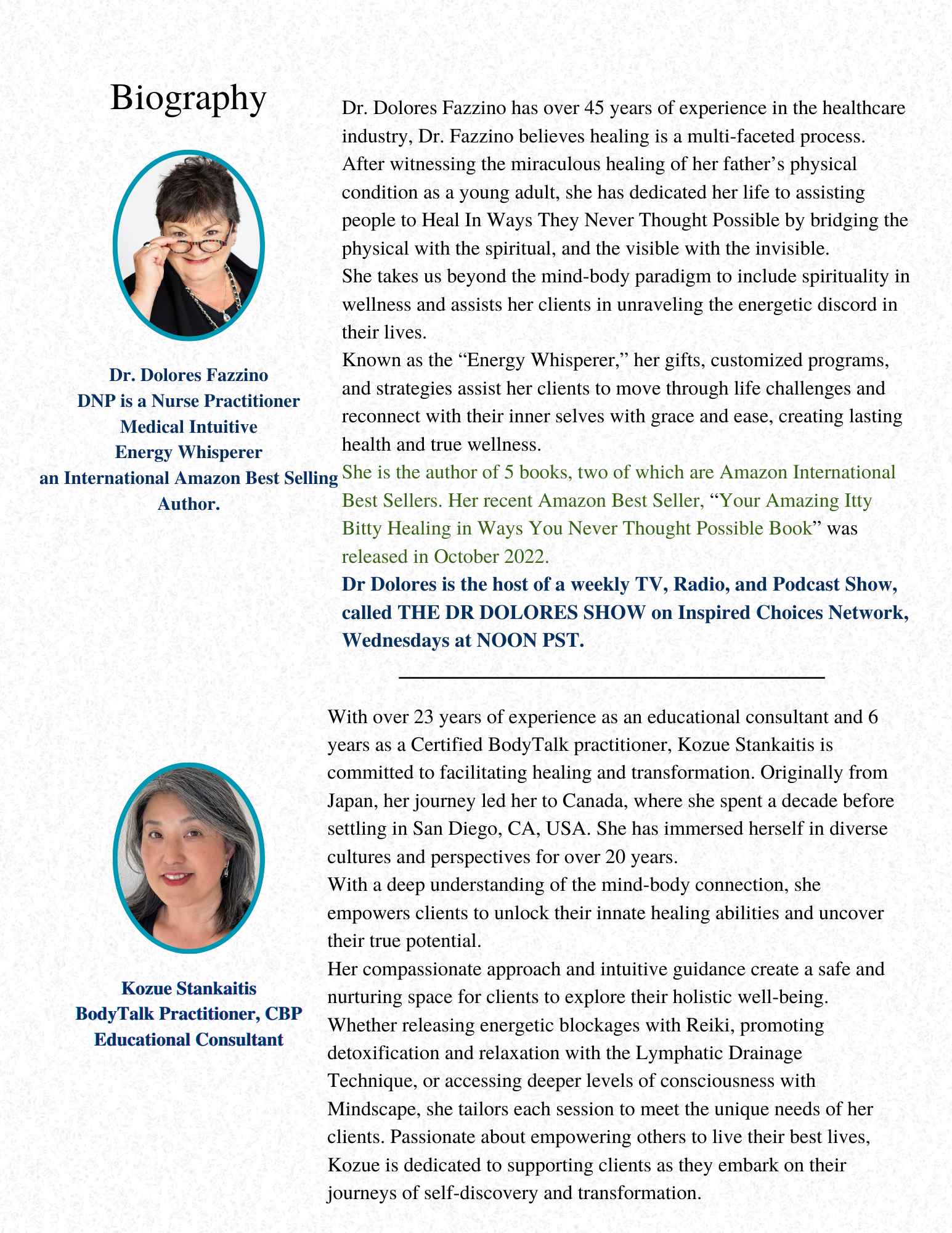
Find Life Coach | Meet Kozue Stankaitis: How to Become a Better Version of Yourself with BodyTalk?

Kozue Stankaitis is one of the coaches that we found this month and we did a little interview with her. She impressed us with her expertise and generosity.

She is a Certified BodyTalk practitioner and an experienced Educational Consultant with over two decades of consulting expertise. Seven years ago, she began exploring the BodyTalk System to better support students and their families in navigating cultural challenges. This led to a natural expansion of her skillset, allowing her to foster holistic well being and self acceptance in her clients.

Her coaching career is built upon helping others understand and overcome inner struggles, empowering them to find balance and personal freedom. Kozue’s approach is driven by a deep understanding of cultural dynamics and the importance of nurturing a robust and healthy belief system. Her dedication to transformation and growth continues to inspire those she works with.

Her personal journey is a testament to resilience and self discovery. Overcoming the influence of a childhood role model whose control masked unhealthy beliefs, she painstakingly rebuilt her own healthy belief system post marriage. This profound experience not only shaped her character but also enriched her coaching methodology, making her a beacon of hope and transformation for her clients. Her coaching style pushes clients to confront and understand their inner struggles, facilitating a path to genuine freedom and lasting change.

She has a unique approach. It’s grounded in the principle that “everything is energy,” and it advocates for a comprehensive cleansing of one’s physical and mental spaces to foster overall well being. Utilizing the BodyTalk modality and other various tools and techniques, she empowers her clients to accept themselves wholly, free from self judgment and external criticism. Through her guidance, they achieve a harmonious balance in their physical, mental, spiritual, and emotional lives, unlocking the potential for profound personal growth. Here is what she said.

Meet Life Coach Kozue Stankaitis:

find-life-coach-kozue-stankaitis

Name: Kozue Stankaitis

Pillar: The Spirit, The Mind, The Body, The Heart

Who is this coach for: Anyone who seeks to heal, release negative blockages from past trauma, update to a better mindset, and install a healthier belief system.

How they can help: By using the BodyTalk System and various tools and techniques like lymphatic drainage techniques, MindScape, colors, aura, and Reiki, just to name a few.

First of all, how are you and your family doing after these Pandemic times?

It is gradually getting easier to go out, but my parents still prefer to stay at home.

How did the coronavirus pandemic affect your clients? Did it affect you at all?

It affected my work.

The educational consulting business had to be put on hold in 2021 to see how things would evolve.

Instead, I started offering remote BodyTalk sessions, which worked well.

Many clients were affected emotionally by the unknown world, and many are dealing with their inner child.

What are the biggest lessons that you learned in this pandemic?

My husband and I learned that we can work remotely 100% of the time if we want.

However, we also realized how important community is for keeping our minds refreshed and maintaining our overall well being.

The Origin:

Tell us about you, your career, how you started with your coaching career?

I’m not sure if a Certified BodyTalk practitioner would be considered a coach.

My background is as an Educational Consultant for 23 years.

Seven years ago, while looking for tools to support my students and their families who face challenges understanding different cultures, I was introduced to the BodyTalk System.

What was your biggest obstacle that you had to overcome in your life that made you who you are today?

When someone I trusted from my childhood, whom I wanted to emulate, turned out not to be someone I should respect because this person controlled me to protect me.

I learned that her belief system was not healthy after marriage.

I had to re establish my healthy belief system.

It took me a while because of denial, but I am happy with who I am and what I am doing.

The Coaching Style:

How do you innovate with coaching your clients?

I help my clients face themselves and understand their issues.

It can be challenging for them to accept these truths, but they eventually do because they are willing to be free from their struggles.

My approach is innovative because it encourages deep self reflection and personal growth, which leads to lasting change.

What’s unique about your coaching approach?

My coaching approach is based on the principle that everything is energy.

To achieve a healthy environment… physically, mentally, spiritually, and emotionally, start by cleaning your physical and mental space.

By doing so, you can observe positive changes in all aspects of your life.

What benefits do your clients get after working with you?

They realize that it is okay to accept who they are.

They don’t need to judge themselves, and others cannot judge them either.

Do you use any specific tools to be efficient with your clients?

I use lymphatic drainage techniques, MindScape (some people say it sounds like hypnotherapy), colors, aura, and Reiki.

The Impact:

If you had a super megaphone that, when you speak into, the whole world will hear your message, what would you say?

Be kind to yourself and maintain healthy boundaries.

What is the greatest lesson you have learned in your life?

Be grateful and be kind to yourself.

Whatever I have and am is a blessing.

If you cannot be kind to yourself, you cannot be kind to others, and I learned how to have healthy boundaries.

Your final thoughts?

I want to share what I’ve learned from BodyTalk sessions.

Let’s embrace the journey of self discovery and healing.

Every step you take towards understanding and accepting yourself brings you closer to a balanced and fulfilling life.

Stay open to change, and always be kind to yourself and others.

You create every thought, right or wrong, good or bad, based on what you have learned from those around you.

Whatever is happening in your life is shaped by your thoughts.

If your beliefs are healthy, there’s no need for extra action.

However, if they are not healthy, those belief systems will no longer support you, so it’s essential to release them.

How to do this?

There are various techniques available.

In a BodyTalk session, you won’t have to confront painful memories if you don’t want to, as we can help release them gently.

Where Can You Find Kozue Stankaitis?

If you liked this interview and you would love to see how coach Kozue can help you through a BodyTalk session, go to https://bodytalkincarmelvalley.com/ and find out.

If you’d like to peak a glimpse in her coaching, follow her YouTube channel.

And if you’d like to connect with her more personally, you can do that through LinkedIn or by sending her a message on her Email [email protected]. It was an honor having this interview with her.