Do You Know About The Rabbit Painting That Will Improve Your Mood Instantly?

Rabbits have been used in the visual arts for centuries. They have been used for different motifs with various mythological and artistic meanings.

Generally speaking, the rabbit signifies rebirth or resurrection. Artists also use rabbits to symbolize fertility and sensuality.

But over the centuries, other symbolic values have also been allocated to rabbits. For example, they are depicted by some painters in their paintings only as wild creatures of hunting, without any symbolic value whatsoever.

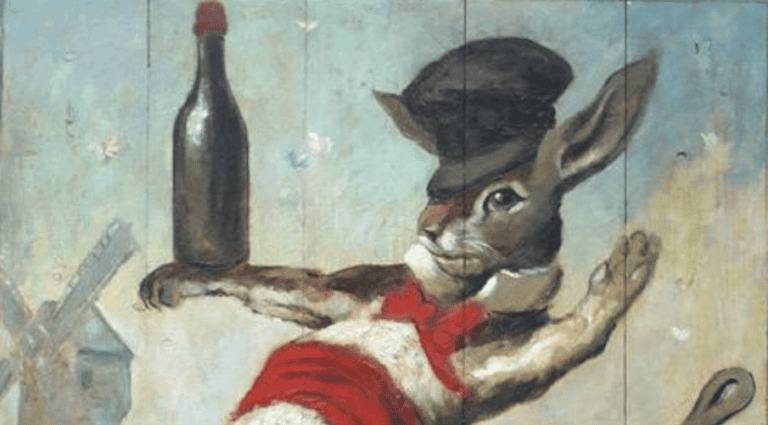
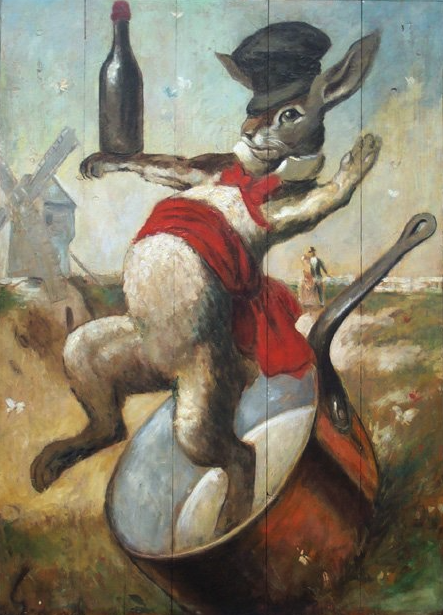
But rabbit painting can also be cute and funny. One well known famous cute rabbit painting is Andre Gill’s “Lapin Agile Cabaret” in Paris. It is a painting that will improve your mood instantly when you look at it.

In this article, we’ll briefly examine how rabbits have been used in art over the centuries, and then we’ll discuss Andre Gill’s famous painting.

The Depiction of Rabbits in Judaism and Classical Antiquity:

The rabbit is considered an unclean animal In Judaism because it does not have a divided hoof. This was one of the reasons for the critical and often disrespectful attitude towards rabbits by Christian artists of the Middle Ages. Rabbits were often seen as “evil.”

But although rabbits were a non kosher animal for the Old Testament Jews, there were also positive symbolic connotations in paintings and sketches during the earlier centuries.

For example, the 16th century German scholar Rabbi Yosef Hayim Yerushalmi saw rabbits as a symbol of the Diaspora.

In Classical Antiquity, rabbits were seen to survive only by prolific breeding. Aristoteles, for instance, described rabbits as the most fertile of all animals.

The rabbit became the symbol of fertility and desire. In later antiquity, rabbits were also used in art to symbolize good luck.

The Depiction of Rabbits in Early Christian and Medieval Art:

In early Christian art, rabbits appeared on articles like icons and oil lamps, but it is not clear what the symbolic connotations were.

Some art scholars believe rabbits in the early Christian artworks are symbolic of the Christian belief that salvation must be found in Christ as the Rock and not in worldly “down on the ground” things.

They base this theory on the teachings of that time where rabbits were seen as to be “escaping” onto rocks instead of falling to the ground to be hunted.

In Medieval art, the rabbit was sometimes used in paintings to symbolize the negative connotation of lust. But art scholars believe that a rabbit symbolizes something positive for many other artists in medieval times, a symbol of the steep path to salvation.

Rabbits in Non Religious Art:

In non religious art, the rabbit is sometimes just depicted as prey for the hunter. But it can also symbolize spring or autumn and is often used as a symbol of physical love.

In Italian Renaissance and Baroque art, rabbits can be found in many famous paintings. For example, Pinturicchio’s depiction of “Susanna in the Bath” shows two old men accompanied by a pair of rabbits, indicating wanton lust.

Another reason artists sometimes include rabbits in their paintings is that small animals with fur, including rabbits, are excellent vehicles to showcase the artist’s ability to paint in fine detail.

Two Wonderful Rabbit Paintings in European Art:

One of the most beautiful rabbit paintings in European art’s earlier history is probably Albrecht Dürer’s 1502 painting “Young Hare.”

This rabbit does not have any symbolic meaning but is one of the most reproduced images of a rabbit in European art history.

It has been printed in many art textbooks, published in hundreds of reproductions, and copied and used in many other ways, even up to today.

The other trendy and famous rabbit painting, “Lapin Agile Cabaret,” was created in the second half of the 1800s.

It depicts a rabbit jumping from a saucepan and has become the “model” of many modern caricature artists.

Let’s find out who this artwork’s creator was and the story behind the painting.
Andre Gill – the Creator of Lapin Agile Cabaret

Andre Gill – the Creator of “Lapin Agile Cabaret”

The 19th century French caricaturist André Gill drew celebrities of his time with giant heads on tiny bodies.

This practice influenced virtually all cartoonists of the late 1800s and even today.

André Gill was born in 1840 in Paris. His family was of high social standing, his father was a count. By using “Gill’ as part of his pseudonym, he honored James Gillray as the person who had influenced him the most.

Although he had a traditional art education, he is known for his cartoon like pictures created in a graphic style.

He drew famous and well known people as a caricature with large heads and small bodies.

His first drawings appeared in 1859 in “Le Journal Amusant,” “Le Hanneton,” and the socialist journal “La Rue.”

He portrayed several famous politicians like Napoléon III, novelists like Charles Dickens, and composers like Georges Bizet.

Unfortunately, Gill’s final years ended in tragedy. In 1883 he was admitted to an asylum because of a mental illness and lost all his former friends except his loyal student, Émile Cohl.

Cohl paid Gill’s medical expenses until he passed away in 1885.

Lapin Agile Cabaret

André Gill was also well known in the cabaret milieu in Paris.

He frequently visited the “Cabaret des Assassins” at the Montmartre. But he was not only a visitor to the club, but he also performed as a singer in this club.

His association with this club was why he created one of his most famous paintings.

The “Cabaret de Assassins” asked him to design a sign for the club. The sign he created depicts a rabbit jumping out of a saucepan.

The local people in Paris loved this sign, and they referred to it as “Lapin à Gill” (“Gill’s rabbit”). As a result, the “Cabaret de Assassins” has become known as” Lapin Agile Cabaret” and is still in operation and is a well known tourist attraction in Paris.

It is said that when you look at this painting your mood instantly improves.

What you should remember?

Rabbit paintings have been part of the art scene for centuries already, and there are many reasons why painters up to today include rabbits in their artworks.

But not many rabbit paintings make you feel good when you look at the image.

However, Andre Gill’s” Lapin Agile Cabaret” depicting a rabbit jumping out of a saucepan will increase your mood every time you look at it.
Are Physical Health And Mental Health Closely Related?

The notion of staying healthy is different for every individual.

Everyone understands that you need to exercise and eat right to maintain a healthy body, but people are only just starting to understand that your mental health is equally important.

While research into mental illness is still in its early stages, there is evidence to suggest that both health concepts are more interlinked than you may think.

As such, let’s explore this notion to discover just how your physical health and mental health work alongside each other.

You may find that you discover something new that can help you to cope with either one of these complicated issues. Read on to find out more.

How Are Physical Health And Mental Health Related?

physical-health-and-mental-health-closely-related

What Is The Mind?

Before looking at how these two entities are related, we need to understand each one as a separate entity.

It is easy to mistake the brain for the mind, but these are two very different things.

The brain is the organ that works to coordinate your body and emotions, whereas the mind represents your consciousness and thought processes.

Therefore, the brain represents the physical, while the mind represents the mental.

With that in mind, it should be easier to understand what is meant by mental health.

What Is Physical Health?

Physical health refers to how well your bodily functions are operating.

Everything inside you needs to work at a certain level of efficiency for you to remain healthy, which is why it is important to maintain good physical health and eat a balanced diet.

These actions can help your body, but you will soon find out that they can also affect your mind.

What are The Physical Health’s Effect On Your Mind?

The reason behind your regular exercise routine is to strengthen your body. The more you work your muscles, the better they become at functioning.

However, it isn’t just your muscles that get a workout. Your organs also receive the benefits of regular exercise.

For example, cardiovascular fitness will increase your lung capacity, which in turn speeds up the rate at which oxygen is delivered throughout your body.

This oxygen is needed to help turn your food into energy, therefore, you should have more energy if you work out more often. But what has this got to do with your mental health?

A common symptom of depression is lethargy. Your body must work harder to combat the serotonin deficiency that is causing this illness, which can greatly reduce your energy levels.

Therefore, by keeping your body physically fit, you should have more energy than you otherwise would to help fight off this symptom of depression.

Of course, this is a massive oversimplification of events, but you should now start to see how the two concepts of health are linked.

What are The Mental Health’s Effect On Your Body?

Your mind is responsible for maintaining the functions of everything needed to help you feel and experience the world around you.

This means that you are also using your mind when you exercise. However, poor mental health is going to influence your overall fitness levels.

Lethargy is not the only symptom linked with a mental illness like depression. Those who live with this mental illness also suffer from bodily aches, reduced sleep, irritability, and a loss of appetite.

As you can guess, working up the motivation to exercise while experiencing these symptoms is extremely difficult, which is why many people lose fitness levels when they experience mental health issues.

Now that you can see how each facet of health is affected by the other, what can you do to balance them?

How to Use Exercise To Ease Symptoms Of Mental Health Disorders?

Once you understand the science behind mental health issues, such as anxiety or depression, it is easier to see how exercise can be used as part of a healing solution.

Since there is no direct cure for these mental illnesses, you will need to focus on tackling each symptom as they arise. The key is reducing the effects instead of abolishing them.

However, the simple act of exercise is not enough to help you in these efforts, as you will discover when you read through Talkiatry’s grounding techniques for anxiety.

Using up the excess energy in your body is necessary for relaxing, but you will find the most important step in grounding techniques for anxiety is to focus on your breathing.

Slow deep breaths will help to reduce your heart rate and reduce the likelihood that your anxiety experience develops into a panic attack.

The best way to practice these breathing techniques, of course, is by engaging in regular fitness workouts.

These regimes will accustom your body to taking long recovery breaths so that you are more prepared to ground yourself next time you find yourself in an anxious situation.

When it comes to depression, these quiet periods of meditation can reduce the harmful spiral of thoughts in your mind.

By giving you an additional focus, you can use exercise as a distraction and as a way to relieve stress. This process should give you some clarity moving forward.

How to Use Mental Health Practices To Improve Fitness?

Once again, just as your fitness regime can help you to ease symptoms of mental illness, mindful mental health practices can help improve your fitness.

The grounding techniques discussed above are designed to relax and comfort you in times of stress.

When you are experiencing stress, your body is not working at full capacity, and there is nothing more stressful for your body than an improper cool down routine.

Grounding yourself with meditation and breathing techniques can teach you to relax your body properly, helping it recover quicker from your workout.

What’s more, meditation techniques can lower your blood pressure, one of the biggest issues facing people with mental illness.

A core part of engaging in sport is keeping concentration. Practicing mindfulness is a great way to clear your mind, giving your body the tools needed to focus on the physical task at hand.

What is The Connection Between Mental Health And Diet?

This article has already explained how exercise can help improve your mental health, but there is another facet that contributes to your physical health, and that is your diet.

Various foods can have a positive or negative effect on your body, but it is important to achieve a balance in the types of nutrients you consume.

In fact, studies have shown that too much of certain food products can actually cause you to experience low moods and stress, two things you should avoid if you struggle with mental illness.

Processed foods that are high in flour or sugar, such as bread, cheese, and biscuits, cause inflammation in your body over time.

While your body is fighting to reduce this inflammation, it has less energy to focus on serotonin production or keeping your oxygen flowing.

Therefore, participating in a poor diet for too long can have a negative effect on your mental health. You don’t have to give up your favorite foods altogether, just consume them in moderation, and you should start to notice a difference.

What you should remember?

The world is only just beginning to understand how the mind and body work together.

But, there can be no denying that there is a positive connection there.

So, to answer the initial question: yes, there is a relation between your physical and mental health.

Is there a difference in mental health between men and women? You can find out here!

What are The Functions of The LL 37 Peptide in The Pathogenesis of Autoimmune Illness and Inflammation?

Various defensive mechanisms are used by the innate immune system, including complement mediated lysis, phagocytosis, NET formation, and the release of antimicrobial peptides (AMPs).

Immune disorders such as rheumatoid arthritis (RA) and systemic lupus erythematosus (SLE), long assumed to be caused by adaptive immunity, are now linked to innate immune system abnormalities.

The role of AMPs in developing autoimmune illnesses has emerged as a common topic in this research. In atopic dermatitis and psoriasis, the defensins and the solitary human cathelicidin, LL 37 peptide may have a role in developing these diseases.

Furthermore, in recent years, LL 37 has emerged as a possible contributor to the pathogenesis of SLE, RA, atherosclerosis, and probably other disorders.

This peptide can be purchased from multiple sources, and researcher can find LL 37 peptide for sale from reputable and licensed sourcesif you ask around.

When it comes to modulating immunological responses, the function of the human version of LL 37, as well as its murine counterpart, MCRAMP, is examined in this paper.

What are The Functions of The LL 37 Peptide in The Pathogenesis of Autoimmune Illness?

functions-of-the-ll-37-peptide

Antimicrobial defense and inflammatory response initiation are critical functions of the innate immune system.

One of the most effective evolutionary conserved defensive mechanisms against bacterial and fungal invasions is antimicrobial peptides (AMP).

Epithelial cells and lymphocytes produce a large number of AMPS in the hundreds. LL 37 is the only member of the human cathelicidin family of antimicrobial peptides (AMPs).

Peptides that have antibacterial capabilities and immune system modifying properties have caught the scientific community’s attention.

These features may contribute to the development of autoimmune diseases.

How it functions?

KERATINOCYTES and NEUTROPHILS both have serine proteases called kallikreins, which break down the C terminus of the 18 kDa human hCAP18 protein to produce the cationic peptide LL 37, which has 37 amino acids. LL 37, unlike other antimicrobial peptides, may form aggregates in solution and lipid bilayers, making it resistant to proteolytic destruction.

It prefers to connect with negatively charged phospholipid membranes because of its positive charge.

Furthermore, during membrane contacts, it takes a mainly helical structure, segregating its hydrophobic residues.

Transmembrane holes develop, membrane penetration occurs, and bacterial lysis takes place. LL 37 protects cholesterol rich cell membranes against the peptide’s pore forming activities.

Secondary neutrophilic granules were first identified as the source of LL 37’s constitutive expression.

Macrophages, natural killer cells (NK), and epithelium from the skin, airways, ocular surface, and gut generate LL 37.

Inflammatory pathways, vitamin D, and endoplasmic reticulum stress all have a role in regulating its expression.

Researchers have shown that mCRAMP, the murine equivalent of LL 37, has primary antibacterial functions. Preventing bacterial infections in the skin requires LL 37 over mCRAMP.

Similarly, mice lacking mCRAMP are more vulnerable to urinary tract infections and colonization by pathogenic microorganisms.

The protective effects of mCRAMP and human LL 37 on the generation of inflammatory cytokines in response to Clostridium difficile toxin induced colon and ileal damage are further shown.

A surprising finding is that mCRAMP has been demonstrated to protect against influenza infection, showing that it also plays a part in the body’s antiviral defenses.

LL 37 regulates the recruitment of inflammatory cells and the phenotype of macrophages. LL 37 contains antibacterial and immunomodulatory properties.

Indeed, LL 37 has been shown to have pro and anti inflammatory properties, which the microenvironment and the underlying illness may influence.

Find Life Coach | Meet Genevieve Manderville: How to Get Out of The “8 to 5” Rat Race and Create Your Audacious Life by Design?

Genevieve Manderville is one of the coaches that we found this month and we did a little interview with her. She impressed us with her holistic approach.

She went from 30+ years in the corporate world into the coaching world and she wouldn’t trade that for anything.

She educates and coaches prospective franchise investors showing them how business ownership is within their reach.

As a Transformation Coach and energy practitioner she helps women gain clarity and drop the chains of corporate life to discover their passion and purpose. Here is what she said.

Meet Life Coach Genevieve Manderville:

find-life-coach-genevieve-manderville

Name: Genevieve Manderville
Pillar: The Spirit, The Mind, The Heart
Who is this coach for: Mainly for women who want to get out of the “8 to 5” rat race, drop the chains of corporate life to discover their passion and purpose, and live an audacious life.
How they can help: Through arsenal of techniques and tools 30+ years in the making, visualizations and mindfulness meditation just to name a few.

First of all, how are you and your family doing in these Pandemic times?

My family and I are doing well. Thankfully none of us became ill including my 82 year old mother.

While we were in quarantine like everyone else, we were diligent in tapping into our spiritual place. And I ensured everyone ate whole healing foods and drank healing beverages.

How does the coronavirus pandemic affect your clients? Did it affect you at all?

We were quite fortunate. No one took ill physically. However, people had a strong need for emotional connection especially during times of quarantine.

I remember doing new things via Zoom such as: spa dates, celebrating birthdays, watching plays and concerts together. I even recalled a New Year’s Eve Dance Party on Zoom.

We tried to keep some sense of normalcy.

I have a private group on Facebook where I was able to stay connected and check on people. Sometimes we do not realize how important it is asking someone, how are you doing?

If it comes from the heart it can go a long way.

During the pandemic, I would get out and walk often. I have a dog and she always wanted to go out. This simple act kept me grounded.

Sometimes the streets were deserted and hardly no traffic. It felt like the “Zombie Apocalypse”. Also, I would see more of the animals, deer, foxes, etc.

This time out was my solace.

What are the biggest lessons that you learned in this pandemic?

The biggest lessons I learned is that things we think cannot happen do.

No one promises us anything in life.

We do not have endless time. Our time is precious. Our time spent with people are precious.

I believe in connecting to my spirituality which is threaded throughout my life. It is how I show up for myself, my loved ones and my clients.

I find that I tend to stay away from situations or even people who cause me angst.

The Origin:

Tell us about you, your career, how you started with your coaching career?

I am a “corporate escapee”. My intention is to be the director of my destiny.

I spent 30+ years in the corporate setting gaining extensive business and financial experience.

I have managed and coached high performing teams for most of my tenure.

After leaving in December 2018, I founded my own firms. First, I launched a franchise consulting business, GEM Franchise Consulting Inc. which specializes in helping others achieve their dreams of business ownership through franchising.

As a Franchise Consultant, I educate and coach prospective franchise investors as part of the process. I enjoy showing people how business ownership is within their reach.

Then feeling the urge to aid women in pursuing their life dreams and desires. I launched The Pearl Pathway of Wellness LLC.

As a Transformation Coach and energy practitioner, I help women see their life through fresh eyes as well as stretch them to achieve their goals that they so richly deserve.

I specialize in showing women how they may leave their “8 to 5”, drop the chains of corporate life to discover their passion and purpose.

What was your biggest obstacle that you had to overcome in your life that made you who you are today?

I would say my biggest obstacle was learning “how to be present” and getting out of my own way.

As mentioned earlier I worked within the corporate space for many years. You get used to running at top speed to get things done. You are consistently multitasking, often juggling multiple priorities. It is very high paced and stressful.

It felt like I thrived on it. It’s part of our programming.

We strive to get the job or position. You work like heck to stay relevant and competitive and to move to the next level. Then, boom, you get promoted. But you can’t rest. The process continues. And guess what it is consistently like that…

During one particular hectic period, we were working extremely long hours including Saturdays. I remember I had just finished a super long 6 day week. That Sunday, I decided that I was going to ride my bike to relax. It had been a very stressful week and I was tired. Well I fell off my bike and hit my head.

I ended up in the trauma center with a concussion and needing 5 staples in my head. I nearly killed myself in the vain of relaxing.

This is where my lesson on learning to be present took hold.

When we are present and mindful, we do not injure ourselves. As my mother used to always tell me when I would rush, be mindful of what you are doing.

We tend to take honor in multitasking and running around. There is no need for it. Nothing gets done any quicker or more efficiently. In fact, I would argue that you get much less done.

Going back to my accident, it could have cost me my life. The cost to me was an overnight stay in the hospital, time away from work and I scared my family senseless.

But the world goes on. And it’ll go on with out you.

You must take care of YOU.

The Coaching Style:

How do you innovate with coaching your clients?

I bring in all the skills in my toolkit.

I have strong business, financial and professional skills which I use consistently to help my clients.

When my clients are looking to transition from their current jobs, I coach them on what to say and do to ensure that they are protected.

Additionally, I am a Reiki Practitioner. This is extremely valuable as we are all mostly energy.

We vibrate and send “currents’ regularly. If our energy is blocked and not flowing, it manifests in the various areas of our lives.

What’s unique about your coaching approach?

My coaching approach is a holistic strategy.

I look at the main areas of your life : career, financial, relationships, spirituality, etc. We explore your desires, thoughts, beliefs, etc.

I utilize a 5 step framework which includes uncovering your passion and purpose, educating you on understanding how your brain works, examine your thoughts, connecting with your feelings, etc.

This process includes learning how to be more present, creating joy and learning to take care of YOU.

As we go through this process you are making strides towards you goals in an empowered and sustainable way.

I have had clients heal long seated trauma which made room for them to feel more joyful. It allowed this client space to start a business.

Or another client who felt empowered to not only explore leaving her job but have more than 1 job offer presented to her. This same client learned how to take a stand for herself in the workplace and with her loved ones.

I show my clients that it is possible to have whatever you desire. And I help them gather the needed parcels to make the journey across the transformation bridge. And it is so much sweeter on the other side.

I guide my clients from the dark tree dense forest to the an open clearing and field where the sun is shining and bright. In this clearing you see all that is available for you.

What benefits do your clients get after working with you?

My clients feel more joyful in their lives. They learn to do more loving things for themselves. They learn how to take inspired action to get what they desire.

They learn how to challenge current thoughts and beliefs and create new ones.

They learn how to find their unique passion and purpose in life.

They learn how design a pathway to living their life which they control, in their way.

They learn how to up level their beliefs and let go of the old patterns that are holding them back and instead feel in control and joyful.

Do you use any specific tools to be efficient with your clients?

I use everything in my arsenal that I have learned and experienced over the last 30+ years. I share exercises to stimulate their thinking, get curious about their thoughts and feelings and show them regular sustainable practice that can be done daily.

There is a fair amount of self reflection, visualizations and mindfulness tasks. These tools fit easily into their current lifestyle.

The Impact:

If you had a super megaphone that, when you speak into, the whole world will hear your message, what would you say?

By igniting our passion, we get to reclaim ourselves, our life and our power.

I can show you how.

No longer do we relegate ourselves to the back burner and putting others needs before ours. We get to choose something different, something more self ful.

What is the greatest lesson you have learned in your life?

My greatest lesson is learning how my brain works and how my thoughts and feelings can impact my results.

In this process, I learn and accept that I cannot change or impact anyone else.

I know you are thinking duh of course you can’t.

But even though we may know that intellectually, on an emotional level we may continue to try.

Once I realized that I am what I think and believe, that was a game changer for me.

I had successes in the past because I believed and I was tenacious. Sometimes I “muscled” things into happening for me.

Yes, that did work although it might not be sustainable. Or it might not have been the best decision or solution for me.

Your final thoughts?

I truly enjoy and love this work.

I remember how I felt in in corporate environment. I could not wait to get out and thought that there wasn’t a way.

However I found one.

I would like to share that with as many women as possible. I love the look on her face when she realizes that not only is it possible, It is possible for her. And it is already done.

Where Can You Find Genevieve Manderville?

If you liked this interview and you would love to escape the “8 to 5” rat race to live your purpose, make sure to connect with Genevieve via LinkedIn and shoot her a message.

You can also connect with her on Facebook. If you want to get a glimpse of her coaching, you can follow her page on Facebook and her account on Instagram. It was an honor having this interview with her.

Find Life Coach | Meet Heather Poirier: How to Change The World, One Leader at a Time?

Heather Poirier is one of the coaches that we found this month and we did a little interview with her. She impressed us with her professionalism and passion for Non Profit Organizations.

She is a coach for leaders in the nonprofit sector and she helps them overcome their stress or even burnout.

She decided to focus on this specific group of people firstly because she understands how hard it is for nonprofits to swim in the unpredictable corporate sea amongst giants.

The second and deeper reason is because she truly believes that nonprofits are way ahead of other organizations when it comes to making the world a better place, so by helping the people involved it’s the best way for her to foster a positive change. Here is what she said.

Meet Life Coach Heather Poirier:

find-life-coach-heather-poirier

Name: Heather Poirier
Pillar: The Mind
Who is this coach for: Mostly leaders in the nonprofit sector who are facing stress and possible burnout.
How they can help: By helping her clients gain clarity about their life path, understanding of their high value activities, and find healing for their emotional stressors.

First of all, how are you and your family doing in these Pandemic times?

My husband and I were able to adjust to working from home during the lockdown here in DC, and once things began to reopen, we took every precaution to keep ourselves safe.

We’ve been fortunate despite the circumstances.

How does the coronavirus pandemic affect your clients? Did it affect you at all?

It didn’t affect my coaching practice because I have been geared from the beginning to coach online.

My clients have been affected in ways both large and small, from loss of motivation to loss of jobs and family members.

What are the biggest lessons that you learned in this pandemic?

Be careful but not afraid.

Be wise and listen to your instincts.

Trust people who know what they’re talking about.

The Origin:

Tell us about you, your career, how you started with your coaching career?

Before I became a business coach, I was a longtime writer and editor whose position, along with 10 colleagues, was outsourced in December 2020.

I’d been wanting to change professions for a few years, so I seized the opportunity and retrained as a coach.

I work with leaders in the nonprofit sector who are facing stress and possible burnout.

Both staff and volunteers struggle with the issues facing nonprofits, ranging from budgets to internal politics, and most leaders don’t have the full set of tools they need to cope.

The work is much harder than it seems. Because most nonprofits don’t pay their volunteers (and some can’t even pay for staff members at first), the volunteers have to dig deep within themselves for motivation. That can last for only so long.

What was your biggest obstacle that you had to overcome in your life that made you who you are today?

My fear of client development, believe it or not!

I find everything else about being a coach and an entrepreneur really easy, but reaching out to prospects is something I still have to face head on.

The Coaching Style:

How do you innovate with coaching your clients?

My coaching is geared toward keeping people engaged, so I use techniques and strategies that engage each of the seven ways people learn best.

Most coaches, and in fact, most programs of any kind, aren’t aware of these methods and don’t use them.

Keeping my clients engaged is the best way I can help them achieve their outcomes.

My coaching is largely virtual, too, so I have structured it in ways that means my clients don’t have to make a special trip somewhere to meet me, unless that’s their preference.

I’m always open to face to face engagement, but being able to hop onto a video call with clients helps everyone stay on track.

What’s unique about your coaching approach?

Everyone has a story, a past, a set of problems they’d rather not face.

I have an array of tools to help my clients find healing for their emotional stressors and upset.

These tools go straight to emotions rather than staying caught up in the mind with all its words and objections. They help people find healing very quickly.

It’s not what I advertise as my coaching service, but it’s usually something I do with a client whenever we reach a major sticking point.

What benefits do your clients get after working with you?

The full understanding of what their highest value, highest dollar activities are, what their life changing activities are, and clarity about the path of transformation ahead of them.

Do you use any specific tools to be efficient with your clients?

I track each client’s progress and schedule calls for only 45 minutes. That leaves buffers for extra discussion without going into the next client’s session.

The Impact:

If you had a super megaphone that, when you speak into, the whole world will hear your message, what would you say?

Nonprofits will change the world!

What is the greatest lesson you have learned in your life?

Let go of your fear so that you can have faith in other people.

Your final thoughts?

Nonprofits are way ahead of other organizations when it comes to helping society change and grow.

My work with nonprofit leaders is the best way for me to help foster a better world for us all.

Where Can You Find Heather Poirier?

If you liked this interview and you would love to see how Heather can help you, go to https://rapidnonprofitsuccess.com/ and discover your next step.

If you like to connect with Heather personally, you can do that through her LinkedIn profile. It was an honor having this interview with her.

Find Life Coach | Meet Aline Dalcin: How to Become a Conscious Creator of Your Life?

Aline Dalcin is one of the coaches that we found this month and we did a little interview with her. She impressed us with her holistic approach to coaching.

She has been in this career for over 10 years now and throughout these 10 years she has fully dedicated herself in learning about human development and self awareness, especially her own.

She looks at each person as a whole being, not constituted just by their bodies and minds, but also by their parents, ancestors, emotions and environments they live in.

Her approach is integral and unique to each individual. She dives deep and looks for the root cause of their problem. Here is what she said.

Meet Life Coach Aline Dalcin:

find-life-coach-aline-dalcin

Name: Aline Dalcin
Pillar: The Spirit, The Mind, The Body, The Heart
Who is this coach for: Anyone who wants to find the root causes of what’s keeping them stuck in life, gain greater awareness, transform and become a conscious co creators of their own lives.
How they can help: Through an integral approach customized for each individual uniquely.

First of all, how are you and your family doing in these Pandemic times?

Two and a half years after the pandemic, I’m absolutely sure that we’ve all grown a lot. We grew as humans, as well as spiritually, because we learned in pain how difficult it was for everyone.

After all, it was the whole world going through the same situation and how much we made this fear, this panic, something to resignify, transforming it into strength.

No one came out of this pandemic without having a different perspective on life, without having another vision of the world, because now we look at it as another reality, understanding that we have no control over almost anything.

That we have to look at ourselves and others, that we don’t have all the time in the world, that we are vulnerable, and that cooperation and union are what help us to get out of every chaotic situation on the planet.

How does the coronavirus pandemic affect your clients? Did it affect you at all?

It didn’t just affect my work, but almost everyone else’s work around the world.

But in these moments of adversity, being flexible is essential, because I understand that flexibility is better than knowledge.

After all, what’s the point of having all the knowledge in the world if you don’t know how to adapt in the face of life’s adversities? You stay behind.

I am a very flexible person, and in the face of the pandemic, I sought to innovate, leaving the face to face and going online, which made me grow a lot in this market, and today, practically 50% of my work is online.

What are the biggest lessons that you learned in this pandemic?

The biggest lessons I learned during this pandemic were the 12 steps to a full life, which are:

1. Take care of your health.

2. Have healthy relationships.

3. Be clear and objective.

4. Watch, feel and create.

5. Cooperation and networking.

6. Emotional intelligence.

7. Common sense.

8. Would I buy myself?

9. Adaptation and flexibility.

10. Move internally and externally.

11. Positive magneto persona.

12. Full resilience.

The Origin:

Tell us about you, your career, how you started with your coaching career?

My coaching career started a decade ago.

I am 40 years old and for ten years I have dedicated myself to human development and self knowledge, especially mine. And everything I’ve experienced and worked on, I take to other people.

Everything that positively impacted me and that made perfect sense to me, I can take to others.

What was your biggest obstacle that you had to overcome in your life that made you who you are today?

Look, I’m grateful for everything in my life. The obstacles I went through, I believe they were all stages, growth cycles, because everything we experience, good or bad, is for our growth.

So there’s nothing to say that it was something terrible, it was just cycles, phases, and transformations.

The same happens with the butterfly, before leaving the cocoon, it undergoes a tremendous transformation. For a baby to come into the world, the mother needs to feel that birth pain… So, there is no process and there never will be a process if there is no transmutation, that change.

Everything that happens to us is to elevate us.

The Coaching Style:

How do you innovate with coaching your clients?

As a coach, I look at the whole person.

I look at what level of consciousness she is, how is her physical body (that is health care), and how she is in her career, in her professional and financial life.

So, we look at the human in an integral way, at the cause of the problem that the client brought, so that we can work in a deep way, not just on the surface.

What’s unique about your coaching approach?

I believe that what makes my approach unique is that I look not only at that human, that client who is there, I look at the whole set: at his father, at his mother, at his ancestors, at his emotions and feelings, for your childhood traumas, for your wounded inner child…

I look at how the psyche is doing, how the physical body is doing, how health and relationships are going, how financial matters are going…

I look at the being in an integral way.

What benefits do your clients get after working with you?

The benefits that my clients have is that they understand, they begin to understand that they create their own realities, but before, they were creating in an unconscious way.

After I bring the light, they understand that they are co creators of their own lives, becoming more aware and making healthy decisions and choices.

Do you use any specific tools to be efficient with your clients?

I work with numerous tools, I have several backgrounds, so each client receives a personalized service, because each person has a world inside them.

The Impact:

If you had a super megaphone that, when you speak into, the whole world will hear your message, what would you say?

If I could talk to everyone and if everyone could hear me, I would talk about a text I created and love, “You should first be in order to have”:

“We choose many things, we want to have many things, we ask for a lot, but we need to understand that in order to have, we must first be, that is, merge with the energy that we are choosing.

If you want peace, be the peace.
If you want to have abundance, be the abundance.
If you want to have love, be the love.
If you want to have patience, be the patience.
If you want to live lightly, be the lightness.
If you want to have something, no matter what you are choosing for yourself, first you have to be it in order to have it and not the opposite.

Merge with the energy of everything that has a positive impact on your life.

You should first be on order to have.”

Whatever you choose for you, choose 100% and merge with the energy of what you are choosing and especially what impacts you positively, because we create our reality at all times, so let us be conscious co creators of this planet Earth.

What is the greatest lesson you have learned in your life?

The biggest lesson I’ve learned in my entire life over these four decades is that only self love heals, only self love that transforms, only self love that elevates us…

So you want to raise your vibration, you want to have a full life, want to have a light life?

Self love!

Large doses of self love, so by resonance you will emanate this wave of love to all the surroundings.

Your final thoughts?

“Most people only learn life’s lessons after the hard hand of fate touches them on the shoulder.” — Napoleon Hill

Where Can You Find Aline Dalcin?

If you liked this interview and would love to learn how to become conscious co creator, go to www.alinedalcin.com.br and see how Aline can help you do that.

If you want to get in touch personally with her, you can do that via Facebook, by following her on Instagram, or by connecting with her directly on LinkedIn.

If you like to get a glimpse of her coaching, she has an active YouTube channel and TikTok so make sure to check it out.

Find Life Coach | Meet Rafael Marlowe: How to Gain Greater Awareness in Your Life?

Rafael Marlowe is one of the coaches that we found this month and we did a little interview with him. He impressed us with his dedication and professionalism.

He helps his clients dive deep into their subconscious mind and greater awareness, discover their life path and gain clarity.

He had a rough childhood and few rough patches in his life that made him the man he is today. That didn’t stop him to continue helping other people.

His coaching approach uses several proprietary coaching methodologies that got him strong ratings. Here is what he said.

Meet Life Coach Rafael Marlowe:

find-life-coach-rafael-marlowe

Name: Rafael Marlowe
Pillar: The Mind
Who is this coach for: Anyone who wants to gain clarity, find their life path and grow awareness.
How they can help: Through a Visual Facilitation method, helping the client to get access to their subconscious awareness.

First of all, how are you and your family doing in these Pandemic times?

Thank God not bad.

How does the coronavirus pandemic affect your clients? Did it affect you at all?

Not really an issue. It affected my clients but I prefer not to discuss that.

What are the biggest lessons that you learned in this pandemic?

Patience, patience and integrity work best.

The Origin:

Tell us about you, your career, how you started with your coaching career?

I am an adult educator for 25 years, primarily executives and c suite people. It was what I was doing all along, except with a broader philosophical perspective, and other info tied in.

What was your biggest obstacle that you had to overcome in your life that made you who you are today?

Early childhood abuse, and a major life transition at age 23. Losing a son aged 26.

The Coaching Style:

How do you innovate with coaching your clients?

I have several proprietary coaching methodologies that I have strong ratings see my linkedin.

What’s unique about your coaching approach?

Its a Visual Facilitation method that allows clients to gain access to their more subconscious awareness.

It helps them flush out what the real issues are quickly and uniquely.

As one therapist, Ph.D., told me after she worked on it for 1hr and 15 minutes: “Great job you did that in one fifth the time it takes me!”

What benefits do your clients get after working with you?

Clarity, life path, and awareness.

Do you use any specific tools to be efficient with your clients?

Yes, see above.

The Impact:

If you had a super megaphone that, when you speak into, the whole world will hear your message, what would you say?

Personal growth is the juice that makes life work.

What is the greatest lesson you have learned in your life?

Humility works across the board.

Your final thoughts?

Nothing to add.

Where Can You Find Rafael Marlowe?

If you liked this interview and you would love to gain some awareness and clarity of your life, make sure to contact and connect with Rafael through his LinkedIn profile.

Don’t be shy, just send him a message and ask him how he can help you. Rafael is more than happy to help you. It was an honor having this interview with him.

Medical Marijuana: How Safe is it and What Does It Treat?

Medical marijuana has proven analgesic, anticonvulsant, nausea, and vomiting effects.

People with cancer and HIV can use it for pain relief.

It is possible that legal cannabis inhibits the growth of cancerous tumors and has a good effect in the early stages of some serious diseases, like dementia, pathology of the central nervous system.

In the world of psychiatric practice, there is an experience of successful use of medical marijuana in the treatment of post traumatic stress disorder.

Privately, a medical cannabis doctor may prescribe smoking weed to reduce anxiety, stress, and intrusive thoughts.

How Safe is Medical Marijuana?

medical-marijuana-is-it-safe

So prescription of marijuana can help with chronic pain, spastic syndrome, and strong convulsive readiness just to name a few.

Foci of pathological activity appear in the cerebral cortex, which the body cannot cope with on its own.

Entering the body from the outside, cannabinoids of plant and synthetic origin bind free receptors and stop the production of gamma aminobutyric acid, one of the leading neurotransmitters.

As a result, excitation is not transmitted to the higher nerve centers, so there is a slowing down effect.

Curiously, first, the reflexes with negative reinforcement, which appear with pain and fear, are suppressed.

The general inhibitory effect, which causes memory disorders, is manifested only with the very frequent use of marijuana.

Why medical marijuana isn’t as bad as it sounds?

It is wrong to equate marijuana prescribed by a doctor with illegally purchased marijuana.

The purpose of medical marijuana is not to bring pleasure, but to relieve suffering. Specialists from GreenHealthDocs are well aware of this, which is why they seek to provide access to medical cannabis for as many people as possible in as many states as possible. They can orient you on how to get a medical marijuanas card in MO, and several other states with marijuana programs.

Therefore, to obtain a medical product, specially bred varieties of marijuana are used, which are under the supervision of qualified specialists.

The influence of marijuana as a medical drug was studied decades ago.

After going through hundreds of medical studies and consultations in the community of doctors, it turned out that marijuana in small doses does not always harm people.

On the contrary, under the strict supervision of a physician, the substance can have a positive effect.

What are the diseases that marijuana treats?

The moderate use of marijuana for medical purposes affects health in many diseases.

For example, marijuana can relieve severe pain or nausea in people who have migraines or HIV. Some studies show that the substance can greatly reduce the sensation of pain by 50%.

Marijuana has also shown itself well in the treatment of chronic pain, multiple sclerosis, systemic lupus erythematosus, arthritis, spinal muscular atrophy, Crohn’s disease, and others.

The relaxing effect of marijuana can be a substitute for other drugs that are prescribed for severe pain or stress. You can find additional info on this website.

How to use cannabis for medical purposes?

It is possible to use marijuana only according to indications and under constant medical supervision. In addition, only medical specialists are engaged in the selection of varieties for patients.

Self medication is not much different from ordinary leisure consumption.

Medical marijuana is also produced in the form of nasal sprays, when inhaled, the aerosol drugs act just as quickly.

It is worth remembering that not all cannabis is suitable for medical treatment.

Medical specialists prescribe a certain variety of marijuana, which is grown under constant supervision, taking into account various specifics. Such substances are under strict control, therefore they are safe and legal.

We do not advise or promote the usage of cannabis. We are just sharing information that some readers might find helpful. It’s always the smartest decision to consult with your doctor before making an important decision for your health.