
You said the right thing.
You prepared.
You knew what you wanted to convey.
And yet, something didn’t land.
The room moved on.
The idea was adopted later when someone else said it.
Or the client nodded politely and went quiet.
Or you finished speaking and felt, somehow, that you had said everything and communicated nothing.
Does This Sound Familiar?
Maybe you recognize one of these experiences.
You understand what you want to say, but the words come out differently than you intended.
In important moments, your body stiffens.
Your voice flattens.
You feel yourself performing rather than speaking.
You sense a gap between who you actually are and how you come across, but you cannot locate where that gap is.
You have worked on your communication.
You have read the books.
You have practiced.
And still, something feels unresolved.
If any of this feels familiar, this article is for you.
Not because I am going to teach you a new technique.
But because I want to give a name to something you have probably been feeling for a long time.
What you are experiencing is not a confidence problem.
It is not a language problem.
It is not even a skill problem.
It is a misalignment.
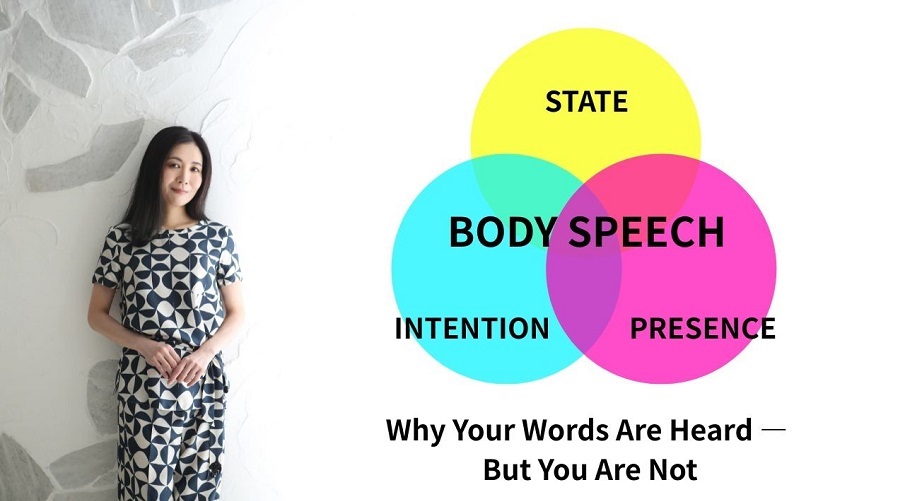
A misalignment between your intention, your state, and your physical presence.
And it happens before you speak.
People do not just hear your words.
They read your state.
And your body broadcasts that state whether you intend it to or not.
When what you feel inside matches what your body expresses, trust forms naturally.
People lean in.
Your words carry weight.
When they do not match, even slightly, people sense it.
They cannot always name what feels off.
But something in them hesitates.
And that hesitation is what stands between you and being truly heard.
I Grew Up Hyperaware of This Gap
Not as a concept, but as a physical sensation.
From a young age, shaped by childhood trauma, I learned to read people’s inner states before their words as a form of survival.
I could feel when someone’s body said one thing and their words said another.
That specific discomfort became the thing I could not stop studying.
As an actress, I developed a language for what I was observing.
I watched performers recite perfect lines with collapsed breathing.
I watched people speak about vision while their presence retreated inward.
The body always revealed what the words tried to conceal.
The inconsistency was often invisible to the speaker.
It was never invisible to the people around them.
Later, while coaching leaders, executives, and TEDx speakers across Japan and internationally, I kept seeing the same pattern.
Brilliant, capable people whose words were not landing.
Not because of what they said.
Because of the state they were in when they said it.
I did not set out to build a methodology.
I set out to understand a feeling I had never been able to explain.
Body Speech is the result of that pursuit.
What Is Body Speech?
Body Speech emerged from more than four decades of studying performance, human behavior, and communication.
Founded by Mayumi Ogata, it aligns intention, state, and physical presence to build trust, presence, and influence before words are fully spoken.
Drawing on more than forty years of stage experience and actor training, the methodology helps people communicate with congruence so that who they are and how they are perceived become aligned.
It has been applied in coaching executives, leaders, and TEDx speakers across Japan and internationally.
When these three elements move together, something shifts.
Not just in how you speak, but in how you are received.
When they are aligned, communication becomes naturally authentic.
Trust forms before you finish a sentence.
Not because you performed well.
But because you were congruent.
This is not a speaking technique.
This is not about posture, eye contact, or vocal warmups.
Those things matter.
But they are downstream of something more fundamental.
The question Body Speech asks is not, “How do you speak?”
The question is,
“What state are you in when you do?”
Why Alignment Matters More Than Ever
We live in an era where information is abundant.
Logic is learnable.
AI can produce a persuasive argument in seconds.
And yet trust remains rare.
Because trust is not built by words.
It is built by congruence.
It is built through the felt sense that what someone says matches who they are.
Body Speech is, at its core, a philosophy of evaluation:
Trust is the result of alignment being perceived.
This is why brilliant people are still misunderstood.
Not because they lack ideas.
Not because they lack preparation.
But because their inner state and outer expression have not been brought into alignment.
And alignment, unlike talent, can be cultivated.
What Comes Next?
In the next article, we will explore why this misalignment happens, even in the most capable and well intentioned people, and what it reveals about the way human beings actually form trust.
If this article named something you have felt but could not explain, the next step is practice.
My Udemy course takes you through the Body Speech fundamentals.
You will learn how to read your own state.
How to reset it before high stakes moments.
And how to build the kind of presence that allows trust to form naturally.
You do not need to perform better.
You need to align more fully.
That alignment is the foundation of Body Speech.