
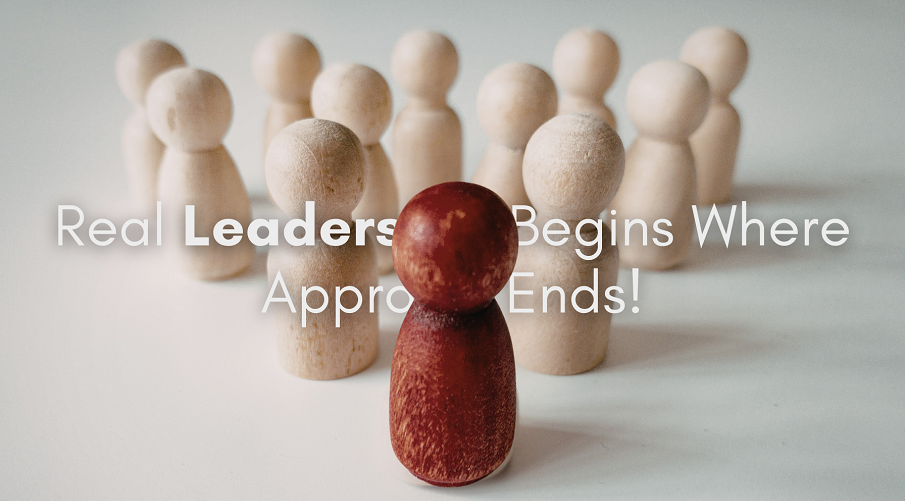
A title can make someone a manager. It cannot make them a leader.
The title may give them the right to call the meeting, set the agenda, approve the budget, or make the final decision…
But it does not give them presence. It does not make people trust them, nor does it give them the courage to say what is true when the room goes quiet.
That kind of leadership comes from somewhere else.
Where Does Real Leadership Begin?
Does leadership begin by knowing your purpose?
Does it begin by knowing your self?
No…
It truly begins when a person stops organizing their life around approval.
This is not a call to become cold, careless, or indifferent. Quite the opposite.
The most developed leaders are often the ones who care the most, but they are not controlled by the need to be liked. They can remain connected to people without surrendering their judgment to the mood of the room.
That distinction is not small. It is the difference between leadership and performance.
A leader who needs approval too much will often avoid the very truth the situation requires. They may delay a hard conversation or soften the message until it loses its meaning.
They may over-explain, over-function, or try to keep everyone comfortable while the real problem grows quietly under the table.
The organization may look polite. The team may look aligned. But everyone can feel what is not being said.
And in leadership, what is not being said often leads the room.
Gravitas Is Not a Technique
People often talk about executive presence as if it were a style problem.
Stand taller. Speak slower. Use fewer filler words. Make better eye contact. Take up more space.
There is usefulness in all of that, but it is not the essence of gravitas.
Gravitas comes from being grounded enough in oneself to be seen and heard without begging for permission.
It is the inner expectation that one has a right to exist in the room, to think clearly, to speak honestly, and to take responsibility for one’s impact.
That cannot be faked for long.
Many leaders walk into rooms carrying old fears they have never fully examined. Fear of being dismissed, criticized, being exposed as inadequate.
Fear of being disliked, left out, wrong.
Those fears do not always look like fear.
Sometimes they look like control. Sometimes they look like charm… silence, defensiveness, over-talking, avoidance, perfectionism, or the familiar corporate fog of “let’s circle back.”
We call these things leadership styles.
Often, they are not styles at all. They are unfinished development running the meeting.
One leader avoids conflict because disagreement feels like danger. Another dominates because resistance feels intolerable. Another conforms because belonging matters more than truth. And another performs competence while quietly avoiding the decision that would reveal where they actually stand.
In each case, the outer challenge is exposing the inner work.
That is one of the gifts of leadership, though it rarely feels like a gift at the time.
Leadership gives constant feedback. The missed deadline, the difficult employee, the failed initiative, the tense meeting, the colleague checking out while we are speaking. Each moment shows us where we are steady and where we are still reactive.
The question is whether we are willing to learn from it.
The Room Knows When a Leader Is Performing
There is a polished kind of leadership that can be mistaken for maturity.
It uses the right language, sounds strategic, knows how to appear calm, thoughtful, and professional. It can speak fluently about values, culture, innovation, and accountability.
But underneath, it may still be organized around fear.
Fear of being wrong, of losing control. Fear of disappointing people, of being disliked, making the decision that cannot please everyone.
People can sense the difference between a leader who is meeting reality and a leader who is managing an image.
They may not say it out loud, but they feel it. The room tightens. The conversation becomes less honest. People begin to protect themselves.
Performance leadership may produce results for a while. It may even be rewarded. But it rarely creates deep trust, because trust requires contact with reality.
Real leadership asks more of us.
It asks us to say what needs to be said without contempt. To challenge without humiliating. To disagree without disappearing. It asks us to care about people while still holding them to a higher standard.
This is not easy, and it is not supposed to be. Leadership develops us precisely because it keeps placing us in situations where our old protections no longer work.
The pleasing no longer works.
Posturing no longer works.
Hiding no longer works.
The leader has to become more honest than the role alone requires.
Can You Belong and Still Tell the Truth?
One of the great leadership tests is whether we can stay connected to a group without surrendering our truth to it.
Many people know how to belong by conforming. They read the room, adjust the message, protect the relationship, and avoid disturbing the group.
Others know how to tell the truth in a way that separates them from everyone else. They pride themselves on being blunt, disruptive, or “the only one willing to say it,” but they are often speaking from isolation rather than service.
Mature leadership asks for something harder.
It asks us to belong and tell the truth.
To stay in relationship while standing in reality.
That means we stop using approval as our compass. Approval is too unstable. It changes with the room, the politics, the fear level, the incentives, and the personalities involved.
A leader cannot be governed by that.
A leader must be able to ask:
- What is actually happening here?
- What am I afraid to name?
- Where am I protecting comfort at the expense of growth?
- Where am I calling something “strategy” when it is really avoidance?
- Where am I asking others to take risks I am not taking myself?
These are uncomfortable questions. Good. They should be.
Comfortable questions rarely create meaningful leadership.
Leadership Is a Developmental Path
Leadership is not separate from personal development. It is one of its most demanding arenas.
Every meeting is practice. Every conflict, disappointment, every moment when we are tempted to collapse, conform, dominate, charm, perform, or retreat is practice… a chance to become more conscious.
The leader is always part of the system they are trying to change.
If I want more honesty in the room, I have to become more honest.
More courage from my team? I have to examine where I am still hiding.
More people to take responsibility? I have to stop blaming the room for what I am unwilling to lead.
This is where leadership becomes more than management.
Management can organize work. Leadership develops people.
Management can track progress. Leadership can call forth capacity.
Management can maintain the system. Leadership can help transform it.
But only if the leader is willing to be transformed as well.
The world does not need more leaders who merely know what to say…
It needs leaders who are willing to become the kind of people who can hear what is difficult, say what is needed, and act in service of something larger than ego, comfort, or approval.
The deeper question is not simply, “How do I lead them?”
It is:
Who must I become to lead this well?
That is where authority becomes presence.
That is where influence becomes contribution.
And that is where leadership begins.