
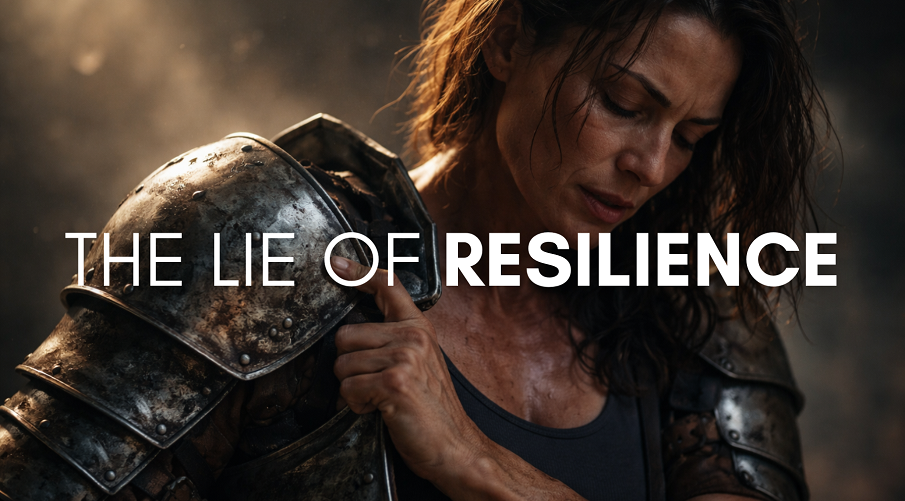
Most leaders think resilience is ‘holding it together’. That’s the lie.
Or at least, the way we have been sold it is.
We have been taught that resilience looks like strength.
That it looks like pushing through, holding it together, and never breaking.
That if you can handle more, carry more, and endure more, you are doing it right.
But what if that is not resilience at all?
What if that is survival dressed up as strength?
I am used to being one of the only people in the room with big T trauma.
Not because I think I am special.
In fact, there are plenty of people who have experienced big T trauma, some more than once.
Yet very few talk about it openly.
And I understand why.
Sometimes it is fresh, even when it is not.
It lives in the body. It lingers in reactions. It shows up in ways that are hard to explain but impossible to ignore.
Hyper independence, hypervigilance, coping under pressure.
These are not personality traits. They are learned responses. They are intelligent adaptations.
They are what protect us from life, from people, from hurt. They are what kept us safe when we had no one else to rely on.
And for that, they deserve respect.
But here is the truth.
Pain still comes.
And when it does, those same strategies begin to show their limits.
They start to wear down. They stop serving and start constraining.
Surviving Is the Easy Part
Surviving is the easy part.
You can survive and still build a career.
You can survive and still be seen as successful.
You can survive and still be the one everyone depends on.
From the outside, it can look like you have it all together.
But internally, it feels very different.
Because the cost of being “resilient” in this way is invisible at first.
Until it is not.
You become hypervigilant. Always scanning. Always anticipating. Always bracing for what might go wrong.
You become the hustler. The one who cannot switch off. The one who feels uncomfortable doing nothing.
You tie your worth to productivity. If you are not doing, achieving, or fixing, you start to question your value.
You watch, wait, and overthink. You calibrate everyone else’s needs. You anticipate problems that do not even exist yet.
And you exhaust yourself in the process while appearing completely fine to everyone else.
Yes, that strength has likely saved you.
But it is also draining you.
The cost of being the capable one, the reliable one, the one who holds everything together, is that you keep showing up in that same identity.
Coping. Holding. Managing. Staying quiet when you should speak. Playing small when you could expand.
That is not resilience.
That is armour.
Heavy, exhausting armour.
I know this because I lived it for nearly fifty years.
When the Strategy Becomes the Limitation
The hardest part is not what you went through.
It is what you built to survive it.
Because when your identity becomes the strong one, the independent one, the one who does not need anyone, it becomes incredibly difficult to change.
You keep performing the same patterns. Hypervigilance. Over functioning. Staying in constant motion.
Not because you need to anymore.
But because it feels unsafe not to.
You start to believe your value only exists in what you do, not in who you are.
And that makes integration almost impossible.
Because the very strategy that saved you is now the one that limits you.
This is why so many capable, high performing people feel stuck.
Not because they are not strong enough.
But because they are still operating from survival.
Burn the Script
At some point, something has to change.
And when it does, it is not subtle.
Because stepping away from that identity comes with consequences.
When you stop being the doer, the people pleaser, the socially acceptable version of yourself, people notice.
And not always in supportive ways.
There can be criticism. There can be judgment. There can be whispers.
Attention seeker. Too much. Different.
Especially if you grew up in an environment where your value was tied to productivity.
Where independence was rewarded.
And needing support was quietly discouraged.
Many of us learned early to just get on with it.
To carry on regardless.
To be low maintenance and high functioning.
That script worked.
It made us resilient.
It made us dependable.
It made us the ones who could hold everything together.
But it also came with a cost.
We suppressed our voice.
We filtered our truth.
We disconnected from parts of ourselves that did not feel acceptable.
What Real Strength Actually Looks Like
I saw this clearly in a leadership workshop with about twenty senior leaders.
The first exercise was simple on paper.
Share something vulnerable.
In reality, it was anything but simple.
In most professional environments, vulnerability is controlled. Measured. Rehearsed. Safe.
I chose not to do that.
I shared some of my big T trauma.
I expected judgment.
I expected discomfort.
There was a moment where the room felt still.
And then something shifted.
They listened.
Not politely.
Not performatively.
They really listened.
There was no rejection.
No dismissal.
Just acceptance.
And then something even more powerful happened.
They shared. Honestly. Deeply.
Some stories were heavier.
Some were harder.
But there was a clear difference in the people who had done the work to integrate their experiences.
They showed up differently.
They were not just open. They were grounded.
They were not just vulnerable. They were bold.
They spoke with clarity.
They contributed without shrinking.
They challenged ideas without fear.
They were not operating from armour.
They were operating from alignment.
From Surviving to Leading
This is where resilience becomes real.
Not as endurance.
Not as toughness.
But as integration.
Real resilience is not about getting through hard things…
It is about no longer being controlled by them.
It is about taking the armour off.
It is about showing up fully.
Not just with your capability…
But with your perspective. Your creativity. Your voice. Your truth.
This is the difference between surviving and leading.
The difference between performing and influencing.
People who show up in this way bring more value.
They create psychological safety.
They challenge norms.
They innovate.
They elevate the people around them.
Organisations do not need more people who can handle everything.
They need people who have handled it and evolved beyond it.
Redefining Resilience
This is why the version of resilience we have been taught is incomplete.
If resilience only means being the strong one, the capable one, the one who keeps going no matter what, then it is not growth.
It is limitation disguised as strength.
Real resilience looks different.
It includes awareness… It includes honesty… It includes the willingness to notice where old coping strategies are still running your life…
And the courage to change them.
It is not clean.
It is not linear.
It is not comfortable.
But it is real.
Face It or Stay Small
So in a quiet moment, driving home or sitting on a train, ask yourself one question.
Am I truly resilient, or am I just really good at carrying armour?
Because the cost of not knowing the difference grows over time.
It shows up as exhaustion.
As frustration.
As disconnection.
Exhausted high performing leaders are often the least effective leaders.
Understanding this can change everything.
Not just for you.
But for your team.
And for the impact you create.
The Future of Leadership
This is the work.
Moving beyond survival.
Moving beyond performance.
Moving into integration, authenticity, and real influence.
Because the future of leadership will not be defined by who can endure the most.
It will be defined by who can show up fully.
And lead from that place.