
Let us know if this sounds familiar: You spend the entire week “being good.” You meticulously track your macros, you go to the gym, and you push through the exhaustion of your daily grind…
But then Friday night rolls around, a massive wave of stress hits, and suddenly you are standing in your kitchen, frantically eating through a bag of chips.
The next morning, the heavy cloak of shame settles in. You look in the mirror and ask the same agonizing question: “What is wrong with me? Why don’t I have any willpower?”
If you have ever felt trapped on this exhausting merry-go-round of restrictive dieting and emotional bingeing, we have a message for you: You are not broken. And your willpower is not the problem.
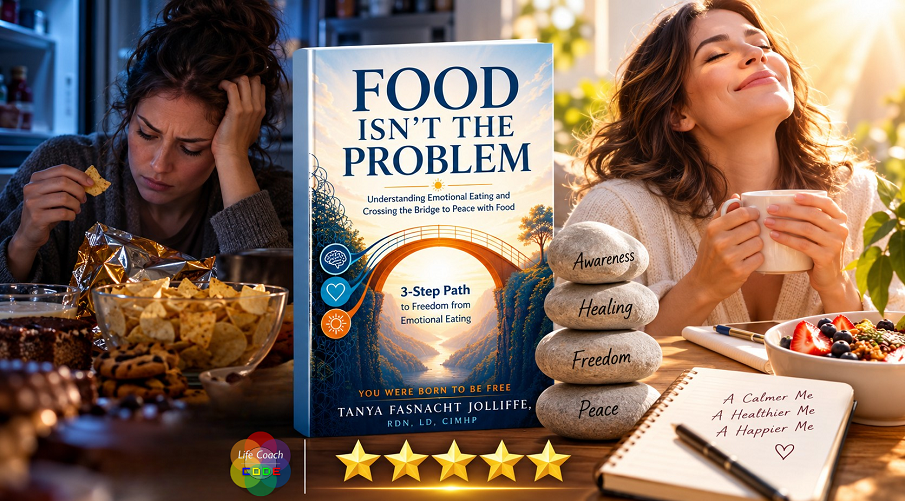
This is the liberating premise of the newly released book, Food Isn’t The Problem: Understanding Emotional Eating to Cross the Bridge to Peace with Food, by Tanya Fasnacht Jolliffe (RDN, LD, CIMHP).
Officially launched this week, this book is making massive waves in the health and wellness space… and for good reason!
I have read countless books on mindset, weight loss, and personal development. But rarely do I find a book that so perfectly bridges the gap between biological science and emotional healing.
Here is our honest review of why Food Isn’t The Problem is an absolute must read, and how it is rewriting the rules of wellness.
“Food Isn’t The Problem” Honest Review
The Ultimate Paradigm Shift: You Aren’t Addicted to Food
The diet industry has sold us a lie.
It has told us that if we just find the right meal plan and exercise more discipline, we will finally achieve our health goals.
But Tanya Fasnacht Jolliffe, a Registered Dietitian Nutritionist and Certified Integrative Mental Health Professional, takes a sledgehammer to that idea.
In the opening chapters, she delivers a massive paradigm shift: You are not addicted to food; you are addicted to the relief the food gives you.
When life gets overwhelming, your brain’s fear center (the amygdala) sounds the alarm.
It literally shoves your logical brain into the passenger seat and takes the steering wheel.
Your nervous system demands a way to regulate the stress, and food is the most predictable, reliable, and accessible tranquilizer in your environment.
We can fight this as much as we want with our will power… but at the end of the day our subconscious mind wins because will power is a limited resource and the subconscious mind controls 95% of our actions.
It is an unfair fight… and it shouldn’t be a fight!
Jolliffe brilliantly explains that emotional eating is not a moral failure, it is simply a highly trained neural response. You aren’t weak. Your brain is just doing what it was taught to do to survive.
Decoding Your Cravings (The “Aha!” Moment)
One of the most fascinating and transformative sections of the book is the “Dictionary of Cravings.”
Jolliffe acts as a symptom sleuth, teaching the reader that cravings are actually a secret language.
You don’t crave specific foods by accident.
You subconsciously choose the exact physical texture required to fix your current emotional state:
- Craving Crunchy (Chips/Pretzels): You are experiencing Anger or Frustration. You are looking for a physical release valve for pent-up tension in your jaw, literally trying to “chew your way” through a problem or bite back unsaid words.
- Craving Creamy/Soft (Ice Cream/Mac & Cheese): You are experiencing Sadness, Loneliness, or Anxiety. The physical sensation of heavy, cold cream coating a tight throat acts as a soothing balm. It is a biological “hug.”
- Craving Sweet (Chocolate/Candy): You are burnt out and seeking a dopamine hit as a reward. This is what Jolliffe calls the “Celebration Trap”, eating because you feel you “deserve a treat.”
By learning to decode the texture, the reader is empowered to identify the hidden emotion driving the binge.
A Practical Toolkit, Not Just Theory
What elevates Food Isn’t The Problem from a good book to a 10 out of 10 coaching masterpiece is its sheer practicality.
Jolliffe doesn’t leave you sitting in your emotions without a life raft. She provides a concrete, 3 step cognitive reappraisal framework: Name It, Claim It, Reframe It.
She teaches the reader how to implement a 5 minute “Intentional Pause” to hit the biological brake pedal on the vagus nerve.
Instead of ‘white knuckling‘ a craving, she guides you to build personalized “Comfort Menus” and “Dopamine Menus”… giving your nervous system non food alternatives to find true relief.
The book even tackles the harsh reality of relapse.
Instead of punishing a slip up with more food restriction (which guarantees another binge), Jolliffe teaches the reader how to use self compassion to turn a bad night into a valuable “training rep.”
The Verdict
If you are tired of the food noise, the guilt, and the constant restricting, this book is your roadmap to freedom.
Tanya Fasnacht Jolliffe has managed to write a clinical, neuroscience backed guide that reads like a warm, empathetic conversation with a master life coach.
It removes the shame of emotional eating and replaces it with profound curiosity.
Food Isn’t The Problem is officially available now worldwide.
Ready to cross the bridge to lasting food freedom?
You can grab your copy of the book today on Amazon. To take the work even further, we highly recommend pairing it with Tanya’s companion workbook, The Mindful Me Journey, designed to help you track your triggers and rewire your neural pathways daily.
For more information, one on one coaching, and corporate wellness resources, visit Tanya at www.LITWellnessSolutions.com.