
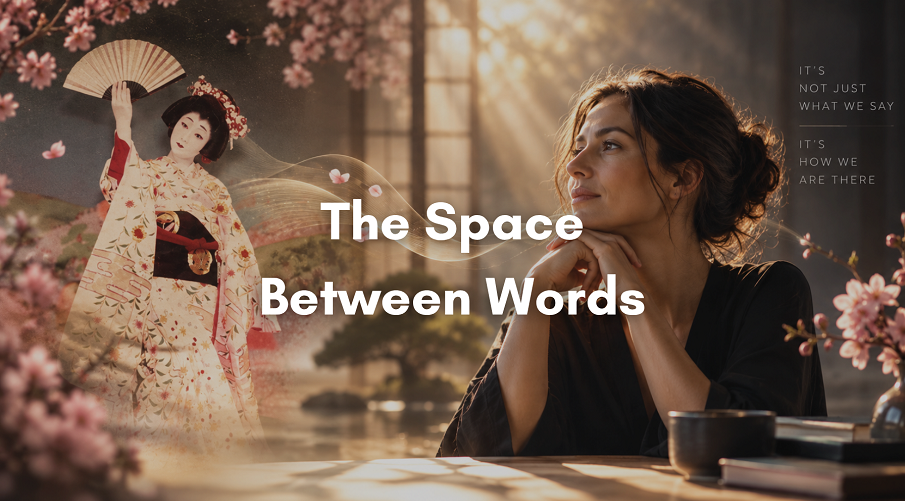
AI can generate the words.
Increasingly sophisticated words. Contextually appropriate, emotionally calibrated, persuasively structured words, faster than any human being can compose them.
So the question has changed.
If anyone can generate the words, what remains uniquely human in communication?
Not the output. Not the language itself.
The space around it.
Presence Matters More Than Communication in the Age of AI
When Words Become Easier to Produce
For most of human history, the ability to communicate clearly, to write well, to speak persuasively, and to construct a logical argument was a differentiating skill.
That is no longer true in the same way.
What AI has done is not simply automate tasks. It has made generating language easier than ever.
And when words become easier to produce, something else becomes more visible.
When everyone can generate a compelling email, a polished presentation, or a perfectly structured response, the person behind the language becomes more visible, not less.
The question audiences are now asking, often without realizing it, is not What are you saying?
It is Who is saying it, and are they really here?
This is the question that presence answers.
And presence, unlike language, cannot be produced on demand.
Perhaps We’ve Been Defining Communication Too Narrowly
I’ve spent many years as an actor and performer, learning to listen to what happens between the lines.
For more than two decades, I’ve also practiced Japanese dance, a form where movement, stillness, timing, and space communicate without a single word.
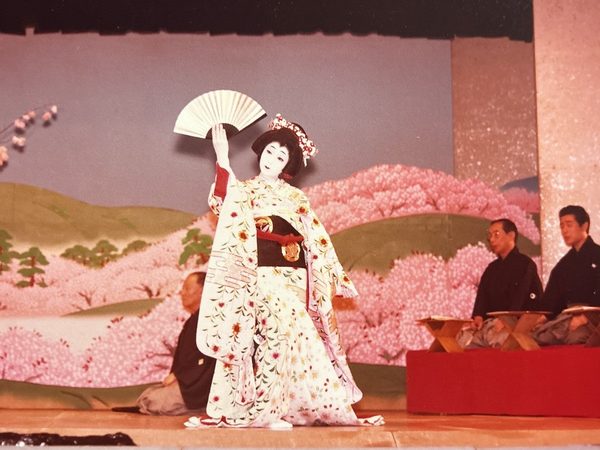

It took me many years to put into words what my body had already learned.
Perhaps we’ve been defining communication too narrowly.
We tend to think of communication as the exchange of words. But human communication happens in the space around them, between them, and before them.
There’s a concept in Japanese aesthetics called Ma, often translated as “negative space” or “pause,” but more accurately described as the meaningful interval between things. In music, it’s the silence between notes. In conversation, it’s the space between words where something real is exchanged.
Ma is not empty. It’s full of intention, attention, and reception.
The same thing happens in every conversation, every meeting, and every moment of communication between human beings.
What’s exchanged isn’t only information. It’s attention. Intention. The felt quality of being received.
And the space where that exchange happens, the space the words don’t fill, is where communication actually lives.
Silence Is Not Empty
Most people, especially in Western and fast paced communication cultures, experience silence as absence. A gap. Something to be filled.
But over the years, observing what happens between human beings when they speak, I’ve come to understand something different.
Silence is not empty. It’s full.
Not because we should speak less, but because something happens in the space before the next word.
We receive. We feel. We interpret. We choose.
In Japanese traditional dance, I learned to experience this meaningful interval as Ma.
It is full of attention. Full of interpretation. Full of the body’s response to what was just said. Full of the choice, conscious or not, of what to say next.
Think of communication as a game of catch.
One person throws. The other receives. There’s a moment, however brief, between the throw and the return. In that moment, the receiver processes not just the words, but also the tone, the weight, and the intention behind them. Their body responds. And then they return the ball from that response.
Silence is the space between the throw and the return.
It’s not where communication stops. It’s where communication actually happens.
AI can give you the next sentence. But it cannot stand inside that moment of receiving, the moment when another human being’s words land in your body and you feel them before you answer them.
That capacity belongs to the person in the room.
The Body Reads What the Words Don’t Say
Body Speech is built on this observation.
In the articles before this one, we explored how trust is formed before language arrives, and how another person reads your state, your breath, and your physical presence before your words are consciously evaluated.
But there’s another dimension to this.
Presence isn’t only the ability to be seen.
It’s the ability to receive.
A person who’s truly present in a conversation isn’t only broadcasting. They’re receiving. Their body is open to what’s coming toward them. Their attention isn’t preoccupied with the next thing they want to say. They are, in the truest sense, there.
This is rarer than it sounds.
In a world increasingly optimized for output, where we’re measured by what we produce, what we respond with, how quickly we respond, and how well we perform, the capacity to pause and receive is becoming endangered.
And yet, it’s precisely this capacity that the people around us are most hungry for.
From Commanding the Room to Creating Space
Traditional models of leadership communication have long emphasized presence as a form of projection. Command the room. Project confidence. Own the space.
Body Speech starts somewhere different.
The goal isn’t to command the room. It’s to settle it.
When a speaker arrives with regulated breath, a grounded body, and open attention, you can feel the room settle. Defenses lower. Something that was contracted begins to open.
This isn’t a technique for appearing confident. This is what happens when a human being chooses to regulate their own state and, in doing so, creates space for others to regulate as well.
This is coherence in action. And coherence, as Body Speech teaches, is contagious.
But so is its absence.
A speaker who’s performing rather than arriving, whose breath is shallow and whose attention is searching for safety rather than meeting the room, creates a different kind of contagion. The audience tightens. Guardedness rises.
The words may be identical in both cases. What the room receives is entirely different.
AI Can Generate a Response. Can You Receive One?
This is the question I find most important for this moment.
As AI systems become more sophisticated at producing language, generating the next sentence, the empathetic response, or the perfectly calibrated reply, there’s a risk that human communicators will begin to optimize in the same direction.
More output. Faster responses. More persuasive language.
But the most irreplaceable thing a human being can offer in a conversation isn’t the quality of their output.
It’s the quality of their reception.
The pause before the answer. The moment of actually feeling what the other person said. The silence in which something real is allowed to land.
Can you read the space between the lines?
This is a distinctly human capacity, and one that human beings are at risk of losing, not because of AI, but because the culture of communication increasingly rewards those who speak most quickly and most fluently.
Body Speech is a counter to that pressure.
It begins with something simple: noticing what happens in your body before you decide what to say next.
Not speaking faster. Not generating better responses. Pausing long enough to receive and responding from that place, rather than from the performance of a response.
Presence Is the Space We Create for Each Other
Before you speak, there’s a space.
That space isn’t empty.
It’s where you receive.
It’s where you choose.
It’s where connection begins.
The most human part of communication may not be the words we choose. It may be the silence that allows us to hear what comes before them.
In the age of AI, language will become more abundant. More optimized. More fluent.
The space between the words will remain entirely human.
Coherence is contagious. So is its absence.
The choice of which one you bring into the room starts with you.
In the next article: what happens when the emotions we carry into a room are blocking our presence, and a practice for releasing them before you speak.
Body Speech isn’t something you understand by reading about it. It’s something you begin to notice in your own body.
If you’d like to experience the framework for yourself, my Udemy course takes you through the Body Speech fundamentals: how to read your own state, how to reset it before important moments, and how to build the kind of presence that makes trust form naturally.
You don’t need to perform better. You need to arrive differently.