
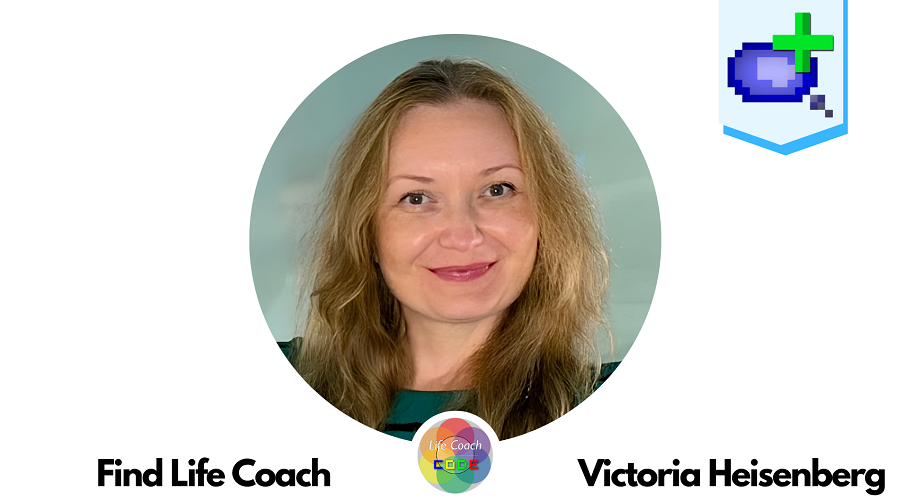
Victoria Heisenberg is one of the coaches that we found this month and we did a little interview with her. She impressed us with her kindness and honesty.
She helps people look beneath their emotional and behavioral patterns to understand what is truly driving their reactions, struggles, and recurring challenges, creating greater self awareness and more possibilities for meaningful change.
She combines her background in psychology and behavioral health with curiosity, careful observation, and a nonjudgmental approach, helping clients move away from asking “What is wrong with me?” and toward understanding what their behavior may actually be communicating.
She focuses on practical and sustainable change by helping people recognize patterns earlier, understand their triggers, develop useful emotional and behavioral skills, and create healthier responses they can actually use during stressful and challenging moments in everyday life. Here is what she said…
Meet Life Coach Victoria Heisenberg:
Name: Victoria Heisenberg
Pillar: The Mind
Who is this coach for: Children, adolescents, adults, parents, and families who want to better understand emotional and behavioral patterns, improve self awareness, and respond to challenges more effectively.
How they can help: By using structured assessments, behavior tracking, psychoeducation, skill building exercises, visual supports, parent coaching strategies, and evidence based interventions when they are useful.
First of all, how are you and your family doing in these “crazy” times?
We’re doing well, although “normal” seems to have become a very ambitious concept lately.
My family is healthy, everyone is moving forward with their own lives, and there is always something changing.
I’ve learned not to wait for life to become perfectly organized before enjoying it.
If I did, I might be waiting forever.
So I’ve become pretty good at enjoying life while it’s still under construction.
Apparently, chaos and I have reached a working relationship.
How did the coronavirus pandemic affect your clients? Did it affect you at all?
The pandemic became an enormous involuntary experiment in what happens when you remove routine, privacy, predictability, social contact, and most of our usual escape routes all at once.
People struggled.
For many children and families, difficulties that were already present became much more visible.
Anxiety increased.
Family conflict intensified.
Children lost structure, peer connection, and ordinary routines that had been regulating them more than anyone realized.
What interested me was that the pandemic did not always create entirely new problems.
Often, it turned up the volume on the old ones.
Adults discovered this too.
A packed schedule can hide a surprising amount of emotional material.
Suddenly, the schedule disappeared, everyone was home, and apparently inner peace did not automatically arrive with the sourdough starter.
It affected me too, of course.
I came away with much more respect for how deeply human beings depend on structure, connection, and a sense that life is moving somewhere.
It also cured me of the fantasy that certainty is something we can permanently arrange.
These days, I’m less interested in controlling every variable and more interested in what we do when the variables refuse to cooperate.
The Origin:
Tell us about you, your career, how you started with your coaching career?
I became fascinated with psychology for a very simple reason: people make absolutely no sense.
We say one thing and do another.
We repeat things we swore we would never repeat.
Children communicate entire emotional worlds through behavior before they have the words to explain any of it.
Adults do too.
We are simply much better at explaining why our behavior is perfectly reasonable.
I wanted to understand what happens underneath all of that.
That curiosity eventually became a profession.
I studied psychology in Ukraine, earning both bachelor’s and master’s degrees, and today I work in behavioral health in the United States with children, adolescents, and families navigating complex emotional and behavioral challenges.
My work can take me from a conversation with a child to meetings with parents, schools, medical providers, or an entire multidisciplinary team.
Very often, the question starts as, “How do we stop this behavior?”
I am usually more interested in, “What is this behavior trying to tell us?”
That distinction has shaped almost everything about the way I work.
I should also clarify something: I’m not a traditional life coach.
My professional background is in psychology and behavioral health.
When Dejan reached out, I told him exactly that, and he essentially said, “Perfect. You belong in the Mind pillar.”
So here I am.
Apparently, I became a life coaching interview subject without ever having the dramatic “I became a life coach” origin story.
Life is efficient like that.
What connects my work to coaching is the same basic curiosity that brought me into psychology in the first place: helping people see themselves more clearly and discover what becomes possible once they do.
What was your biggest obstacle that you had to overcome in your life that made you who you are today?
Learning to start over without treating starting over as failure.
That sounds simple until life asks you to do it more than once.
New country.
New systems.
New professional rules.
New expectations.
Suddenly, things you knew how to do well required translation, sometimes literally, sometimes professionally, sometimes internally.
And starting over can be very humbling.
You can be experienced and still be the person asking basic questions.
You can be competent and still feel completely lost in a new system.
You can know exactly who you are and still find yourself rebuilding the evidence for it from scratch.
For a long time, I thought progress meant moving forward in a straight line.
Life apparently found that concept adorable.
What changed me was realizing that rebuilding does not erase what came before.
You do not become a beginner just because the environment changed.
You carry your judgment, your experience, your mistakes, your instincts, and your history, and then you learn the new language of the room.
That made me less afraid of beginnings, less impressed by titles, and much more interested in what people are actually capable of when the familiar structure disappears.
Now, when life says, “We’re starting again,” my reaction is usually somewhere between, “Of course we are,” and, “Fine. Show me the map.”
What are the biggest lessons that you learned overcoming your greatest obstacle?
Probably three.
First: Competence travels better than circumstances do.
A title can disappear.
A familiar system can disappear.
The people who already know what you are capable of may suddenly be thousands of miles away.
But the way you think, solve problems, read situations, make decisions, and recover from mistakes comes with you.
Second: Asking basic questions does not make you less intelligent.
That one took some adjusting.
Starting over means occasionally being very capable and very confused at exactly the same time.
It is an interesting combination.
Third: Identity is much bigger than whatever role you happen to be playing at the moment.
We attach ourselves so easily to jobs, places, routines, status, and plans.
Then life rearranges the furniture, and suddenly we are standing there wondering who moved everything.
Eventually, I learned that I am still me even when the surroundings change.
And one bonus lesson: Humor is not the opposite of taking life seriously… Sometimes it is how we remind ourselves that pain may be in the room, but it does not get to own the whole house.
The Coaching Style:
How do you innovate with coaching your clients?
I’m not sure innovation always means inventing something new.
Sometimes it means refusing to accept the obvious answer too quickly.
Instead of asking, “How do we fix this person?” I want to know:
What is this behavior doing for them?
What happens right before it?
What changes afterward?
What are we missing because we are staring so hard at the behavior itself?
That is where my clinical background really shapes my work.
I look at the person, but also at the system around them: relationships, environment, stress, communication, expectations, and skills that may not be there yet.
Behavior rarely drops out of the sky.
It usually starts making much more sense once you understand what it is responding to.
I also don’t think insight deserves a trophy simply for being insightful.
A conversation can sound brilliant in the room, but if none of it is usable on Tuesday afternoon when someone is exhausted and arguing with their teenager, we still have work to do.
So my version of innovation is probably less glamorous than people expect.
Make it useful.
Make it usable.
And make sure it still works on Tuesday.
What’s unique about your coaching approach?
I rarely trust the first version of the problem.
Someone says, “My child is defiant.”
Or, “I have no motivation.”
Or, “My relationship is the problem.”
Maybe.
But usually, that is the headline, not the whole story.
My clinical background trained me to look underneath the label.
- What is happening around this person?
- What keeps setting this off?
- What purpose might the behavior be serving?
- What skill is missing?
- What are we calling a personality problem that might actually be fear, exhaustion, overload, or a perfectly understandable response to a difficult situation?
I am probably less interested in giving advice than people expect.
Advice is wonderfully efficient when you are assembling furniture.
Human beings are slightly less cooperative.
I would rather help someone become curious about something they have spent years judging.
Because the moment you move from “What is wrong with me?” to “What is happening here?” the conversation changes.
And very often, so do the possibilities.
What benefits do your clients get after working with you?
Ideally, they need me less.
That may sound like a terrible sales pitch, but I mean it.
I want people to become better at noticing what is happening before they are already ten steps into the same old reaction.
A parent may stop interpreting every difficult behavior as a personal attack.
A teenager may recognize the moment before shutting down or exploding.
An adult may discover that what they have been calling “laziness” or “lack of motivation” is actually fear, overload, avoidance, or something else entirely.
That matters because confusion is exhausting.
When you can name what is happening, you have a better chance of doing something different with it.
Not perfectly.
I am not trying to produce people with flawless coping skills and beautifully regulated nervous systems.
I have yet to meet one of those in the wild.
What I want is simpler: more awareness, more options, and a little more ability to recover when a day goes badly.
To me, that is useful change.
And useful change tends to last longer than impressive change.
Do you use any specific tools to be efficient with your clients?
Yes, but I try not to fall in love with tools.
A worksheet is still just a worksheet.
It does not become profound because someone printed it in calming colors.
My background in behavioral health means I use structured assessments, behavior tracking, psychoeducation, skill building exercises, visual supports, parent coaching strategies, and evidence based interventions when they are useful.
But I am very particular about that last word.
A tool has to earn its place.
Does it show us something we were missing?
Does it make a complicated idea easier to use?
Can someone remember it when they are stressed, tired, angry, or halfway through a difficult Tuesday?
If not, it may simply be a very beautiful piece of paper.
And I use observation constantly.
People tell you a great deal through what they repeat, what they avoid, what changes their energy, and sometimes through the sentence they say five minutes after insisting that everything is fine.
So yes, I use tools.
I just prefer the ones that actually earn their keep.
The Impact:
If you had a super megaphone that, when you speak into, the whole world will hear your message, what would you say?
You do not have to become a different person before you are allowed to have a good life.
Understand yourself.
Be honest about what needs to change.
But stop treating your current self like a disappointing rough draft.
You are already here.
Start from there.
What is the greatest lesson you have learned in your life?
That life does not have to look right to be meaningful.
We spend an extraordinary amount of time measuring ourselves against invisible timelines.
By this age, I should have figured this out.
By now, I should be further ahead.
My relationship should look like this.
My career should look like that.
I should be happier.
Calmer.
More certain.
More organized.
There is an exhausting amount of “should” involved in being human.
And while we are comparing our actual lives to the imaginary version we think we were supposed to have, we can miss the life happening right in front of us.
Some of the most important periods of my life did not look particularly impressive while I was living them.
Some looked messy.
Some looked uncertain.
Some looked suspiciously like I had absolutely no idea what I was doing.
Sometimes that was accurate.
But they still mattered.
So I have stopped waiting for my life to look more convincing before allowing myself to live it.
Apparently, life did not receive the memo about our five year plan.
Your final thoughts?
I think we put a lot of pressure on ourselves to feel ready before we move.
We want clarity first.
The right plan first.
Confidence first.
Some reassuring evidence that we are definitely not about to make a ridiculous decision would also be nice.
Life is rarely that organized.
Sometimes clarity comes after the conversation.
After the mistake.
After the uncomfortable first attempt.
Sometimes we understand what we needed only because we tried something and discovered, very efficiently, what absolutely did not work.
So I would leave people with this:
You do not need complete certainty to make one decent next move.
And sometimes progress is much quieter than we expect.
It may be noticing something five minutes earlier.
Recovering from a bad day a little faster.
Saying something differently.
Choosing not to repeat one familiar reaction.
Those things rarely come with background music.
They still count.
Where Can You Find Victoria Heisenberg?
If you liked this interview and if you would love to gain more clarity and equip you yourself with practical tools that work even on a regular Tuesday, see what Coach Victoria has to offer.
And if you’d like to connect with her more personally, you can do that through LinkedIn or by sending her a direct message on her Email [email protected]. It was an honor having this interview with her.