
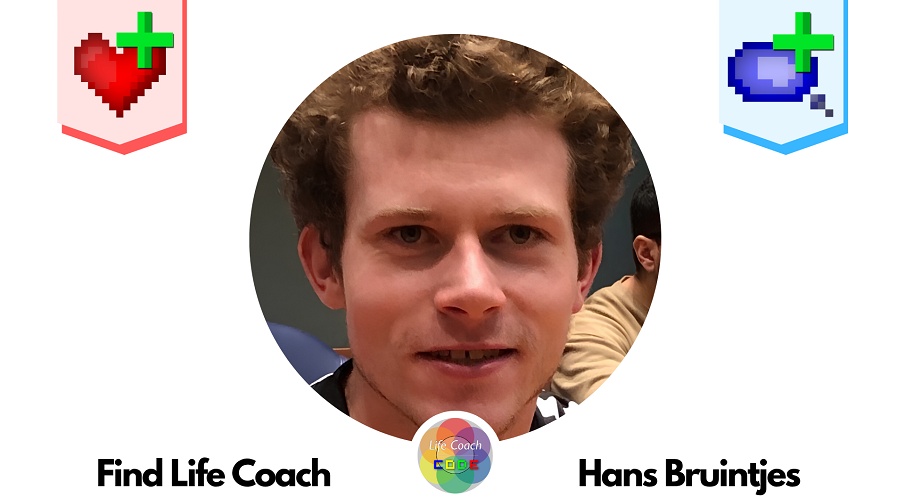
Hans Bruintjes is one of the coaches that we found this month and we did a little interview with him. He impressed us with his unique perspective and passion for coaching.
He brings together lived experience as a neurodivergent person with a background in law, public policy, and independent research into discrimination and inclusion. His work is shaped by both personal experience and a deep understanding of the systems that influence people’s lives.
He is passionate about giving neurodivergent people a stronger voice, particularly in environments where their needs and perspectives are often overlooked. Through coaching, research, presentations, and advocacy, he helps people navigate challenges with greater awareness and confidence.
He offers a distinctive perspective by connecting personal experience with legal, administrative, and human rights knowledge. His work encourages people to question the rules and expectations around them, understand what truly serves their wellbeing, and take purposeful action toward meaningful change. Here is what he said…
Meet Life Coach Hans Bruintjes:
Name: Hans Bruintjes
Pillar: The Mind, The Heart
Who is this coach for: Neurodivergent people seeking greater self awareness, inclusion, confidence, and support in navigating education, work, and everyday systems.
How they can help: By combining lived experience, coaching, legal knowledge, and policy insight to help clients understand their options, advocate for themselves, and create meaningful change.
First of all, how are you and your family doing in these “crazy” times?
I’m doing fine.
I still live with my parents, so I can easily build my career and study public law alongside it.
How did the coronavirus pandemic affect your clients? Did it affect you at all?
The coronavirus had hardly any impact on me.
I was already working from home a lot before that time, and I was already taking a distance learning course.
So it didn’t really affect my work.
Life was mainly influenced by measures such as face masks and social distancing.
The Origin:
Tell us about you, your career, how you started with your coaching career?
This is a long story, and I do my coaching for several reasons.
The first reason is that I am autistic myself and, as a result, have experienced a great deal of inaccessibility in education, primarily due to policy choices.
I was advised against studying at a university of applied sciences, and I was treated poorly during an internship, which resulted in health problems.
I thought about this and realized that this has to stop.
The second reason is that I worked as a policy advisor, and in that role, my portfolio included social issues and diversity and inclusion, among other things.
In doing so, I read all kinds of reports and policy documents on discrimination, inclusion, and human rights.
And every time, I saw that there was no attention paid to autistic and other neurodivergent people.
I wanted to change that.
The third reason was that, for my bachelor’s thesis, I started conducting my own research using a survey on discrimination against neurodivergent people.
I received so many responses to it that I thought, “I need to do more with this.”
After quite a few failed job applications, with arguments such as “you don’t fit in here” and “you lack experience,” I thought, “I need to make this my profession.”
That is why I started conducting independent research into discrimination against neurodivergent people, and I apply my knowledge by giving presentations and providing advice to government organizations and universities, among others.
What was your biggest obstacle that you had to overcome in your life that made you who you are today?
The advice not to pursue higher education was particularly significant.
I was told this by the admissions coordinator at a vocational school for students facing barriers to employment.
During the introductory interview, the conversation revolved around my autism and my rejections from regular vocational schools.
That coordinator told me at the time that I would not be entitled to the accommodations I needed in higher education.
At the time, I gave in because I didn’t know what to say in response.
So I went to study there.
But I didn’t choose the program myself.
I was first thoroughly assessed.
I completed all kinds of practice assignments and tests and had conversations about everything in my life.
Based on that, advice was given regarding a tailored study program.
Initially, that gave me some peace of mind.
But later in my time at that school, I was often spoken to aggressively by an internship supervisor, which the school had approved at the time with phrases such as “not our responsibility.”
I also experienced all sorts of stigmatizing remarks made about me by the work coach.
I knew then that this wasn’t going to work for me.
I did have a way out back then.
I applied for another assessment, but this time one focused on higher education.
That was possible, and I was advised to pursue a distance learning law course and work as an advisor.
So I started a distance learning course and am currently taking another one.
What are the biggest lessons that you learned overcoming your greatest obstacle?
The system I am part of can also make mistakes.
And you have to be vigilant about that.
As a child, I was quite the authority figure everywhere and followed every rule.
This also stemmed from the fact that I really like rules and agreements.
But I have also learned that you can go so far with this that rules, agreements, and actions that can hurt or harm others end up being defended.
This also happened to me during that intense internship.
I spoke up about it once and asked if I could take it easier.
This request was rejected with an explanation such as “that makes you tough.”
My parents also felt that the work coach treated me poorly on multiple occasions and spoke out about it.
I still find agreements and rules very important, and they still give me a lot of peace.
But now I believe that you establish these primarily to protect things like love, safety, health, and harmony.
So the rules you make should serve these goals.
And if they do not, they must be adjusted.
The Coaching Style:
How do you innovate with coaching your clients?
The work is largely influenced by the public.
In the advice and presentations I give, I sometimes receive questions from my clients that prompt me to conduct further research.
I also try to tailor my coaching as closely as possible to the client’s needs.
Furthermore, it involves a great deal of observation.
Where can I make a difference as a coach?
I just mentioned the absence of neurodivergence in reports on discrimination.
I can make a difference here by sharing what I have experienced as a neurodivergent person, analyzing it using relevant concepts, and building upon work that has already been done.
My research methods are primarily inspired by research into discrimination that is already being conducted systematically, combined with relevant legal concepts and my personal experiences with discrimination.
What’s unique about your coaching approach?
I combine my experiential knowledge with a legal and administrative perspective.
Because I am neurodivergent, I can view my work through the eyes of neurodivergent people.
And because I have worked as a policy advisor and am a lawyer, I can also look at individual cases from a legal and administrative perspective.
My knowledge profile is also very unique.
For instance, there are many researchers and coaches who focus on neurodivergence in the workplace or in education.
There are researchers and policy advisors who focus on inclusion and discrimination.
There are also lawyers specializing in constitutional law and human rights.
But in my work, I combine all these fields.
What benefits do your clients get after working with you?
For many neurodivergent people, I am a voice in places where I can make an impact.
For example, I discussed my research with the Dutch Coordinator against Discrimination and Racism.
I have also used this knowledge to advise politicians on submitting proposals to ensure greater inclusion.
One example is submitting a proposal to clarify definitions so that compliance with human rights becomes more verifiable.
And my book, “The Voice of the Neurodivergent,” has been used by several people to shape their research into neurodivergence and contribute to relevant discussions, such as disclosure about one’s neurodivergence and the knowledge policymakers need to possess.
Do you use any specific tools to be efficient with your clients?
Yes, I mainly use LinkedIn.
Here I can see what is important to my target audience.
I also often have video calls in response to content I post or to content that other people post.
That way, I can network effectively as well.
The Impact:
If you had a super megaphone that, when you speak into, the whole world will hear your message, what would you say?
“Accept each other as you are to ensure peace, health, and safety, and treat each other and what is important to each other with appropriate respect.”
“Handle your responsibilities with care, especially if you hold a position of power, such as a civil servant, teacher, or director.”
“Realize that the things you do can have a significant impact on people’s lives.”
What is the greatest lesson you have learned in your life?
Think carefully about why you do what you do.
And I am mainly referring to the following questions.
What are my goals?
More money?
Better health?
More peace of mind?
Do my actions contribute to this?
And you certainly need to pay close attention to this.
For instance, many actions may be popular, yet they are not necessarily effective.
And some “ugly” and “unusual” actions can actually be good for achieving your goal.
Thinking about this and having a strong vision regarding it fosters a healthy level of self awareness.
This provides peace of mind and can also help you overcome setbacks.
Your final thoughts?
I am happy to have been given a platform here to share these matters with people.
I consider these matters very important, and they are a major reason why I do my work.
Wher Can You Find Hans Bruintjes?
If you liked this interview and you would love to see how Coach Hans can help you, go to hansbruintjes.com and learn more about his coaching.
If you’d like to peak a glimpse into his coaching, we strongly suggest to get his book and join his Substack. Feel free to follow his Instagram account as well.
And if you’d like to connect with him more personally, you can do that through LinkedIn or by sending him a direct message on WhatsApp or to his Email [email protected]. It was an honor having this interview with him.