
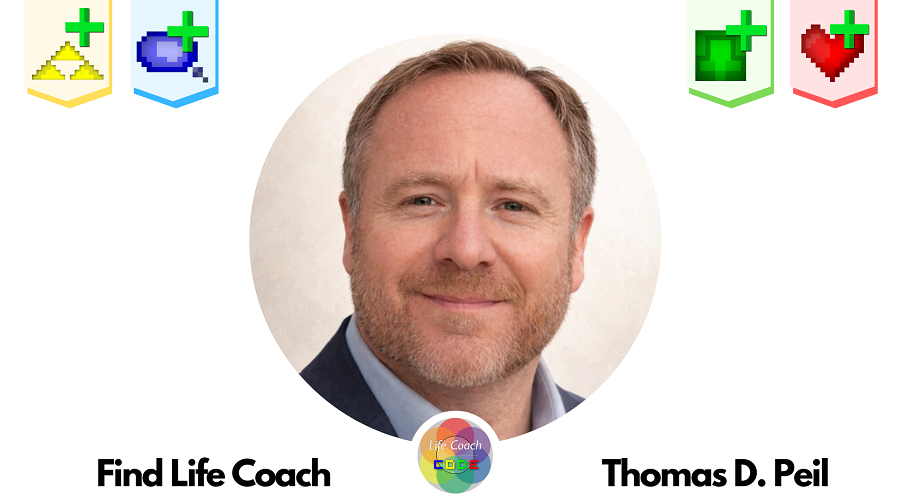
Thomas D. Peil is one of the coaches that we found this month and we did a little interview with him. He impressed us with his innovation and passion.
He is the founder and CEO of Adonis Wellness Group™. He helps people transform difficult life experiences into opportunities for growth, resilience, and greater self awareness, drawing from his own journey through trauma, grief, addiction, and the search for purpose.
He combines consciousness, transpersonal psychology, physiology, trauma awareness, meditation, leadership, behavioral science, and identity development to help clients bridge the gap between what they know, what they value, and how they actually live.
He is the creator of the 3.2 Method, combining morning, midday, and evening reflection with journaling, breathwork, meditation, goal review, physical practices, and pattern tracking to turn insight into consistent action and lasting personal change. Here is what he said…
Meet Life Coach Thomas D. Peil:
Name: Thomas D. Peil, Founder and CEO of Adonis Wellness Group and creator of the 3.2 Method™
Pillar: The Spirit, The Mind, The Body, The Heart
Who is this coach for: People who want to overcome past challenges, build resilience, understand their patterns, and consciously reshape their identity and daily behavior.
How they can help: By using the 3.2 Method, as well as various tools and techniques like journaling, guided reflection, breathwork, meditation, goal review, physical practices, and pattern tracking technology.
First of all, how are you and your family doing in these “crazy” times?
We are doing well, and I am grateful.
Life has taught me not to answer that question automatically.
Doing well does not mean everything is easy or perfectly settled.
It means we are present, connected, and continuing to move forward.
My son is an adult now, and I am proud of the man he has become.
I have also learned that family is not only defined by proximity.
It is built through showing up, checking on one another, and refusing to let pride or busyness replace real connection.
How did the coronavirus pandemic affect your clients? Did it affect you at all?
I was not operating a conventional coaching practice when the pandemic began, so I do not want to rewrite history and pretend that I was.
The pandemic affected the formation of my work because it intensified a period of profound personal crisis.
In 2020, my brother Adonis died by suicide.
Later that year, I found my mother after she had passed away.
At the same time, I was confronting addiction, trauma, isolation, and the question of whether I was going to continue living the way I had been living.
That period stripped away the illusion that information alone changes people.
People were surrounded by advice, content, and motivational language, yet many were still isolated, dysregulated, and disconnected from themselves.
I began to understand that human beings need practices that help them reflect, regulate, reconnect, and integrate what they know into daily life.
That realization became part of the architecture of the 3.2 Method.
The Origin:
Tell us about you, your career, how you started with your coaching career?
I did not begin by deciding to become a life coach.
I arrived here through lived experience.
I am a United States Marine Corps infantry veteran, a father, an author, and the founder of Adonis Wellness Group.
I am also completing my bachelor’s degree in Consciousness and Human Potential at Maharishi International University, with a minor in Transpersonal Psychology.
For years, I lived with trauma, depression, addiction, grief, and a lack of purpose.
I was never a bad person.
I was a human being in pain who had not yet learned how to organize that pain into meaning.
My life began changing when I stopped searching for one dramatic breakthrough and started rebuilding through disciplined, repeated practices.
Reflection, physical training, meditation, writing, accountability, and service gradually became part of my identity.
That process eventually became the foundation of the 3.2 Method.
My work today is broader than traditional coaching.
I think of myself as a Transpersonal Architect, someone who integrates consciousness, psychology, physiology, identity, leadership, spirituality, and technology into systems that help people create lasting change.
What was your biggest obstacle that you had to overcome in your life that made you who you are today?
The greatest obstacle was not one event.
It was the accumulation of trauma, grief, addiction, and purposelessness.
I lost my father after a tornado took his life.
In 2020, my brother died by suicide, and later that year I found my mother after she had passed away.
I also had to confront my dependence on alcohol, Xanax, and pain medication, along with years of depression and unresolved trauma.
The hardest part was realizing that pain could explain how I arrived somewhere without being allowed to decide who I would become.
I could not change what happened, but I could take responsibility for what happened next.
That distinction changed my life.
I stopped asking only, “Why did this happen to me?” and began asking, “What am I responsible for building from here?”
What are the biggest lessons that you learned overcoming your greatest obstacle?
I learned that resilience is less dramatic than people imagine.
It is not one heroic moment.
It is making breakfast, answering emails, attending class, paying bills, training, writing, and showing up on the days when nobody would blame you for quitting.
I learned that discipline without reflection can become another form of avoidance, while reflection without action can become rumination.
Real growth requires both.
I also learned that healing is not the erasure of pain.
It is the development of a larger identity that can carry pain without being controlled by it.
Most importantly, I learned that responsibility is not self blame.
Responsibility is the recovery of agency.
The Coaching Style:
How do you innovate with coaching your clients?
The central innovation is that I do not treat transformation as an information problem.
Most people already know many of the things they should do.
The real gap is integration.
Knowledge does not automatically become behavior, and behavior does not become identity without repetition.
The 3.2 Method creates a daily loop of intention, awareness, and integration through morning, midday, and evening reflection.
In the morning, a person identifies how they intend to show up.
At midday, they examine what is actually happening and recalibrate while the day is still in motion.
In the evening, they integrate the experience, identify patterns, and decide what needs to change next.
The technology is being designed to remember themes over time, adapt prompts, recognize recurring patterns, and provide personalized feedback without replacing human agency.
The purpose is not to tell people who they are.
It is to help them see themselves clearly enough to participate consciously in who they are becoming.
What’s unique about your coaching approach?
My approach combines lived experience with an interdisciplinary framework.
I draw from consciousness studies, transpersonal psychology, physiology, trauma, Stoicism, leadership, meditation, behavioral science, and identity development.
I do not force every person into the same language or worldview.
Context shapes delivery.
The 3.2 Method is also built around continuity.
A powerful conversation can create insight, but insight disappears if it is not revisited and practiced.
The system is designed to follow patterns across time, adapt to the person’s language and state, and help close the distance between stated values and lived behavior.
I am not interested in temporary inspiration.
I am interested in integration that becomes visible in how a person actually lives.
What benefits do your clients get after working with you?
The goal is greater coherence.
People begin to see the connection between what they say they value, what they repeatedly do, and the internal states that influence those choices.
They develop stronger self awareness, clearer language for their patterns, and a more practical way to interrupt automatic behavior.
They also leave with a process they can continue using.
I do not want people dependent on me for every answer.
I want them to become better observers of their own lives, more honest about where they are, and more capable of choosing their next action.
The work is designed to strengthen agency, responsibility, emotional regulation, purpose alignment, and follow through.
Outcomes vary by person, but the aim is always sustainable change rather than a short burst of motivation.
Do you use any specific tools to be efficient with your clients?
Yes.
The primary tool is the 3.2 Method, currently delivered through structured reflection materials and a working digital product demo while the commercial platform is being developed.
It uses morning, midday, and evening prompts, pattern tracking, adaptive feedback, identity metrics, and a rolling memory model.
I also use journaling, guided reflection, breathwork, meditation, goal review, physical practices, and direct conversation when appropriate.
Technology should improve continuity and pattern recognition, but it should not replace judgment, presence, or the human relationship.
AI is most valuable when it helps a person see more clearly, not when it claims authority over that person’s life.
The Impact:
If you had a super megaphone that, when you speak into, the whole world will hear your message, what would you say?
You are not finished.
What happened to you matters, but it does not have to become the final authority over your identity.
Stop waiting to feel completely ready.
Tell the truth about where you are.
Take responsibility for the next choice.
Repeat that choice until it becomes part of who you are.
Ask for help when the weight exceeds what you can carry alone, and become the kind of person who notices when someone else needs a second chair beside them.
Be the best human you can possibly be, not as a slogan, but as a daily practice.
What is the greatest lesson you have learned in your life?
The greatest lesson I have learned is that a human being can participate in the construction of his own identity.
We are shaped by our history, biology, relationships, culture, and circumstances, but we are not merely passive products of them.
Every repeated choice teaches the nervous system, the mind, and the people around us who we are becoming.
Pain may explain where you are, but it does not get to decide who you become.
That does not mean pretending suffering is simple.
It means refusing to surrender authorship of the next chapter.
Your final thoughts?
We are living in a time of extraordinary access to information and growing difficulty turning information into wisdom.
The next frontier in human development is not simply giving people more content.
It is building systems that help them recognize patterns, regulate their state, integrate insight, and live in greater alignment with what they know matters.
That is the work I am building through Adonis Wellness Group and the 3.2 Method.
It began with my own effort to rebuild a life, but it is becoming something larger:
A human development system designed to help people become more coherent, conscious, and capable of meaningful change.
Where Can You Find Thomas D. Peil?
If you liked this interview and if you would love to discover what the 3.2 Method is, go to adoniswellnessgroup.com and see how Coach and Transpersonal Architect, Mr. Thomas D. Peil can help you.
If you’d like to peak a glimpse into his coaching, you can follow his personal Instagram and also his coaching Instagram accounts.
If you’d like to sneak peak into the Adonis Wellness Group follow their Instagram here.
And if you’d like to connect personally with him, you can do that through LinkedIn or by sending him a direct message on his WhatsApp or his Email [email protected]. It was an honor having this interview with him.