
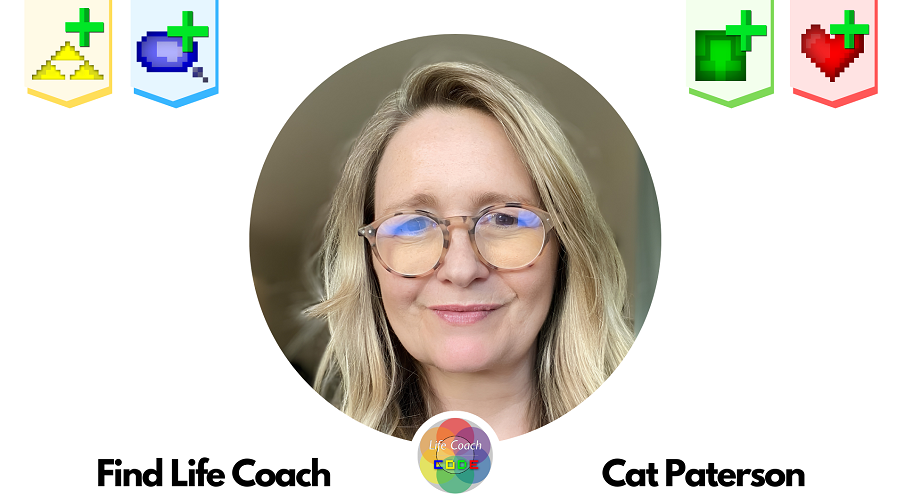
Cat Paterson is one of the coaches that we found this month and we did a little interview with her. She impressed us with her expertise and vast toolbox.
She knows what it means to rebuild yourself from the ground up. After a life threatening battle with malaria left her bedbound and struggling to walk again, Cat Paterson discovered something extraordinary about the connection between the mind, body, and our capacity for transformation. What began as a personal journey of recovery eventually became her life’s work.
She believes that many of the patterns keeping us stuck are not conscious choices, but deeply rooted beliefs and protective responses shaped by our past experiences. Through hypnotherapy, NLP, breathwork, and nervous system regulation, she helps people understand these patterns, challenge their limitations, and discover new possibilities for themselves.
She is on a mission to show people that their past does not have to dictate their future. As an Advanced Rapid Transformational Therapist, NLP Master Practitioner, and Wim Hof Method instructor, Cat combines science, personal experience, and a deeply human approach to transformation. In this interview, she shares her remarkable story, the lessons adversity taught her, and why real change often begins when we stop trying to fix ourselves and start discovering who we truly are. Here is what she said…
Meet Life Coach Cat Paterson:
Name: Cat Paterson
Pillar: The Spirit, The Mind, The Body, The Heart
Who is this coach for: Individuals struggling with anxiety, limiting beliefs, self sabotage, emotional overwhelm, and repeating subconscious patterns who want to build resilience, regain control, and experience lasting transformation.
How they can help: By using various tools and techniques like Rapid Transformational Therapy, NLP, hypnotherapy, parts work, breathwork, the Wim Hof Method, nervous system regulation, somatic practices, visualisation, mindfulness, neuroplasticity informed techniques, memory reframing, and embodied transformation, just to name a few.
First of all, how are you and your family doing in these “crazy” times?
We’re doing well, thank you.
Although I think “crazy times” has acquired rather a lot of different meanings over the last few years!
What strikes me now is the sheer amount of stimulation we’re exposed to.
We’re more connected technologically than ever before, yet many people feel overwhelmed, anxious, disconnected from themselves, and permanently switched on.
Anxiety seems to have become increasingly prevalent, and I think part of the challenge is that our brains and nervous systems simply weren’t designed for this relentless volume of information, comparison, and demand.
It makes learning how to regulate ourselves, reconnect with our bodies, and occasionally step away from all the noise increasingly important.
How did the coronavirus pandemic affect your clients? Did it affect you at all?
Interestingly, the pandemic became one of my busiest periods.
Of course, there was enormous anxiety, uncertainty, and isolation.
But something else happened too.
Life stopped.
For perhaps the first time in years, many people had enough space to ask themselves questions they’d been too busy to ask:
Do I actually want to live like this?
Who am I without all the things that normally define me?
What matters to me?
And what do I want my life to look like when this is over?
I worked with many people who weren’t simply trying to cope with the pandemic.
They were reevaluating careers, relationships, priorities, and identity.
For all its enormous difficulties, that pause gave some people permission to reconsider how they wanted to live their lives.
I think we’re now facing almost the opposite problem: chronic overstimulation.
We don’t necessarily need another crisis to give ourselves permission to stop, reassess, and change direction.
The Origin:
Tell us about you, your career, how you started with your coaching career?
My route into this work wasn’t particularly conventional.
My background was originally in broadcasting, media, and the arts, but I’ve always been fascinated by human behaviour: why we think the way we think, why we repeat patterns even when we consciously want to change them, and what allows some people to adapt extraordinarily well to adversity.
That fascination became very personal when I contracted severe malaria and became critically ill.
My body effectively shut down, and the consequences lasted for years.
At my worst, I was bedbound and had to gradually teach my body to walk and function again.
I was repeatedly confronted with ideas about what I wouldn’t be able to do or how far I could realistically recover.
That experience sent me down a very different path.
I became fascinated by neuroplasticity, the subconscious mind, breath, perception, nervous system regulation, and the relationship between our physiology and psychology.
That exploration eventually led me to become an Advanced Rapid Transformational Therapist, NLP Master Practitioner, breathwork practitioner, and Wim Hof Method instructor.
What began as a determination to understand my own recovery eventually became my life’s work: understanding what keeps human beings stuck and what helps us change.
What was your biggest obstacle that you had to overcome in your life that made you who you are today?
Becoming critically ill with malaria changed the trajectory of my life.
I went from being extremely active and independent to spending years dealing with the consequences of serious illness.
There were periods when I was bedbound, my body had deteriorated enormously, and simply walking again became something I had to rebuild.
During the worst periods, I remember thinking:
“I still have my mind, and I still have my breath. If I have those two things, I have something I can work with.”
That became enormously important to me.
I began using breathing, visualisation, attention, and techniques that work with the connection between mind and body to influence my internal state.
Later, through experiences including severe anaphylactic reactions and being trapped during wildfires in Portugal, I noticed something else that fascinated me.
In moments of genuine danger, when you might expect the mind to become completely overwhelmed, I sometimes experienced the opposite: an extraordinary stillness.
Time seemed to narrow.
Attention became incredibly precise.
The unnecessary noise disappeared, and there was simply the next breath, the next decision, the next thing that needed to happen.
I don’t claim to have a complete explanation for that experience, but it profoundly shaped my interest in consciousness, attention, altered states, and what human beings may be capable of accessing when the usual mental noise falls away.
The Wim Hof Method later gave me another doorway into that understanding.
At advanced training, despite having practised cold showers, I had never actually been in a proper ice bath.
Not my finest piece of preparation.
I watched an enormous quantity of ice being tipped into an outdoor tub and genuinely wondered whether I’d made a terrible mistake.
I asked one of the instructors how I was supposed to manage it.
His advice was:
“Just fucking get in.”
I was deeply unimpressed.
So instead, I drew on everything I knew about the mind.
I used breath, visualisation, and techniques from hypnotherapy and NLP to change my internal state before entering the cold.
And then I got in.
Rather than fighting the stressor, I relaxed into it.
I worked with my breathing and focused my attention.
When I opened my eyes, many of the extremely fit people I’d mentally labelled the “superheroes” had already climbed out.
Something shifted.
This body, which I had spent years thinking of as fragile and limited, had just given me evidence of something completely different.
I realised then that sometimes we don’t think ourselves into a new identity.
Sometimes we experience ourselves into one.
What are the biggest lessons that you learned overcoming your greatest obstacle?
One of the greatest lessons has been that presence changes everything.
In difficult or frightening situations, our minds can race ahead into catastrophe, prediction, and fear.
But occasionally, underneath all of that, there is another place available to us: the immediate experience of this breath, this body, this moment.
I’ve encountered that state several times in extreme circumstances, and I’ve become deeply interested in how we can access something of it without needing a crisis to take us there.
That now influences my work enormously.
Whether I’m using breathwork, hypnosis, NLP, parts work, or cold exposure, I’m helping people move away from being completely captured by an automatic reaction and toward having enough internal space to choose what happens next.
My experience with cold taught me another important lesson: change can become particularly powerful when the body has an experience that contradicts an old belief.
For years, my body had represented illness, limitation, and caution.
The ice gave me a direct experience of capability.
That’s why, when I now teach cold exposure, I don’t believe in simply shouting encouragement while someone throws themselves into an ice bath.
My hypnotherapy, NLP, and training in approaches informed by an understanding of trauma mean I spend considerable time helping people establish safety first.
There is laughter and playfulness in what I do because both are enormously useful states.
But underneath them is safety.
Good facilitation means recognising when somebody is ready to move slightly beyond their current comfort zone and when they need time for their nervous system to adapt.
The goal isn’t to force someone through fear.
It’s to help them discover that they can meet the edge of it differently.
The Coaching Style:
How do you innovate with coaching your clients?
I don’t really think of what I do as conventional coaching.
People frequently arrive knowing exactly what they “should” do.
They’ve read the books.
They’ve listened to the podcasts.
They understand the pattern intellectually.
And yet they keep finding themselves back in the same relationship, experiencing the same anxiety, sabotaging the same opportunity, or reacting in exactly the way they promised themselves they wouldn’t.
That’s the bit that interests me.
Instead of simply asking, “What do you want to change?”, I want to know:
Why does this pattern keep repeating, and what is maintaining it?
Our subconscious learning, previous experiences, and nervous system all influence how we interpret what happens in the present.
Part of my work is helping people look at familiar experiences from a different direction.
A person may initially experience something entirely through the question, “Why did this happen to me?”
They may then move through anger, blame, or self blame.
But eventually, another question becomes possible:
“What can I learn from this, and who can I become because of it?”
That doesn’t mean pretending painful things were good, excusing what happened, or plastering positivity over genuine difficulty.
It means changing our relationship with the experience.
Modern memory research gives us an interesting framework for understanding this.
Memories aren’t necessarily fixed recordings.
Under certain conditions, when memories are recalled, new information and emotional experiences can become integrated with previous learning.
For me, that’s where transformation becomes fascinating.
We cannot change what happened, but we can change the meaning, predictions, and behaviours that continue to arise from it.
What’s unique about your coaching approach?
I work at the intersection of neuroscience, subconscious change, nervous system regulation, breath, and behaviour.
But perhaps what most defines my approach is that I’m fascinated by patterns.
When somebody tells me, “I can’t understand why this keeps happening to me”, my ears prick up.
Why this relationship again?
Why this response again?
Why does one part of you desperately want something while another seems determined to sabotage it?
I don’t believe people are consciously choosing most of these patterns.
Often, there’s an old piece of learning or a protective strategy operating underneath them.
So I work with both mind and body.
I use subconscious work, parts work, NLP, breath, nervous system regulation, and embodied experiences to help people recognise the pattern, understand what it has been trying to accomplish, and create a different possibility.
And I don’t fit people to a methodology.
Human beings are far too interesting for that.
What benefits do your clients get after working with you?
One of the most important is agency.
People begin to understand why they react as they do instead of simply judging themselves for doing it.
They learn how to recognise patterns earlier, regulate their nervous system, interrupt automatic responses, and create different choices.
Sometimes the change is psychological.
Sometimes it’s behavioural.
Sometimes it’s something they experience physically.
But ultimately, I want people to become less dependent on therapists and coaches, not more.
I want them to leave with an understanding of themselves and practical tools they can use long after our work has finished.
Because there is an enormous difference between intellectually knowing how you want to live and actually being able to embody it.
Do you use any specific tools to be efficient with your clients?
Yes, although I don’t use the same toolkit with everybody.
Depending on the person, I draw from Advanced Rapid Transformational Therapy, NLP, hypnosis, parts work, breathwork, nervous system regulation, somatic practices, visualisation, mindfulness, and approaches based on neuroplasticity.
Breath is particularly interesting because it gives us a practical way of influencing our physiological state, while hypnosis and NLP can help us work with perception, beliefs, and subconscious patterns.
But the modality is never the star of the show.
The person is.
Sometimes somebody needs to be challenged.
Sometimes they need to feel safe enough to stop fighting themselves.
Knowing the difference is an important part of the work.
The Impact:
If you had a super megaphone that, when you speak into, the whole world will hear your message, what would you say?
You are not necessarily who you have learned to believe you are.
Look again.
Become interested in your patterns rather than ashamed of them.
Question the stories that have quietly become facts.
Your past contains information, but it doesn’t have to contain your instructions for the future.
The brain, body, and nervous system retain an extraordinary capacity for adaptation and new learning throughout life.
So instead of asking only:
“Why am I like this?”
Perhaps ask:
“What is this showing me?”
And then the much more interesting question:
“What might I become next?”
What is the greatest lesson you have learned in your life?
That our interpretation of an experience can have an enormous influence on what happens next.
We all develop stories about ourselves:
“I’m not good enough.”
“I’m unsafe.”
“Relationships always end this way.”
“My body can’t do that.”
“People like me don’t succeed at things like this.”
Eventually, those stories can begin to feel like facts.
One of the most powerful things we can do is learn to look again.
Not to deny what happened, but to ask a different question.
Rather than remaining only with “Why me?” or “Whose fault was it?”, we can eventually reach:
“What can I learn from this?”
And beyond that:
“What can I become?”
That shift in perspective has probably been one of the most important lessons of my life.
Your final thoughts?
We’re living at a fascinating point in our understanding of human potential.
Neuroscience is continuing to challenge old assumptions about how fixed our brains, memories, and behavioural patterns really are.
At the same time, practices involving breath, attention, visualisation, meditation, and the body, some of them ancient, are increasingly being examined through modern science.
I’m interested in the territory where those worlds meet.
And I’m particularly fascinated by thresholds: those moments when our habitual way of thinking is interrupted and another experience becomes possible.
Sometimes that happens through therapy.
Sometimes through breath.
Sometimes through the body.
Sometimes through challenge.
And sometimes, unfortunately, life creates the threshold for us.
My own experiences have repeatedly shown me that beneath the mental noise, there can be an extraordinary capacity for presence and stillness.
I don’t think we need to wait for catastrophe to discover it.
Part of my work is helping people find smaller, safer doorways into that state: to become less dominated by automatic patterns, more able to observe themselves, and more able to choose their response.
Transformation, to me, isn’t about endlessly trying to fix ourselves.
I often think of the idea associated with Michelangelo and his sculptures: that the figure was already there within the marble, and the artist’s task was to reveal it.
That is very close to how I see transformation.
Perhaps we are not always trying to manufacture a better version of ourselves.
Sometimes the work is about removing what has accumulated: old beliefs, protective patterns, assumptions, and identities that once had a purpose but no longer fit.
It’s about revealing what sits beneath those patterns, looking at familiar things from unfamiliar directions, and creating experiences that allow the mind and body to learn something new.
There is an enormous difference between knowing and becoming.
My work lives in that space.
Where Can You Find Cat Paterson?
If you liked this interview and if you would love to see how Coach Cat can help you become aware of your patterns and choose who you are becoming, go to catherinepaterson.co.uk and see what she offers.
If you’d like to peak a glimpse into her coaching, follow her Instagram and Facebook accounts.
And if you’d like to connect with her more personally, you can do that through LinkedIn or by sending her a direct message via WhatsApp or her Email [email protected]. It was an honor having this interview with her.