
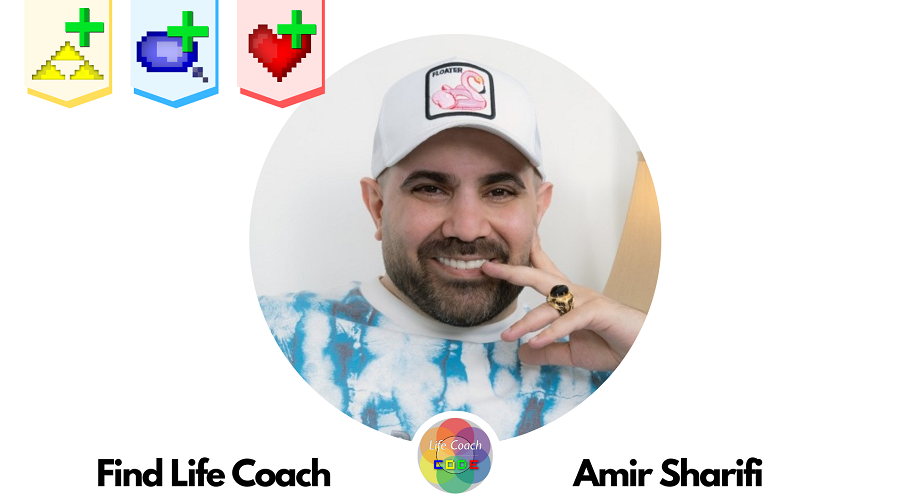
Amir Sharifi is one of the coaches that we found this month and we did a little interview with him. He impressed us with his dedication and purposefulness.
He is a coach whose journey reflects deep transformation and an unwavering commitment to helping others find their strength from within. With every session, he brings a sense of clarity and purpose, guiding his clients to reconnect with their inner power and realign with the vision of who they truly are.
He believes that growth begins with awareness… the willingness to see oneself honestly and make conscious choices that lead to change. Through his grounded yet inspiring approach, he helps people break through their limitations and discover the wisdom hidden within their challenges.
He stands as a living example of what’s possible when resilience meets purpose. His story, insights, and coaching philosophy inspire others to move beyond fear and step fully into their potential, making transformation not just a dream, but a daily practice. Here is what he said…
Meet Life Coach Amir Sharifi:
Name: Amir Sharifi
Pillar: The Spirit, The Mind, The Heart
Who is this coach for: Ambitious individuals who want to rapidly increase their income, improve their relationships, and achieve lasting personal growth.
How they can help: By providing practical strategies, mindset tools, and personalized guidance to create measurable results and transform their lives.
First of all, how are you and your family doing after these Pandemic times?
We are doing well, thank you.
We try not to get too caught up in things that are beyond our control.
Many situations in life, like natural disasters, earthquakes, floods, or even pandemics, are simply out of our hands.
During those times, we just focused on living as normally as possible, rather than worrying about things we couldn’t change.
How did the coronavirus pandemic affect your clients? Did it affect you at all?
Honestly, I didn’t notice any major impact on our work or clients during the pandemic.
We try not to focus on things beyond our control.
The pandemic was an external event, there wasn’t much we could do about it.
It didn’t cause significant financial issues for us, but even if it had, our approach would have been the same, focus on what we can change rather than worrying about what we can’t.
What are the biggest lessons that you learned in this pandemic?
Since my business was already operating online before the pandemic, it didn’t directly affect us much.
But it did leave one lasting thought in my mind: always be ready to adapt.
Just because you’re successful today doesn’t guarantee success tomorrow.
We’ve seen massive companies like Yahoo or Nokia fade away because they failed to adapt.
Even the strongest companies in the world (Apple, Nvidia, and others) must keep evolving or risk disappearing.
The Origin:
Tell us about you, your career, how you started with your coaching career?
I became interested in personal development when I was 16 years old.
I remember reading a book called Unlimited Success in 20 Days by Anthony Robbins.
That was when I first realized that personal growth and success actually have a method and structure behind them.
Before that, I thought success was mostly about luck, family wealth, or connections… like someone just getting a good opportunity by chance or because of their background.
But that book opened my eyes to the fact that there is real research and proven strategy behind personal success.
At first, I studied just for myself, reading extensively for years.
Then, when social media became popular in Iran, I started sharing some of my insights, mostly just for fun and to stay connected with my audience.
I would post audio messages about personal development.
Surprisingly, people started asking me to create structured courses and teach everything in an organized way.
For me, it felt natural because, by then, I had been studying personal growth for over a decade, so sharing what I knew was second nature.
Eventually, I began creating full programs, and in just a few years, my courses sold over 100,000 copies… not just in Iran, but also in neighboring Farsi speaking countries.
That’s how I gradually got into coaching as a career, and I’ve been continuing on this path ever since.
What was your biggest obstacle that you had to overcome in your life that made you who you are today?
One of the biggest challenges I faced was that I had never seen wealth or success up close.
There were no wealthy or highly successful people in my immediate environment to look up to as role models.
When you grow up without seeing success firsthand, it’s hard to truly believe it’s achievable.
You might think the people on TV or in magazines had advantages you don’t have.
That’s why I always tell my students: put yourself in environments where people have already achieved what you want.
When you see wealthy people making money easily, or successful people building strong connections effortlessly, you start believing it’s possible for you too.
That belief changes everything.
The Coaching Style:
How do you innovate with coaching your clients?
Instead of focusing only on innovation for the sake of it, I try to solve real problems, often starting with my own experiences.
For many years, I was a client myself in the personal development field, so I deeply understand what frustrates people, what challenges them, and what is missing in many programs.
Even today, I frequently put myself back in the shoes of my younger self when I was still learning and searching for solutions.
This helps me see things from the client’s perspective.
For example, in Iran, we were the first to launch an educational app in the personal development field.
Why? Because I personally disliked being tied to a computer all the time to listen to training materials.
I wanted the flexibility to listen even while waiting in line or during short breaks.
So, many of our innovations came from solving my own problems first.
I believe this is the best approach because when clients describe their issues, they often do so indirectly, and it’s easy to misunderstand them.
But when you’ve lived through those problems yourself, you know exactly how to fix them.
What’s unique about your coaching approach?
The biggest thing that makes a difference in my approach is that I have always tested everything on myself.
I was inspired by a famous coach (Hadi Choopan’s sports coach).
I even have an interview where he said, “I test everything on myself first.”
He said, for example, sometimes I only ate carbohydrates, sometimes only protein.
Everything that came to my mind, I tested.
I am really like that.
For three years, I had only about three and a half hours of sleep every day.
I also experienced more than eleven hours of sleep.
Interestingly, the opposite of what I thought happened.
I saw that, at least for me, longer sleep works much better.
For me, sleeping more than eleven hours was better.
But I should say that this eleven hours was not continuous.
Because I am Muslim, I wake up at night for worship at sacred times.
So it was like nine and a half hours of full sleep.
I saw this works better for me.
Since childhood, I had heard a lot that “less sleep is better, you have more time.”
But I saw it’s not like that at all.
Now I even talk with experts about it and say, “I’m not sure short sleep is good at all.”
Maybe for some people, but I’m sure long sleep is good for many.
This helped me a lot because I can test everything with great precision.
Why precision?
Because I don’t have bias in training.
For example, sometimes I completely cut all training or reduce it to a very low level, just to keep a small routine in case one day I want to come back to it… and then I test the effect.
That’s why when people listen to me they say, “When you explain something, it’s like you’re not reading from a book, you say it very simply.”
That’s because I don’t use books to talk, I use my memories and experiences.
Of course, I learned things from books too, but my teaching comes from my own experiences.
What benefits do your clients get after working with you?
We have a page where we share the results of people who worked with me.
We even have several pages and a Telegram channel where we post them.
When I compare with similar examples, I see that our numbers are very high.
In our country, we don’t really have an organized system for this.
Maybe you also know, some people say these things are superstitions, so others feel embarrassed to tell people around them that they are using these classes.
Even with all these limitations, if we try to collect them, we probably have at least five hundred videos (maybe more) from people who had big results like five or ten times increases in their income.
And if we count the audio files that they send us, this number goes over two thousand.
I think this is the biggest difference, the results people get are really big and very close to their goals.
For example, I once joined a similar course in English, not in our language, and they were saying that after one year, participants could expect fifty percent growth in income.
For us, this kind of thing is nothing.
In our courses, we say the minimum is three times increase in six months.
And this is only about income, relationships and other areas are the same.
We focus on big results.
At first, students themselves don’t even believe it, but then they see it.
We try to change their belief.
Because in many trainings people say, “If in one year your income grows thirty percent, that’s very good.”
Or they say, “If yesterday everyone in your relationships was insulting you, and today at least they don’t insult you, that’s good enough.”
But we say, “No, think about the ideal and get close to it.”
And then the growth is huge.
In some of our courses, more than seventy percent of participants triple their income in six months.
Where do we get this statistic from?
Very simple methods.
When we hold an event, we ask, “Who here has tripled their income? Stand up and clap.”
And only a few people don’t stand up.
Most of them stand and clap.
That’s how we see that the majority have reached big results.
In my opinion, this is our biggest difference… or better to say, our biggest advantage.
Do you use any specific tools to be efficient with your clients?
In my opinion, the most efficient thing is to do nothing.
I mean, when we are in our own natural state, the state we were truly created for, we have the most influence.
And in that way, I can run the session in the best way.
There is something in our religion called riya, which means trying to do something that is not really inside you, just playing a role.
In those moments, a person’s inner power becomes very weak.
Many times students came to me with surprise, especially in past years.
Even now it happens more because of social media.
For example, they were surprised… “Why is this person, who is supposed to be a speaker, wearing colorful sneakers and jeans? Why isn’t he wearing a suit?”
But over time they saw that a person is more influential when he does not try to be like someone else.
Most of our energy is wasted when we try to act like another person.
I believe all people are influential, very influential.
But they lose all their energy when they put themselves inside another person’s mold instead of showing their own way.
Just say what you have learned, say what you remember.
Sometimes I even say, “I wanted to tell you a poem, but I forgot it.”
And people don’t think, “Oh, he doesn’t know much, he has a weak memory.”
No, for them it’s attractive that you can present yourself without censorship.
At that moment, they also feel safe to share their own problems.
Because this game we are in, where we want to show ourselves as perfect, actually makes us act very imperfectly.
I believe every problem that exists in me also exists in other people… maybe four of them in one person, maybe ten in another.
There is no need to hide them.
When we try to show ourselves as completely perfect, like “Oh no, I have a position as a guide, so I must be flawless,” then we lose everything.
Our focus and power drop so much that it becomes worthless.
For me, the only thing is to just be ourselves.
The most efficient state of a human is when he is himself.
That is the most efficien, especially in our job.
The Impact:
If you had a super megaphone that, when you speak into, the whole world will hear your message, what would you say?
I would say the biggest skill you need to learn is the skill of making your emotions one step better.
In any situation, if you are very angry, bring it down just a little.
Then little by little, move it to a better and better feeling.
This is the biggest skill you need to learn.
And if your beliefs change, your whole world will change.
You said one message, but I gave two, because both are very important.
What is the greatest lesson you have learned in your life?
The most important lesson I’ve learned is the power of managing your emotions.
When people hear “emotions,” they often think only about relationships.
But emotions affect everything… anger, frustration, hopelessness, depression, as well as positive feelings like hope and excitement.
The worst decisions I’ve made in my life were always during negative emotional states.
If I could go back and focus on mastering one skill, it would be learning how to shift my emotional state quickly (maybe not in seconds, but at least within minutes) so that negative emotions don’t control my actions or my life.
Your final thoughts?
You asked for a summary, but I can’t really give one.
However, I do have something to say.
Because in this interview there were many questions about the pandemic, I feel that most people focus too much on the world outside, on things they cannot change.
This interview shows that people’s general thoughts are more about outside events.
But I think we should focus more on the parts of life where we have responsibility and where we can really make changes.
For example, some people criticize government policies from morning until night.
What does it do for them?
What changes does it bring?
Some people complain about the weather being too hot.
Others argue about how animals should be treated.
But what about you?
Are you doing what you believe is right?
When you just think about what others should do and you don’t act yourself, your self esteem goes down.
Because you see yourself as powerless.
We spend a lot of our day focused on areas where we cannot make any change.
Yes, maybe I also don’t like that there are so many wars in the world.
Maybe I also don’t want another pandemic to come.
Maybe I am not happy that the earth is getting warmer.
But I don’t spend my day thinking about it, because I cannot change it.
We should focus on where we can make changes.
I prefer to spend five hours a week exercising rather than ten hours following the news about global warming, wars, or floods in other countries.
That is much better for me.
And let me say this clearly, I am not saying we should be indifferent to our fellow human beings.
Helping others is very good.
But most of the time, we just disturb our minds and we don’t actually help.
We read the news about hunger and lack of water in Africa, but we don’t even donate one dollar.
We just read it, get upset, and make ourselves feel bad.
That doesn’t help anyone.
Of course, if someone truly wants to help, I completely support that and I’m very grateful to people who really take action.
But usually it is not like that.
Instead, we become critics of society, government, neighbors, everyone.
But this doesn’t solve anything.
You can only drive properly when your focus is on the road in front of you, with your own hands on the steering wheel.
If you keep thinking, “Why is that red car driving badly? Why is the car behind me speeding? What if the car coming toward me suddenly changes direction and crashes into me?” then you cannot drive at all.
In the same way, in life, we should keep our focus on the steering wheel in our own hands.
That steering wheel is our own life.
Where Can You Find Amir Sharifi?
If you liked this interview and if you would love to tripple your income and improve your relationships in less than 6 months, contact Coach Amir and see how he can help you achieve that.
What we would suggest is to download his app by following this link.
If you’d like to peak a glimpse into his coaching, feel free to follow his Instagram account.
And if you’d like to connect with him more personally, you can do that through LinkedIn or by sending him a direct message on his Email [email protected]. It was an honor having this interview with him.